












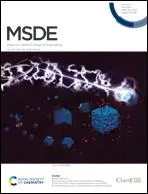
Exploring the oxygen evolution electrocatalysis of an amine-based cobalt metal–organic framework
Literature Information
Publication Date
2023-03-01
DOI
10.1039/D2ME00259K
Impact Factor
4.935
Authors
Jade Nadine S. Ang, Manjunath Chatti, Khang N. Dinh, Stuart R. Batten, Alexandr N. Simonov, David R. Turner
View Original
Abstract
When immobilised on a suitable electrode surface, metal organic frameworks (MOFs) can effectively promote the oxygen evolution reaction (OER) – the anode process of water electrolysis for the green hydrogen synthesis – most commonly through the electrooxidative decomposition of the framework into thermodynamically stable (oxy)hydroxides/oxides. In this study, the potential advantageous electrocatalytic effect of the macrocyclic amine core coordinating to the cobalt ions in an interdigitating 2D sheet framework is investigated. Nickel foam electrodes modified with Co-TMBT-MOF at a low loading of 0.25 mg cm−2 (0.004 mmolCo cm−2) sustained the OER rate of 20 mA cm−2 (80 A gMOF−1) in 1 M KOH at ambient temperature at a stabilised overpotential of only 0.294 ± 0.005 V on a timescale of 20 h. Physical characterisation of the electrode after the OER tests confirmed transformation of the MOF into the catalytically active cobalt oxyhydroxide.
Related Literature
Doping effect on the local structure of metamagnetic Co doped Ni/NiO:GO core–shell nanoparticles using X-ray absorption spectroscopy and the pair distribution function
U. P. Gawai, D. K. Gaikwad, M. R. Bodke, H. A. Khawal, K. K. Pandey, A. K. Yadav, S. N. Jha, D. Bhattacharyya, B. N. Dole
2018-12-05
Paper
DOI: 10.1039/C8CP05267K
Base adsorption mechanism over zeolite catalysts at different Al contents probed by the tapered element oscillating microbalance (TEOM)
Pierre Bräuer, Carmine D’Agostino
2018-09-10
Paper
DOI: 10.1039/C8CP05001E
Thermodiffusion of citrate-coated γ-Fe2O3 nanoparticles in aqueous dispersions with tuned counter-ions – anisotropy of the Soret coefficient under a magnetic field
M. Kouyaté, G. Demouchy, G. Mériguet, S. Nakamae, V. Peyre, M. Roger, A. Cēbers, J. Depeyrot, E. Dubois, R. Perzynski
2018-12-28
Paper
DOI: 10.1039/C8CP06858E
Effect of Si substitution in ferromagnetic Pr2Fe17: a magnetocaloric material with zero thermal expansion operative at high temperature
Shovan Dan, S. Mukherjee, Chandan Mazumdar, R. Ranganathan
2019-01-18
Paper
DOI: 10.1039/C8CP06222F
Evolution of optical properties and electronic structures: band gaps and critical points in MgxZn1−xO (0 ≤ x ≤ 0.2) thin films
Yue-Jie Shi, Rong-Jun Zhang, Xin Chen, Lei Wang, Lei Chen, Qing-Hua Huang, Da-Hai Li, Yu-Xiang Zheng, Song-You Wang, Ning Dai, Liang-Yao Chen
2018-09-21
Paper
DOI: 10.1039/C8CP04942D
Origin of high thermoelectric performance with a wide range of compositions for BixSb2−xTe3 single quintuple layers
Zhen Li, Siyu Han, Yuanchun Pan, Jian Zhou, Huibin Xu
2018-12-10
Paper
DOI: 10.1039/C8CP06534A
Time-gated triplet-state optical spectroscopy to decipher organic luminophores embedded in rigid matrices
Atul D. Sontakke, Jean-Marie Mouesca, Victor Castaing, Mathieu Salaün, Isabelle Gautier-Luneau, Vincent Maurel, Alain Ibanez, Bruno Viana
2018-08-27
Paper
DOI: 10.1039/C8CP03952F
Nucleation of pseudo hard-spheres and dumbbells at moderate metastability: appearance of A15 Frank–Kasper phase at intermediate elongations
Itziar Zubieta, Pablo Llombart, Carlos Vega, Eva G. Noya
2018-10-12
Paper
DOI: 10.1039/C8CP04964E
Nuclear spin singlet states as magnetic on/off probes in self-assembling systems
2018-08-14
Paper
DOI: 10.1039/C8CP04448A
Theoretical study on the reaction mechanism and selectivity of acetylene semi-hydrogenation on Ni–Sn intermetallic catalysts
Tao Sun, Yu-Sen Yang, Pan Yin, Min Pu, Hong Yan, Min Wei
2018-12-12
Paper
DOI: 10.1039/C8CP06032K
You might also like
Compound Q&A
Are there alternatives to 1-(4-Chlorophenyl)-N-hydroxymethanimine (CAS: 3848-36-0) in synthesis?
When considering alternatives to 1-(4-Chlorophenyl)-N-hydroxymethanimine (CAS: 3...
3848-36-01-(4-Chlorophenyl)-N...
Compound Q&A
How should (1R,9S,10S,12S,14E,16S,19R,20R,21S,22R)-3,9,21-Trihydroxy-5,10,12,14,16,20,22-heptamethyl-23,24-dioxatetracyclo[17.3.1.1~6,9~.0~2,7~]tetracosa-2,5,7,14-tetraen-4-one (CAS: 183202-73-5) be stored?
This compound should be stored in a cool, dry place away from direct sunlight. I...
183202-73-5(1R,9S,10S,12S,14E,1...
Compound Q&A
How is 3-(4-Bromophenyl)-5-(2-fluorophenyl)-1,2,4-oxadiazole (CAS: 419553-16-5) typically synthesized?
3-(4-Bromophenyl)-5-(2-fluorophenyl)-1,2,4-oxadiazole is synthesized through a m...
419553-16-53-(4-Bromophenyl)-5-...
Compound Q&A
How is 5-Chloro-2-(4-chlorophenyl)-4-methyl-6-[3-(1-piperidinyl)propoxy]pyrimidine (CAS: 1639220-19-1) typically synthesized?
5-Chloro-2-(4-chlorophenyl)-4-methyl-6-[3-(1-piperidinyl)propoxy]pyrimidine (CAS...
1639220-19-15-Chloro-2-(4-chloro...
Compound Q&A
What industries use 2-Chloro-4-(difluoromethoxy)pyridine (CAS: 1206978-15-5)?
2-Chloro-4-(difluoromethoxy)pyridine is used in the pharmaceutical industry for ...
1206978-15-52-Chloro-4-(difluoro...
Compound Q&A
What regulatory guidelines apply to 3-Chloro-6-methylpyridazine (CAS: 1121-79-5)?
3-Chloro-6-methylpyridazine (CAS: 1121-79-5) is classified under the Globally Ha...
1121-79-53-Chloro-6-methylpyr...
Compound Q&A
Are there alternatives to Methyl 4,5-dimethyl-2-nitrobenzoate in synthesis?
Several alternatives can be used in the synthesis of Methyl 4,5-dimethyl-2-nitro...
90922-74-0Methyl 4,5-dimethyl-...
Compound Q&A
Are there alternatives to (2E,2'E)-3,3'-(1,4-Phenylene)bisacrylaldehyde in synthesis?
Alternatives to (2E,2'E)-3,3'-(1,4-Phenylene)bisacrylaldehyde include other acry...
63405-68-5(2E,2'E)-3,3'-(1,4-P...
Compound Q&A
What is 3-Amino-5-chloropyridin-2-ol hydrochloride (CAS: 1261906-29-9)?
3-Amino-5-chloropyridin-2-ol hydrochloride is an organic compound with the CAS n...
1261906-29-93-Amino-5-chloropyri...
Compound Q&A
What precautions should be taken when handling 6,7-Difluoro-2,3-dihydro-4H-chromen-4-one (CAS: 1092349-93-3)?
When handling 6,7-Difluoro-2,3-dihydro-4H-chromen-4-one, it is essential to wear...
1092349-93-36,7-Difluoro-2,3-dih...
Source Journal
Recommended Compounds

(E)-2-methyl-4-(4,4,5,5-tetramethyl-1,3,2-dioxaborolan-2-yl)but-3-en-2-ol
CAS Number:
581802-26-8
Molecular Formula:
C11H21BO3
Recommended Suppliers






Disclaimer
This page provides academic journal information for reference and research purposes only. We are not affiliated with any journal publishers and do not handle publication submissions. For publication-related inquiries, please contact the respective journal publishers directly.
If you notice any inaccuracies in the information displayed, please contact us at support@chemtradehub.com. We will promptly review and address your concerns.