












Mechanism of CO2 photoreduction by selenium-doped carbon nitride with cobalt clusters as cocatalysts
Literature Information
Publication Date
2023-03-01
DOI
10.1039/D2CP05872C
Impact Factor
3.676
Authors
Yuanyuan Hu, Ting Wu
View Original
Abstract
Doping is an efficient strategy for improving the photocatalytic activity and tuning the electronic structure of carbon nitride. Selenium-doped melon carbon nitride (Se-doped melon CN) as a promising photocatalyst for CO2 reduction is investigated using density functional theory calculations. In addition, considering the special role of a cocatalyst in CO2 reduction, we have explored the electronic and optical properties of Co4 clusters loaded on the Se-doped melon CN surface. After loading cobalt clusters, CO2 activation is significantly improved, with preference for the 8-electron product CH4, as the 2-electron products have higher desorption energies. Overall, this work provides a microscopic understanding of the CO2 reduction mechanism on Se-doped melon CN with cobalt as the co-catalyst.
Related Literature
Near-ambient XPS characterization of interfacial copper species in ceria-supported copper catalysts
Manuel Monte, Guillermo Munuera, Dominique Costa, José C. Conesa, Arturo Martínez-Arias
2015-10-14
Paper
DOI: 10.1039/C5CP04354A
Graphene quantum dots from graphite by liquid exfoliation showing excitation-independent emission, fluorescence upconversion and delayed fluorescence
Yang Yang, Sunil Misra
2016-06-02
Paper
DOI: 10.1039/C6CP01528J
The role of alkali metal cations in the stabilization of guanine quadruplexes: why K+ is the best‡
F. Zaccaria, C. Fonseca Guerra
2016-05-03
Paper
DOI: 10.1039/C6CP01030J
Impact of Ho3+-doping on 13C dynamic nuclear polarization using trityl OX063 free radical
Andhika Kiswandhi, Peter Niedbalski, Christopher Parish, Pavanjeet Kaur, André Martins, Leila Fidelino, Chalermchai Khemtong, Likai Song, Lloyd Lumata
2016-07-13
Paper
DOI: 10.1039/C6CP03954E
EPR studies of intermolecular interactions and competitive binding of drugs in a drug–BSA binding model
Y. Akdogan, M. Emrullahoglu, D. Tatlidil, M. Ucuncu, G. Cakan-Akdogan
2016-07-25
Paper
DOI: 10.1039/C6CP04137J
Dual-mode, tunable color, enhanced upconversion luminescence and magnetism of multifunctional BaGdF5:Ln3+ (Ln = Yb/Er/Eu) nanophosphors
Honglan Li, Guixia Liu, Jinxian Wang, Xiangting Dong, Wensheng Yu
2016-07-04
Paper
DOI: 10.1039/C6CP03743G
Magnetic properties with multiwavelets and DFT: the complete basis set limit achieved
Stig Rune Jensen, Dan Jonsson, Rune Sørland Monstad, Kenneth Ruud, Luca Frediani
2016-04-11
Paper
DOI: 10.1039/C6CP01294A
A computationally efficient double hybrid density functional based on the random phase approximation
Stefan Grimme, Marc Steinmetz
2015-12-03
Paper
DOI: 10.1039/C5CP06600J
Tuning the electronic structures and magnetism of two-dimensional porous C2N via transition metal embedding
Juan Du, Congxin Xia, Wenqi Xiong, Xu Zhao, Tianxing Wang, Yu Jia
2016-07-21
Paper
DOI: 10.1039/C6CP03210A
You might also like
Compound Q&A
How should waste containing (6-Bromo-2-naphthyl)oxy](dimethyl)(2-methyl-2-propanyl)silane be handled?
Waste containing (6-Bromo-2-naphthyl)oxy](dimethyl)(2-methyl-2-propanyl)silane (...
100751-65-3[(6-Bromo-2-naphthyl...
Compound Q&A
How is 7-Fluoro-4-isoquinolinecarboxylic acid (CAS: 1841081-40-0) typically synthesized?
7-Fluoro-4-isoquinolinecarboxylic acid can be synthesized via a multi-step proce...
1841081-40-07-Fluoro-4-isoquinol...
Compound Q&A
What are the physical and chemical properties of 2,3,5,6-Tetrabromothieno[3,2-b]thiophene (CAS: 124638-53-5)?
2,3,5,6-Tetrabromothieno[3,2-b]thiophene is a crystalline compound with a high m...
124638-53-52,3,5,6-Tetrabromoth...
Compound Q&A
Is 1-[4-(Benzylamino)-7,8-dihydro-5H-pyrano[4,3-d]pyrimidin-2-yl]-2-methyl-1H-indole-4-carboxamide (CAS: 1542705-92-9) safe?
1-[4-(Benzylamino)-7,8-dihydro-5H-pyrano[4,3-d]pyrimidin-2-yl]-2-methyl-1H-indol...
1542705-92-91-[4-(Benzylamino)-7...
Compound Q&A
What is the market or research trend for imidazo[5,1-d]-1,2,3,5-tetrazine-8-carboxylic acid, 3,4-dihydro-3-methyl-4-oxo- (CAS: 113942-30-6)?
The market for imidazo[5,1-d]-1,2,3,5-tetrazine-8-carboxylic acid, 3,4-dihydro-3...
113942-30-6Imidazo[5,1-d]-1,2,3...
Compound Q&A
What is 3-(Triisopropylsilyl)propiolaldehyde (CAS: 163271-80-5)?
3-(Triisopropylsilyl)propiolaldehyde is a synthetic organic compound with the CA...
163271-80-53-(Triisopropylsilyl...
Compound Q&A
What regulatory guidelines apply to 6-Nitro-2H-1,4-benzoxazin-3(4H)-one (CAS: 81721-87-1)?
6-Nitro-2H-1,4-benzoxazin-3(4H)-one (CAS: 81721-87-1) is subject to various regu...
81721-87-16-Nitro-2H-1,4-benzo...
Compound Q&A
How should waste containing (3-Fluorophenyl)(4-{[(2-methyl-2-propanyl)oxy]carbonyl}-1-piperazinyl)acetic acid (CAS: 885272-91-3) be handled?
Waste containing (3-Fluorophenyl)(4-{[(2-methyl-2-propanyl)oxy]carbonyl}-1-piper...
885272-91-3(3-Fluorophenyl)(4-{...
Compound Q&A
What are the physical and chemical properties of N,N'-4,4'-Biphenyldiyldiisonicotinamide (CAS: 55119-40-9)?
N,N'-4,4'-Biphenyldiyldiisonicotinamide is a white crystalline solid with a mole...
55119-40-9N,N'-4,4'-Biphenyldi...
Compound Q&A
What industries use 6-Bromo-8-fluoro-2-quinazolinol (CAS: 1036756-15-6)?
6-Bromo-8-fluoro-2-quinazolinol is primarily used in the pharmaceutical industry...
1036756-15-66-Bromo-8-fluoro-2-q...
Source Journal
Physical Chemistry Chemical Physics

CiteScore:
5.5
Self-citation Rate:
10.3%
Articles per Year:
3036
Physical Chemistry Chemical Physics (PCCP) is an international journal co-owned by 19 physical chemistry and physics societies from around the world. This journal publishes original, cutting-edge research in physical chemistry, chemical physics and biophysical chemistry. To be suitable for publication in PCCP, articles must include significant innovation and/or insight into physical chemistry; this is the most important criterion that reviewers and Editors will judge against when evaluating submissions. The journal has a broad scope and welcomes contributions spanning experiment, theory, computation and data science. Topical coverage includes spectroscopy, dynamics, kinetics, statistical mechanics, thermodynamics, electrochemistry, catalysis, surface science, quantum mechanics, quantum computing and machine learning. Interdisciplinary research areas such as polymers and soft matter, materials, nanoscience, energy, surfaces/interfaces, and biophysical chemistry are welcomed if they demonstrate significant innovation and/or insight into physical chemistry. Joined experimental/theoretical studies are particularly appreciated when complementary and based on up-to-date approaches.
Recommended Compounds
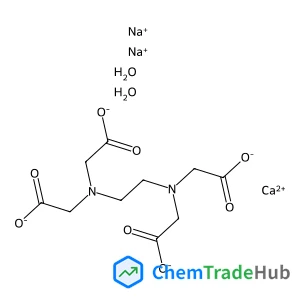
EthylenediaminetetraaceticacidcalciumDisodiumsalthydrate
CAS Number:
23411-34-9
Molecular Formula:
C10H16CaN2Na2O10
Recommended Suppliers




Disclaimer
This page provides academic journal information for reference and research purposes only. We are not affiliated with any journal publishers and do not handle publication submissions. For publication-related inquiries, please contact the respective journal publishers directly.
If you notice any inaccuracies in the information displayed, please contact us at support@chemtradehub.com. We will promptly review and address your concerns.