













Near-ambient XPS characterization of interfacial copper species in ceria-supported copper catalysts
Literature Information
Publication Date
2015-10-14
DOI
10.1039/C5CP04354A
Impact Factor
3.676
Authors
Manuel Monte, Guillermo Munuera, Dominique Costa, José C. Conesa, Arturo Martínez-Arias
View Original
Abstract
Catalysts based on combinations of copper and cerium oxides are interesting alternatives to noble metal ones for processes involved in the production/purification of hydrogen produced from hydrocarbons or biomass like the water–gas shift or the preferential oxidation of CO reactions. Active sites for such processes have been proposed to correspond to reduced species formed at the interface between both oxides. The present work provides direct evidence of reduced copper species located at the interface and observed during the course of near-ambient XPS experiments performed over samples of copper oxide supported on ceria nanospheres and nanocubes subjected to interaction with CO at different temperatures. The analysis of XPS results is based on DFT+U calculations employed as a complementary method for the analysis of redox properties of the catalysts and core-level shifts produced upon such redox changes. Differences observed in interfacial redox properties as a function of the ceria support morphology appear to be most useful to explain catalytic properties of this type of system for mentioned processes.
Related Literature
Structural instability and mechanical properties of MoS2 toroidal nanostructures
Gaosheng Nie, Jun Xu, Jianying He, Qingchi Xu, Zhiliang Zhang
2015-11-12
Paper
DOI: 10.1039/C5CP05435D
Enhanced thermal energy harvesting performance of a cobalt redox couple in ionic liquid–solvent mixtures
Manoj A. Lazar, Danah Al-Masri, Douglas R. MacFarlane, Jennifer M. Pringle
2015-09-08
Paper
DOI: 10.1039/C5CP04305K
Anti-icing properties of a superhydrophobic surface in a salt environment: an unexpected increase in freezing delay times for weak brine droplets
Ludmila B. Boinovich, Alexandre M. Emelyanenko, Kirill A. Emelyanenko, Konstantin I. Maslakov
2015-12-14
Paper
DOI: 10.1039/C5CP06988B
Variable electronic properties of lateral phosphorene–graphene heterostructures
Xiaoqing Tian, Lin Liu, Yu Du, Juan Gu, Jian-bin Xu, Boris I. Yakobson
2015-11-06
Paper
DOI: 10.1039/C5CP05443E
Zigzag-edge related ferromagnetism in MoSe2 nanoflakes
Baorui Xia, Daqiang Gao, Peitao Liu, Yonggang Liu, Shoupeng Shi, Kun Tao
2015-11-11
Paper
DOI: 10.1039/C5CP05640C
Relaxation dynamics of deeply supercooled confined water in l,l-diphenylalanine micro/nanotubes
P. M. G. L. Ferreira, M. S. Ishikawa, S. Kogikoski, Jr., W. A. Alves, H. Martinho
2015-06-01
Paper
DOI: 10.1039/C5CP01055A
Localised and delocalised excitons in star-like squaraine homo- and heterotrimers
Harald Ceymann, Moritz Balkenhohl, Alexander Schmiedel, Marco Holzapfel, Christoph Lambert
2015-12-18
Paper
DOI: 10.1039/C5CP06917C
Magnetic properties of C–N planar structures: d0 ferromagnetism and half-metallicity
W. H. Brito, Joice da Silva-Araújo, H. Chacham
2015-11-06
Paper
DOI: 10.1039/C5CP04926A
The new insight into the structure–activity relation of Pd/CeO2–ZrO2–Nd2O3 catalysts by Raman, in situ DRIFTS and XRD Rietveld analysis
X. Yang, L. Yang, J. Lin, R. Zhou
2015-12-22
Paper
DOI: 10.1039/C5CP06956D
You might also like
Compound Q&A
How should waste containing (6-Bromo-2-naphthyl)oxy](dimethyl)(2-methyl-2-propanyl)silane be handled?
Waste containing (6-Bromo-2-naphthyl)oxy](dimethyl)(2-methyl-2-propanyl)silane (...
100751-65-3[(6-Bromo-2-naphthyl...
Compound Q&A
How is 7-Fluoro-4-isoquinolinecarboxylic acid (CAS: 1841081-40-0) typically synthesized?
7-Fluoro-4-isoquinolinecarboxylic acid can be synthesized via a multi-step proce...
1841081-40-07-Fluoro-4-isoquinol...
Compound Q&A
What are the physical and chemical properties of 2,3,5,6-Tetrabromothieno[3,2-b]thiophene (CAS: 124638-53-5)?
2,3,5,6-Tetrabromothieno[3,2-b]thiophene is a crystalline compound with a high m...
124638-53-52,3,5,6-Tetrabromoth...
Compound Q&A
Is 1-[4-(Benzylamino)-7,8-dihydro-5H-pyrano[4,3-d]pyrimidin-2-yl]-2-methyl-1H-indole-4-carboxamide (CAS: 1542705-92-9) safe?
1-[4-(Benzylamino)-7,8-dihydro-5H-pyrano[4,3-d]pyrimidin-2-yl]-2-methyl-1H-indol...
1542705-92-91-[4-(Benzylamino)-7...
Compound Q&A
What is the market or research trend for imidazo[5,1-d]-1,2,3,5-tetrazine-8-carboxylic acid, 3,4-dihydro-3-methyl-4-oxo- (CAS: 113942-30-6)?
The market for imidazo[5,1-d]-1,2,3,5-tetrazine-8-carboxylic acid, 3,4-dihydro-3...
113942-30-6Imidazo[5,1-d]-1,2,3...
Compound Q&A
What is 3-(Triisopropylsilyl)propiolaldehyde (CAS: 163271-80-5)?
3-(Triisopropylsilyl)propiolaldehyde is a synthetic organic compound with the CA...
163271-80-53-(Triisopropylsilyl...
Compound Q&A
What regulatory guidelines apply to 6-Nitro-2H-1,4-benzoxazin-3(4H)-one (CAS: 81721-87-1)?
6-Nitro-2H-1,4-benzoxazin-3(4H)-one (CAS: 81721-87-1) is subject to various regu...
81721-87-16-Nitro-2H-1,4-benzo...
Compound Q&A
How should waste containing (3-Fluorophenyl)(4-{[(2-methyl-2-propanyl)oxy]carbonyl}-1-piperazinyl)acetic acid (CAS: 885272-91-3) be handled?
Waste containing (3-Fluorophenyl)(4-{[(2-methyl-2-propanyl)oxy]carbonyl}-1-piper...
885272-91-3(3-Fluorophenyl)(4-{...
Compound Q&A
What are the physical and chemical properties of N,N'-4,4'-Biphenyldiyldiisonicotinamide (CAS: 55119-40-9)?
N,N'-4,4'-Biphenyldiyldiisonicotinamide is a white crystalline solid with a mole...
55119-40-9N,N'-4,4'-Biphenyldi...
Compound Q&A
What industries use 6-Bromo-8-fluoro-2-quinazolinol (CAS: 1036756-15-6)?
6-Bromo-8-fluoro-2-quinazolinol is primarily used in the pharmaceutical industry...
1036756-15-66-Bromo-8-fluoro-2-q...
Source Journal
Physical Chemistry Chemical Physics

CiteScore:
5.5
Self-citation Rate:
10.3%
Articles per Year:
3036
Physical Chemistry Chemical Physics (PCCP) is an international journal co-owned by 19 physical chemistry and physics societies from around the world. This journal publishes original, cutting-edge research in physical chemistry, chemical physics and biophysical chemistry. To be suitable for publication in PCCP, articles must include significant innovation and/or insight into physical chemistry; this is the most important criterion that reviewers and Editors will judge against when evaluating submissions. The journal has a broad scope and welcomes contributions spanning experiment, theory, computation and data science. Topical coverage includes spectroscopy, dynamics, kinetics, statistical mechanics, thermodynamics, electrochemistry, catalysis, surface science, quantum mechanics, quantum computing and machine learning. Interdisciplinary research areas such as polymers and soft matter, materials, nanoscience, energy, surfaces/interfaces, and biophysical chemistry are welcomed if they demonstrate significant innovation and/or insight into physical chemistry. Joined experimental/theoretical studies are particularly appreciated when complementary and based on up-to-date approaches.
Recommended Compounds

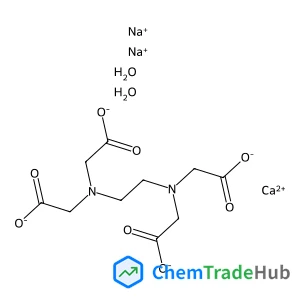
EthylenediaminetetraaceticacidcalciumDisodiumsalthydrate
CAS Number:
23411-34-9
Molecular Formula:
C10H16CaN2Na2O10

Recommended Suppliers





Disclaimer
This page provides academic journal information for reference and research purposes only. We are not affiliated with any journal publishers and do not handle publication submissions. For publication-related inquiries, please contact the respective journal publishers directly.
If you notice any inaccuracies in the information displayed, please contact us at support@chemtradehub.com. We will promptly review and address your concerns.