












Cation-responsive cavity expansion of valinomycin revealed by cryogenic ion trap infrared spectroscopy
Literature Information
Publication Date
2022-12-06
DOI
10.1039/D2CP04570B
Impact Factor
3.676
Authors
View Original
Abstract
Valinomycin (VM) is a natural K+-selective ionophore that transports K+ through the cell membrane. VM captures K+ in its central cavity with a C3-symmetric β-turn-like backbone. Although the binding affinity is drastically decreased for the VM-sodium (Na+VM) complex with respect to K+VM, VM holds relatively high affinity to Rb+ and Cs+. The high affinity for larger ions irrespective of ionic size seems to conflict with the expected optimal size matching model and raises questions on what factors determine ion selectivity. A combination of infrared spectroscopy with supporting computational calculations reveals that VM can accommodate larger Rb+ and Cs+ by flexibly changing its cavity size with the elongation of its folded β-turn-like backbone. The high affinity to Rb+ and Cs+ can be ascribed to a size-dependent cavity expansion. These findings provide a new perspective on molecular recognition and selectivity beyond the conventional size matching model.
Related Literature
Mechanistic studies on millerite chlorination with ammonium chloride
Xiaolu Xiong, Guangshi Li, Hongwei Cheng, Qian Xu
2020-01-30
Paper
DOI: 10.1039/D0CP00197J
Effects of temperature and grain size on deformation of polycrystalline copper–graphene nanolayered composites
Yunlong Ma, Sen Zhang, Yunfei Xu, Xiaoyi Liu
2020-02-10
Paper
DOI: 10.1039/C9CP06830A
Designing bifuncitonal molecular devices with a metalloporphyrin dimer
Ying Xia, Ling Shuai, Yiping Wang, Yao Ma, Lingyun Han, Ming Qiu, Zhenhua Zhang, Michael K. H. Leung
2020-01-29
Paper
DOI: 10.1039/C9CP05079E
Double aromaticity of the B40 fullerene: induced magnetic field analysis of π and σ delocalization in the boron cavernous structure
Nickolas D. Charistos, Alvaro Muñoz-Castro
2019-08-23
Paper
DOI: 10.1039/C9CP04223G
A noncovalent interaction insight onto the concerted metallation deprotonation mechanism
Jean-Pierre Djukic
2019-09-02
Paper
DOI: 10.1039/C9CP03650D
Dichlorine peroxide (ClOOCl), chloryl chloride (ClCl(O)O) and chlorine chlorite (ClOClO): very accurate ab initio structures and actinic degradation
Najoua Derbel, Thibaud Cours, Alexander Alijah
2020-01-23
Paper
DOI: 10.1039/C9CP06875A
Quantification of protein aggregation rates and quenching effects of amylin–inhibitor complexes
Suparna Khatun, Anurag Singh, Debabrata Mandal, Amar Nath Gupta
2019-08-19
Paper
DOI: 10.1039/C9CP03238J
Design of single-porphyrin donors toward high open-circuit voltage for organic solar cells via an energy level gradient-distribution screening strategy of fragments: a theoretical study
Li-Na Wu, Ming-Yue Sui, Song Xiao, Yu-Zhong Xie
2020-01-22
Paper
DOI: 10.1039/C9CP04903G
closo-Carboranes as dual CH⋯π and BH⋯π donors: theoretical study and biological significance
Antonio Frontera, Antonio Bauzá
2019-08-21
Paper
DOI: 10.1039/C9CP03858B
Strongly resonant metasurfaces supported by reflective substrates for highly efficient second- and high-harmonic generations with ultralow pump intensity
Kwang-Hyon Kim
2019-08-16
Paper
DOI: 10.1039/C9CP02674F
You might also like
Compound Q&A
What precautions should be taken when handling 2-Methyl-2-propanyl 5-amino-2-thiophenecarboxylate (CAS: 1498311-57-1)?
When handling 2-Methyl-2-propanyl 5-amino-2-thiophenecarboxylate (CAS: 1498311-5...
1498311-57-12-Methyl-2-propanyl ...
Compound Q&A
What are the physical and chemical properties of 5-Bromo-1,2-dichloro-3-fluorobenzene (CAS: 1000572-93-9)?
5-Bromo-1,2-dichloro-3-fluorobenzene (CAS: 1000572-93-9) is a crystalline solid ...
1000572-93-95-Bromo-1,2-dichloro...
Compound Q&A
How should (2R)-2-Amino-2-(4-bromophenyl)ethanol (CAS: 354153-64-3) be stored?
(2R)-2-Amino-2-(4-bromophenyl)ethanol (CAS: 354153-64-3) should be stored in a c...
354153-64-3(2R)-2-Amino-2-(4-br...
Compound Q&A
What regulatory guidelines apply to Methyl 4-(aminomethyl)tetrahydro-2H-pyran-4-carboxylate hydrochloride (CAS: 362707-24-2)?
Methyl 4-(aminomethyl)tetrahydro-2H-pyran-4-carboxylate hydrochloride (CAS: 3627...
362707-24-2Methyl 4-(aminomethy...
Compound Q&A
What are the main uses of 1,4-dimethyl-1H-pyrazole-5-sulfonyl chloride (CAS: 1174834-52-6)?
1,4-Dimethyl-1H-pyrazole-5-sulfonyl chloride is primarily used as an intermediat...
1174834-52-61,4-dimethyl-1H-pyra...
Compound Q&A
Is Dinaphtho[1,2-b:2',1'-d]furan (CAS: 239-69-0) safe?
Dinaphtho[1,2-b:2',1'-d]furan is generally safe when handled with appropriate pe...
239-69-0Dinaphtho[1,2-b:2',1...
Compound Q&A
What is the market or research trend for 7-Methyl-7,9-dihydro-1H-purine-2,6,8(3H)-trione (CAS: 612-37-3)?
The market for 7-Methyl-7,9-dihydro-1H-purine-2,6,8(3H)-trione (CAS: 612-37-3) i...
612-37-37-Methyl-7,9-dihydro...
Compound Q&A
What are the physical and chemical properties of 2-(4-Chlorophenyl)malonaldehyde (CAS: 205676-17-1)?
2-(4-Chlorophenyl)malonaldehyde (CAS: 205676-17-1) is a colorless or light yello...
205676-17-12-(4-Chlorophenyl)ma...
Compound Q&A
How is 2-Methylchrysene (CAS: 3351-32-4) typically synthesized?
2-Methylchrysene (CAS: 3351-32-4) is typically synthesized via the reaction of c...
3351-32-42-Methylchrysene
Compound Q&A
Is N-(6-aminopyrimidin-4-yl)acetamide (CAS: 89533-23-3) safe?
N-(6-aminopyrimidin-4-yl)acetamide (CAS: 89533-23-3) is generally considered saf...
89533-23-3N-(6-aminopyrimidin-...
Source Journal
Physical Chemistry Chemical Physics

CiteScore:
5.5
Self-citation Rate:
10.3%
Articles per Year:
3036
Physical Chemistry Chemical Physics (PCCP) is an international journal co-owned by 19 physical chemistry and physics societies from around the world. This journal publishes original, cutting-edge research in physical chemistry, chemical physics and biophysical chemistry. To be suitable for publication in PCCP, articles must include significant innovation and/or insight into physical chemistry; this is the most important criterion that reviewers and Editors will judge against when evaluating submissions. The journal has a broad scope and welcomes contributions spanning experiment, theory, computation and data science. Topical coverage includes spectroscopy, dynamics, kinetics, statistical mechanics, thermodynamics, electrochemistry, catalysis, surface science, quantum mechanics, quantum computing and machine learning. Interdisciplinary research areas such as polymers and soft matter, materials, nanoscience, energy, surfaces/interfaces, and biophysical chemistry are welcomed if they demonstrate significant innovation and/or insight into physical chemistry. Joined experimental/theoretical studies are particularly appreciated when complementary and based on up-to-date approaches.
Recommended Compounds
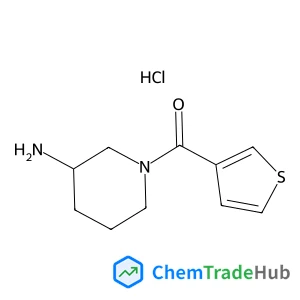
(3-Amino-piperidin-1-yl)-thiophen-3-yl-methanone hydrochloride
CAS Number:
1185316-70-4
Molecular Formula:
C10H15ClN2OS
![1-Oxa-8-azaspiro[4.5]decan-3-ol structure](https://static.chemtradehub.com/structs/757/757239-76-2-a0ec.webp "1-Oxa-8-azaspiro[4.5]decan-3-ol structure")
Recommended Suppliers





Disclaimer
This page provides academic journal information for reference and research purposes only. We are not affiliated with any journal publishers and do not handle publication submissions. For publication-related inquiries, please contact the respective journal publishers directly.
If you notice any inaccuracies in the information displayed, please contact us at support@chemtradehub.com. We will promptly review and address your concerns.