












![2-[2-(2-Methoxyethoxy)ethoxy]-2-methylpropane structure](https://static.chemtradehub.com/structs/527/52788-79-1-71c1.webp "2-[2-(2-Methoxyethoxy)ethoxy]-2-methylpropane structure")
Dichlorine peroxide (ClOOCl), chloryl chloride (ClCl(O)O) and chlorine chlorite (ClOClO): very accurate ab initio structures and actinic degradation
Literature Information
Publication Date
2020-01-23
DOI
10.1039/C9CP06875A
Impact Factor
3.676
Authors
Najoua Derbel, Thibaud Cours, Alexander Alijah
View Original
Abstract
The structural parameters of the three most stable isomers with formula Cl2O2, dichlorine peroxide, chloryl chloride and chlorine chlorite, were determined by high-level ab initio theory. The effects of core–valence electronic correlation as well as relativistic corrections were included in the calculations, and vibrational averaging of the so-obtained structures was performed. The bond distances agree with experimental data, where available, to within 0.01 Å, an unprecedented accuracy in particular for the floppy dichlorine peroxide molecule. The UV spectra of the three molecules were computed and decay pathways investigated. Under actinic UV radiation at 248 nm dichlorine peroxide decomposes principally according to ClOOCl → 2Cl + O2, in a synchronous concerted mechanism. In the low-energy tail region of this signal, the decay proceeds in a non-synchronous manner. There is also a low probability of the decay channel towards ClOO + Cl, whereas ClO molecules were not found. Chloryl chloride absorbs strongly around 300 nm. It disintegrates into ClO2 + Cl, where ClO2 seems to be formed mainly in excited electronic states which decompose further into Cl + O2. Hence chloryl chloride, though much less abundant in the stratosphere than dichlorine peroxide, also contributes to ozone depletion.
Related Literature
Submicro-polymer particles bearing imidazoline-2-selenone: dual mode adsorbents with color-sensing for halogens and mercury ions
Jaewon Choi, So Yeon Park, Hye Yun Yang, Hae Jin Kim, Kyuwook Ihm, Jeong Ho Nam, Joung Real Ahn, Seung Uk Son
2011-09-20
Paper
DOI: 10.1039/C1PY00260K
Unusual activation by solvent of the ethylene free radical polymerization
Etienne Grau, Jean-Pierre Broyer, Christophe Boisson, Roger Spitz, Vincent Monteil
2011-07-28
Paper
DOI: 10.1039/C1PY00200G
RAFT-synthesized copolymers and conjugates designed for therapeutic delivery of siRNA
DeeDee Smith, Andrew C. Holley, Charles L. McCormick
2011-03-25
Review Article
DOI: 10.1039/C1PY00038A
Catalytic synthesis and post-polymerization functionalization of conjugated polyisoprene
Marc A. Hillmyer
2011-06-15
Paper
DOI: 10.1039/C1PY00147G
Peptide-based lipid mimetics with tunable core properties viathiol–alkyne chemistry
Jacob G. Ray, Jack T. Ly, Daniel A. Savin
2011-03-08
Paper
DOI: 10.1039/C1PY00003A
Downwards tuning the HOMO level of polythiophene by carboxylate substitution for high open-circuit-voltage polymer solar cells
Maojie Zhang, Xia Guo, Yang Yang, Jing Zhang, Zhi-Guo Zhang, Yongfang Li
2011-10-21
Paper
DOI: 10.1039/C1PY00327E
Synthesis of hydroxypropyl cellulose derivatives modified with amphiphilic diblock copolymer side-chains for the slow release of volatile molecules
Damien Loïc Berthier, Andreas Herrmann, Lahoussine Ouali
2011-07-08
Paper
DOI: 10.1039/C1PY00195G
Recent progress on photochromic diarylethene polymers
Qianfu Luo, Hui Cheng, He Tian
2011-06-24
Review Article
DOI: 10.1039/C1PY00167A
Nanofluid acrylate composite resins—initial preparation and characterization
2011-05-03
Paper
DOI: 10.1039/C1PY00065A
A photosensitive fluorinated ionic complex with tunable surface wetting properties: mesostructure and photosensitivity
Xuemin Lu, Sufang Xiao, Xumeng Chen, Qinghua Lu
2011-09-01
Paper
DOI: 10.1039/C1PY00236H
You might also like
Compound Q&A
What precautions should be taken when handling 2-Methyl-2-propanyl 5-amino-2-thiophenecarboxylate (CAS: 1498311-57-1)?
When handling 2-Methyl-2-propanyl 5-amino-2-thiophenecarboxylate (CAS: 1498311-5...
1498311-57-12-Methyl-2-propanyl ...
Compound Q&A
What are the physical and chemical properties of 5-Bromo-1,2-dichloro-3-fluorobenzene (CAS: 1000572-93-9)?
5-Bromo-1,2-dichloro-3-fluorobenzene (CAS: 1000572-93-9) is a crystalline solid ...
1000572-93-95-Bromo-1,2-dichloro...
Compound Q&A
How should (2R)-2-Amino-2-(4-bromophenyl)ethanol (CAS: 354153-64-3) be stored?
(2R)-2-Amino-2-(4-bromophenyl)ethanol (CAS: 354153-64-3) should be stored in a c...
354153-64-3(2R)-2-Amino-2-(4-br...
Compound Q&A
What regulatory guidelines apply to Methyl 4-(aminomethyl)tetrahydro-2H-pyran-4-carboxylate hydrochloride (CAS: 362707-24-2)?
Methyl 4-(aminomethyl)tetrahydro-2H-pyran-4-carboxylate hydrochloride (CAS: 3627...
362707-24-2Methyl 4-(aminomethy...
Compound Q&A
What are the main uses of 1,4-dimethyl-1H-pyrazole-5-sulfonyl chloride (CAS: 1174834-52-6)?
1,4-Dimethyl-1H-pyrazole-5-sulfonyl chloride is primarily used as an intermediat...
1174834-52-61,4-dimethyl-1H-pyra...
Compound Q&A
Is Dinaphtho[1,2-b:2',1'-d]furan (CAS: 239-69-0) safe?
Dinaphtho[1,2-b:2',1'-d]furan is generally safe when handled with appropriate pe...
239-69-0Dinaphtho[1,2-b:2',1...
Compound Q&A
What is the market or research trend for 7-Methyl-7,9-dihydro-1H-purine-2,6,8(3H)-trione (CAS: 612-37-3)?
The market for 7-Methyl-7,9-dihydro-1H-purine-2,6,8(3H)-trione (CAS: 612-37-3) i...
612-37-37-Methyl-7,9-dihydro...
Compound Q&A
What are the physical and chemical properties of 2-(4-Chlorophenyl)malonaldehyde (CAS: 205676-17-1)?
2-(4-Chlorophenyl)malonaldehyde (CAS: 205676-17-1) is a colorless or light yello...
205676-17-12-(4-Chlorophenyl)ma...
Compound Q&A
How is 2-Methylchrysene (CAS: 3351-32-4) typically synthesized?
2-Methylchrysene (CAS: 3351-32-4) is typically synthesized via the reaction of c...
3351-32-42-Methylchrysene
Compound Q&A
Is N-(6-aminopyrimidin-4-yl)acetamide (CAS: 89533-23-3) safe?
N-(6-aminopyrimidin-4-yl)acetamide (CAS: 89533-23-3) is generally considered saf...
89533-23-3N-(6-aminopyrimidin-...
Source Journal
Physical Chemistry Chemical Physics

CiteScore:
5.5
Self-citation Rate:
10.3%
Articles per Year:
3036
Physical Chemistry Chemical Physics (PCCP) is an international journal co-owned by 19 physical chemistry and physics societies from around the world. This journal publishes original, cutting-edge research in physical chemistry, chemical physics and biophysical chemistry. To be suitable for publication in PCCP, articles must include significant innovation and/or insight into physical chemistry; this is the most important criterion that reviewers and Editors will judge against when evaluating submissions. The journal has a broad scope and welcomes contributions spanning experiment, theory, computation and data science. Topical coverage includes spectroscopy, dynamics, kinetics, statistical mechanics, thermodynamics, electrochemistry, catalysis, surface science, quantum mechanics, quantum computing and machine learning. Interdisciplinary research areas such as polymers and soft matter, materials, nanoscience, energy, surfaces/interfaces, and biophysical chemistry are welcomed if they demonstrate significant innovation and/or insight into physical chemistry. Joined experimental/theoretical studies are particularly appreciated when complementary and based on up-to-date approaches.
Recommended Compounds
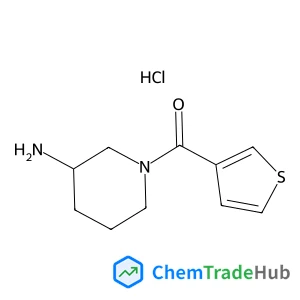
(3-Amino-piperidin-1-yl)-thiophen-3-yl-methanone hydrochloride
CAS Number:
1185316-70-4
Molecular Formula:
C10H15ClN2OS
Recommended Suppliers





Disclaimer
This page provides academic journal information for reference and research purposes only. We are not affiliated with any journal publishers and do not handle publication submissions. For publication-related inquiries, please contact the respective journal publishers directly.
If you notice any inaccuracies in the information displayed, please contact us at support@chemtradehub.com. We will promptly review and address your concerns.