












Quantification of protein aggregation rates and quenching effects of amylin–inhibitor complexes
Literature Information
Publication Date
2019-08-19
DOI
10.1039/C9CP03238J
Impact Factor
3.676
Authors
Suparna Khatun, Anurag Singh, Debabrata Mandal, Amar Nath Gupta
View Original
Abstract
The formation of amyloid aggregates is the hallmark of many protein misfolding diseases, including Type-II diabetes mellitus, which is caused by the fibrillation of amylin protein. It is established that nano-sized ligands such as curcumin, resveratrol and graphene quantum dots can modify protein aggregation rates. In this article, we report a comparative study of these ligands to estimate their protein aggregation rates and fluorescence quenching using various experimental techniques. Through light scattering experiments, the RH of bare amylin was found to increase at a rate of 43% per day, whereas in the presence of the ligands in different molar ratios (A1C10, A1R10 and A1GQDs20), the sizes of the complexes were found to grow at rates of 7%, 8% and 13% per day, respectively. We observed fluorescence quenching using photoluminescence experiments for all three protein–ligand complexes. The protein aggregation rate and fluorescence quenching exhibited a concentration-dependent competitive role in the inhibition process. Interestingly, for graphene quantum dots, the protein aggregation rate is more affected at lower concentrations, while fluorescence quenching dominates at higher concentrations; this is in contrast to curcumin and resveratrol, where fluorescence quenching dominates at all concentrations of the ligands in the complex. The FTIR data showed appreciable conversion of β-sheets into less aggregation-prone secondary structures for all three amylin–ligand ratios; however, the inhibition performance of curcumin overshadowed those of the other two inhibitors. The inhibition behavior of these three ligands was corroborated by analysis of analytical and high-resolution TEM images of the fibrils.
Recommended Journals
Related Literature
Pt atoms on doped carbon nanosheets with ultrahigh N content as a superior bifunctional catalyst for hydrogen evolution/oxidation
Cheng Jiang, Ping Li, Qi Feng, Zhi liang Zhao, Keguang Yao, Jiantao Fan, Hui Li, Haijiang Wang
2020-11-06
Paper
DOI: 10.1039/D0SE01516D
Understanding the role of nickel–iron (oxy)hydroxide (NiFeOOH) electrocatalysts on hematite photoanodes
Jihye Lee, Daye Seo, Sunghwan Won, Taek Dong Chung
2020-12-08
Paper
DOI: 10.1039/D0SE01500H
Practical increases in power output from soil-based microbial fuel cells under dynamic temperature variations
Lingling Gong, Mehran Abbaszadeh Amirdehi, Amine Miled
2020-12-18
Paper
DOI: 10.1039/D0SE01406K
Enhanced photoelectrochemical performance from particulate ZnSe:Cu(In,Ga)Se2 photocathodes during solar hydrogen production via particle size control
Fumiaki Takagi
2020-09-28
Paper
DOI: 10.1039/D0SE00998A
Restructuring a gold nanocatalyst by electrochemical treatment to recover its H2 evolution catalytic activity
Tien D. Tran, Hoang V. Le, Ly T. Le, Anh D. Nguyen, Thi Dieu Thuy Ung, Phong D. Tran
2021-01-29
Paper
DOI: 10.1039/D1SE00026H
Highly efficient and stable perovskite solar cells produced by maximizing additive engineering
Linlin Qiu, Jiacheng Zou, Wei-Hsiang Chen, Lika Dong, Deqiang Mei, Jieqiong Wang, Pei-Cheng Jiang
2020-11-12
Paper
DOI: 10.1039/D0SE01498B
In situ growth of an opal-like TiO2 electron transport layer by atomic layer deposition for perovskite solar cells
Hao Lu, Bangkai Gu, Song Fang
2020-12-23
Paper
DOI: 10.1039/D0SE01558J
H-USY and H-ZSM-5 zeolites as catalysts for HDPE conversion under a hydrogen reductive atmosphere
Cátia S. Costa, Marta Muñoz, M. Rosário Ribeiro
2021-01-14
Paper
DOI: 10.1039/D0SE01584A
You might also like
Compound Q&A
What precautions should be taken when handling 2-Methyl-2-propanyl 5-amino-2-thiophenecarboxylate (CAS: 1498311-57-1)?
When handling 2-Methyl-2-propanyl 5-amino-2-thiophenecarboxylate (CAS: 1498311-5...
1498311-57-12-Methyl-2-propanyl ...
Compound Q&A
What are the physical and chemical properties of 5-Bromo-1,2-dichloro-3-fluorobenzene (CAS: 1000572-93-9)?
5-Bromo-1,2-dichloro-3-fluorobenzene (CAS: 1000572-93-9) is a crystalline solid ...
1000572-93-95-Bromo-1,2-dichloro...
Compound Q&A
How should (2R)-2-Amino-2-(4-bromophenyl)ethanol (CAS: 354153-64-3) be stored?
(2R)-2-Amino-2-(4-bromophenyl)ethanol (CAS: 354153-64-3) should be stored in a c...
354153-64-3(2R)-2-Amino-2-(4-br...
Compound Q&A
What regulatory guidelines apply to Methyl 4-(aminomethyl)tetrahydro-2H-pyran-4-carboxylate hydrochloride (CAS: 362707-24-2)?
Methyl 4-(aminomethyl)tetrahydro-2H-pyran-4-carboxylate hydrochloride (CAS: 3627...
362707-24-2Methyl 4-(aminomethy...
Compound Q&A
What are the main uses of 1,4-dimethyl-1H-pyrazole-5-sulfonyl chloride (CAS: 1174834-52-6)?
1,4-Dimethyl-1H-pyrazole-5-sulfonyl chloride is primarily used as an intermediat...
1174834-52-61,4-dimethyl-1H-pyra...
Compound Q&A
Is Dinaphtho[1,2-b:2',1'-d]furan (CAS: 239-69-0) safe?
Dinaphtho[1,2-b:2',1'-d]furan is generally safe when handled with appropriate pe...
239-69-0Dinaphtho[1,2-b:2',1...
Compound Q&A
What is the market or research trend for 7-Methyl-7,9-dihydro-1H-purine-2,6,8(3H)-trione (CAS: 612-37-3)?
The market for 7-Methyl-7,9-dihydro-1H-purine-2,6,8(3H)-trione (CAS: 612-37-3) i...
612-37-37-Methyl-7,9-dihydro...
Compound Q&A
What are the physical and chemical properties of 2-(4-Chlorophenyl)malonaldehyde (CAS: 205676-17-1)?
2-(4-Chlorophenyl)malonaldehyde (CAS: 205676-17-1) is a colorless or light yello...
205676-17-12-(4-Chlorophenyl)ma...
Compound Q&A
How is 2-Methylchrysene (CAS: 3351-32-4) typically synthesized?
2-Methylchrysene (CAS: 3351-32-4) is typically synthesized via the reaction of c...
3351-32-42-Methylchrysene
Compound Q&A
Is N-(6-aminopyrimidin-4-yl)acetamide (CAS: 89533-23-3) safe?
N-(6-aminopyrimidin-4-yl)acetamide (CAS: 89533-23-3) is generally considered saf...
89533-23-3N-(6-aminopyrimidin-...
Source Journal
Physical Chemistry Chemical Physics

CiteScore:
5.5
Self-citation Rate:
10.3%
Articles per Year:
3036
Physical Chemistry Chemical Physics (PCCP) is an international journal co-owned by 19 physical chemistry and physics societies from around the world. This journal publishes original, cutting-edge research in physical chemistry, chemical physics and biophysical chemistry. To be suitable for publication in PCCP, articles must include significant innovation and/or insight into physical chemistry; this is the most important criterion that reviewers and Editors will judge against when evaluating submissions. The journal has a broad scope and welcomes contributions spanning experiment, theory, computation and data science. Topical coverage includes spectroscopy, dynamics, kinetics, statistical mechanics, thermodynamics, electrochemistry, catalysis, surface science, quantum mechanics, quantum computing and machine learning. Interdisciplinary research areas such as polymers and soft matter, materials, nanoscience, energy, surfaces/interfaces, and biophysical chemistry are welcomed if they demonstrate significant innovation and/or insight into physical chemistry. Joined experimental/theoretical studies are particularly appreciated when complementary and based on up-to-date approaches.
Recommended Compounds
![4-Chloro-N-{[4-(dimethylamino)phenyl]carbamoyl}benzenesulfonamide structure](https://static.chemtradehub.com/structs/558/5581-42-0-7dcb.webp "4-Chloro-N-{[4-(dimethylamino)phenyl]carbamoyl}benzenesulfonamide structure")
4-Chloro-N-{[4-(dimethylamino)phenyl]carbamoyl}benzenesulfonamide
CAS Number:
5581-42-0
Molecular Formula:
C15H16ClN3O3S
![2,5-Dichloro-1H-pyrrolo[3,2-b]pyridine structure](https://static.chemtradehub.com/structs/100/1000342-87-9-f632.webp "2,5-Dichloro-1H-pyrrolo[3,2-b]pyridine structure")
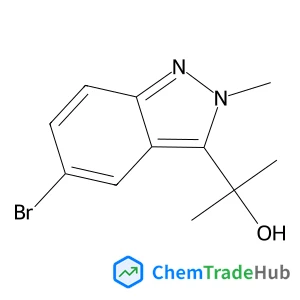
2-(5-Bromo-2-methyl-2H-indazol-3-yl)-2-propanol
CAS Number:
1823787-20-7
Molecular Formula:
C11H13BrN2O
Recommended Suppliers






Disclaimer
This page provides academic journal information for reference and research purposes only. We are not affiliated with any journal publishers and do not handle publication submissions. For publication-related inquiries, please contact the respective journal publishers directly.
If you notice any inaccuracies in the information displayed, please contact us at support@chemtradehub.com. We will promptly review and address your concerns.