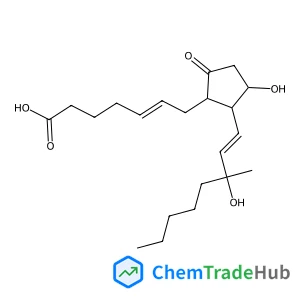
(5Z,11alpha,13E,15R)-11,15-Dihydroxy-15-methyl-9-oxoprosta-5,13-dien-1-oic acid
CAS Number:
55028-70-1
Molecular Formula:
C21H34O5
Li-Na Wu, Ming-Yue Sui, Song Xiao, Yu-Zhong Xie
Open-circuit voltage (VOC) is a key factor for improving the power conversion efficiency (PCE) of bulk heterojunction (BHJ) organic solar cells (OSCs). At present, increasing attention has been devoted towards modifying π bridges in single-porphyrin small molecule donors with an A–π–D–π–A configuration to reduce the highest occupied molecular orbital (HOMO) levels and improve the VOC of devices. However, how to screen the π bridges is a key issue. In this work, nine π bridges were screened by the HOMO level gradient-distribution strategy of fragments (electron-donating donor (D), π bridges, and electron-withdrawing acceptor (A)), where fragments meeting the requirements were combined into five novel small molecule donors. Meanwhile, in order to test whether the strategy is beneficial to increasing VOC, [6,6]-phenyl C61-butyric acid methyl ester (PC61BM) was selected as the acceptor material. The energy levels of all molecules were compared and the photoelectric properties (i.e., energy gap, energy driving force, reorganization energy, intermolecular charge transfer rate, charge recombination rate, and VOC) of the five small molecules were studied. The results showed that the HOMO levels of porphyrin donors could be significantly lowered via this strategy, and VOC was raised without losing the short-circuit current (JSC) and fill factor (FF) of the devices. Meanwhile, the designed five small molecules could be used as donor candidates to improve the performance of OSCs.
Maimur Hossain, Mohammad Adil Afroz, Rabindranath Garai
DOI: 10.1039/D0SE01601B
Cátia S. Costa, Marta Muñoz, M. Rosário Ribeiro
DOI: 10.1039/D0SE01584A
Markus Millinger, Kathleen Meisel
DOI: 10.1039/D0SE01067G
Jihye Lee, Daye Seo, Sunghwan Won, Taek Dong Chung
DOI: 10.1039/D0SE01500H
Tao Zhang, Xinyang Li, Bo Wu, Yue Li
DOI: 10.1039/D0SE01837F
Tuan K. A. Hoang, Yasuyoshi Kurokawa, Noritaka Usami
DOI: 10.1039/D0SE01700K
Alessio Zuliani, Manuel Cano, Federica Calsolaro, Alain R. Puente Santiago, Juan J. Giner-Casares, Enrique Rodríguez-Castellón, Gloria Berlier, Giancarlo Cravotto, Katia Martina
DOI: 10.1039/D0SE01505A
Keval K. Sonigara, Jayraj V. Vaghasiya, Jyoti Prasad, Hiren K. Machhi, Mohammad Shaad Ansari, Mohammad Qureshi
DOI: 10.1039/D0SE01527J
Luke T. Minardi, Faisal H. Alshafei, Zubin K. Mishra, Dante A. Simonetti
DOI: 10.1039/D0SE01638A
Chunyan Li
DOI: 10.1039/D0SE01780A
When handling 2-Methyl-2-propanyl 5-amino-2-thiophenecarboxylate (CAS: 1498311-5...
5-Bromo-1,2-dichloro-3-fluorobenzene (CAS: 1000572-93-9) is a crystalline solid ...
(2R)-2-Amino-2-(4-bromophenyl)ethanol (CAS: 354153-64-3) should be stored in a c...
Methyl 4-(aminomethyl)tetrahydro-2H-pyran-4-carboxylate hydrochloride (CAS: 3627...
1,4-Dimethyl-1H-pyrazole-5-sulfonyl chloride is primarily used as an intermediat...
Dinaphtho[1,2-b:2',1'-d]furan is generally safe when handled with appropriate pe...
The market for 7-Methyl-7,9-dihydro-1H-purine-2,6,8(3H)-trione (CAS: 612-37-3) i...
2-(4-Chlorophenyl)malonaldehyde (CAS: 205676-17-1) is a colorless or light yello...
2-Methylchrysene (CAS: 3351-32-4) is typically synthesized via the reaction of c...
N-(6-aminopyrimidin-4-yl)acetamide (CAS: 89533-23-3) is generally considered saf...

Physical Chemistry Chemical Physics (PCCP) is an international journal co-owned by 19 physical chemistry and physics societies from around the world. This journal publishes original, cutting-edge research in physical chemistry, chemical physics and biophysical chemistry. To be suitable for publication in PCCP, articles must include significant innovation and/or insight into physical chemistry; this is the most important criterion that reviewers and Editors will judge against when evaluating submissions. The journal has a broad scope and welcomes contributions spanning experiment, theory, computation and data science. Topical coverage includes spectroscopy, dynamics, kinetics, statistical mechanics, thermodynamics, electrochemistry, catalysis, surface science, quantum mechanics, quantum computing and machine learning. Interdisciplinary research areas such as polymers and soft matter, materials, nanoscience, energy, surfaces/interfaces, and biophysical chemistry are welcomed if they demonstrate significant innovation and/or insight into physical chemistry. Joined experimental/theoretical studies are particularly appreciated when complementary and based on up-to-date approaches.
![2,5-Dichloro-1H-pyrrolo[3,2-b]pyridine structure](https://static.chemtradehub.com/structs/100/1000342-87-9-f632.webp "2,5-Dichloro-1H-pyrrolo[3,2-b]pyridine structure")