














Current progressions in transition metal based hydroxides as bi-functional catalysts towards electrocatalytic total water splitting
Literature Information
Publication Date
2021-10-18
DOI
10.1039/D1SE01193F
Impact Factor
6.367
Authors
View Original
Abstract
To meet the ever-increasing energy demands with only source of fossil fuels will no longer be sufficient for sustainable energy developments. Thus, the choice of water electrolysis is the finest way of producing clean and greener hydrogen energy as an alternative fuel source for future. Hence, it is necessary to develop electrocatalyst which will have high activity, stability and cost effectivity for overall water splitting. Besides, to replace the high-cost noble metals with various transition metals based nanomaterials (NMs) for total water splitting (TWS) is the eventual objective to make the H2 production towards the industrial level. In this line, the recent literature examination gives the clear notion that the transition metal hydroxides (TMOHs) are superior activity towards TWS reactions with low overpotential. But the effects of metal combinations with simple metal hydroxides on their catalytic performance are stagnant towards bi-functional system in the alkaline water electrolysis. This review details the significance of such combinations (mono, bi-, tri-, tetra-metal hydroxides) and their synergistic effect for the first time. The nature of TM hydroxides and their influence in TWS is not explored as a review before and we strongly believed which is extremely important at the current energy scenario in the globe. So in this review we addressed the potentiality of these TM hydroxides and their analogues for real scale studies for the first time. In-addition, this review also highlights how the overpotential values can be reduced with chalcogenides and phosphides substituted TMOHs as a bi-functional catalyst for TWS. Overall, the investigation on these systems can pave a way for researchers to examine further with TM hydroxides in terms of structure, activity and stability in TWS study in future.
Recommended Journals
Related Literature
A new simple synthesis of poly(thiophene-methine)s
Md. Badruz Zaman, Dmitrii F. Perepichka
2005-07-20
Communication
DOI: 10.1039/B506138E
Shape-dependent magnetic properties of low-dimensional nanoscale Prussian blue (PB) analogue SmFe(CN)6·4H2O
Hao-Ling Sun, Hongtao Shi, Fei Zhao, Limin Qi, Song Gao
2005-07-28
Communication
DOI: 10.1039/B507240A
Structure elucidation of a novel family of mycolactonetoxins from the frog pathogen Mycobacterium sp. MU128FXT by mass spectrometry
Hui Hong, Tim Stinear, Paul Skelton, Jonathan B. Spencer, Peter F. Leadlay
2005-08-05
Communication
DOI: 10.1039/B506835E
Solvolytic routes to new nonabismuth hydroxy- and alkoxy-oxo complexes: synthesis, characterization and solid-state structures of novel nonabismuth polyoxo cations Bi9(μ3-O)8(μ3-OR)65+ (R = H, Et)
John H. Thurston, Dale C. Swenson, Louis Messerle
2005-07-27
Communication
DOI: 10.1039/B504864H
2-Phenallyl as a versatile protecting group for the asymmetric one-pot three-component synthesis of propargylamines
Nina Gommermann, Paul Knochel
2005-07-26
Communication
DOI: 10.1039/B507810E
Chiral azide-bridged two-dimensional Cu(ii) compounds showing a field-induced spin–flop transition
Young Sin You, Jung Hee Yoon, Hyoung Chan Kim, Chang Seop Hong
2005-07-15
Communication
DOI: 10.1039/B507051A
Novel HEXOL-type cyclometallated iridium(iii) complexes: stereoselective synthesis and structure elucidation
Liangru Yang, Alex von Zelewsky, Helen Stoeckli-Evans
2005-07-28
Communication
DOI: 10.1039/B507769A
Zirconium mediated total synthesis of crinitol, 9-hydroxyfarnesoic acid, 9-hydroxyfarnesol, 9-hydroxysargaquinone and the selectively-protected aglycone of moritoside and euplexide A
Sally Dixon, George J. Gordon, Richard J. Whitby
2005-08-05
Communication
DOI: 10.1039/B508524A
A high throughput screening method for the selection of zeolites for binding cations
Edel M. Minogue, Tammy P. Taylor, Anthony K. Burrell, George J. Havrilla, Benjamin P. Warner, Michael T. Janicke
2005-07-26
Communication
DOI: 10.1039/B506044C
You might also like
Compound Q&A
How should waste containing N-Methoxy-N-methyl-1,3-thiazole-5-carboxamide (CAS: 898825-89-3) be handled?
Waste containing N-Methoxy-N-methyl-1,3-thiazole-5-carboxamide (CAS: 898825-89-3...
898825-89-3N-Methoxy-N-methyl-1...
Compound Q&A
How should N-(4-Biphenylyl)dibenzo[b,d]furan-4-amine (CAS: 1318338-47-4) be stored?
N-(4-Biphenylyl)dibenzo[b,d]furan-4-amine should be stored in a tightly sealed c...
1318338-47-4N-(4-Biphenylyl)dibe...
Compound Q&A
What is the market or research trend for 3-Acetamido-5-amino-2,4,6-triiodobenzoic acid (CAS: 1713-07-1)?
The market for 3-Acetamido-5-amino-2,4,6-triiodobenzoic acid (CAS: 1713-07-1) is...
1713-07-13-Acetamido-5-amino-...
Compound Q&A
How should Benzyl 2-O-acetyl-3,4,6-tri-O-benzyl-beta-D-galactopyranoside (CAS: 61820-03-9) be stored?
Benzyl 2-O-acetyl-3,4,6-tri-O-benzyl-beta-D-galactopyranoside (CAS: 61820-03-9) ...
61820-03-9Benzyl 2-O-acetyl-3,...
Compound Q&A
What regulatory guidelines apply to 2-Ethylpiperazine dihydrochloride (CAS: 438050-52-3)?
2-Ethylpiperazine dihydrochloride (CAS: 438050-52-3) is regulated under the Glob...
438050-52-32-Ethylpiperazine di...
Compound Q&A
What regulatory guidelines apply to 1,1'-[1,3-Phenylenebis(methylene)]bis(3-methyl-1H-pyrrole-2,5-dione) (CAS: 119462-56-5)?
1,1'-[1,3-Phenylenebis(methylene)]bis(3-methyl-1H-pyrrole-2,5-dione) (CAS: 11946...
119462-56-51,1'-[1,3-Phenyleneb...
Compound Q&A
Are there alternatives to 5-Fluoro-2-(1-pyrrolidinyl)pyridine (CAS: 1287217-79-1) in synthesis?
Several alternatives can be used in the synthesis of 5-Fluoro-2-(1-pyrrolidinyl)...
1287217-79-15-Fluoro-2-(1-pyrrol...
Compound Q&A
What precautions should be taken when handling 1-((2R,3R,4R,5R)-5-((bis(4-methoxyphenyl)(phenyl)methoxy)methyl)-4-hydroxy-3-methoxytetrahydrofuran-2-yl)-5-methylpyrimidine-2,4(1H,3H)-dione (CAS: 153631-19-7)?
Proper personal protective equipment (PPE) must be worn when handling this compo...
153631-19-71-((2R,3R,4R,5R)-5-(...
Compound Q&A
What precautions should be taken when handling 6-Bromoimidazo[1,2-a]pyridin-8-amine (CAS: 676371-00-9)?
When handling 6-Bromoimidazo[1,2-a]pyridin-8-amine, it is important to wear appr...
676371-00-96-Bromoimidazo[1,2-a...
Compound Q&A
Are there alternatives to (2S,4R)-4-(4-Nitrobenzyl)pyrrolidine-2-carboxylic acid hydrochloride (CAS: 1049740-22-8) in synthesis?
Alternatives to (2S,4R)-4-(4-Nitrobenzyl)pyrrolidine-2-carboxylic acid hydrochlo...
1049740-22-8(2S,4R)-4-(4-Nitrobe...
Source Journal
Recommended Compounds
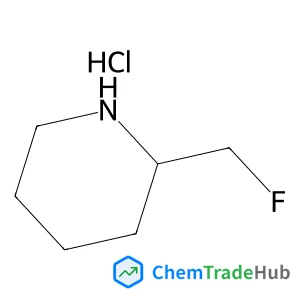
(2S)-2-(Fluoromethyl)piperidine hydrochloride (1:1)
CAS Number:
886216-73-5
Molecular Formula:
C6H13ClFN
![2-Methyl-2-propanyl {3-[4-(4,4,5,5-tetramethyl-1,3,2-dioxaborolan-2-yl)phenyl]-3-oxetanyl}carbamate structure](https://static.chemtradehub.com/structs/127/1279090-25-3-1b84.webp "2-Methyl-2-propanyl {3-[4-(4,4,5,5-tetramethyl-1,3,2-dioxaborolan-2-yl)phenyl]-3-oxetanyl}carbamate structure")
2-Methyl-2-propanyl {3-[4-(4,4,5,5-tetramethyl-1,3,2-dioxaborolan-2-yl)phenyl]-3-oxetanyl}carbamate
CAS Number:
1279090-25-3
Molecular Formula:
C20H30BNO5
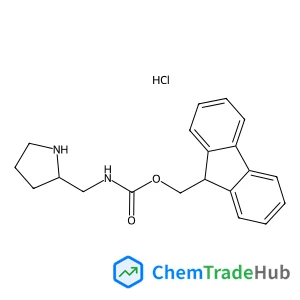
(S)-(9H-Fluoren-9-yl)methyl (pyrrolidin-2-ylmethyl)carbamate hydrochloride
CAS Number:
1217813-15-4
Molecular Formula:
C20H23ClN2O2
Recommended Suppliers




Disclaimer
This page provides academic journal information for reference and research purposes only. We are not affiliated with any journal publishers and do not handle publication submissions. For publication-related inquiries, please contact the respective journal publishers directly.
If you notice any inaccuracies in the information displayed, please contact us at support@chemtradehub.com. We will promptly review and address your concerns.