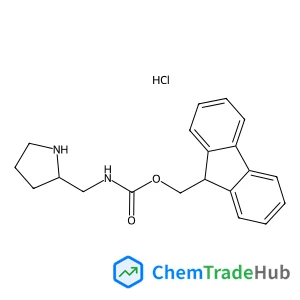
(S)-(9H-Fluoren-9-yl)methyl (pyrrolidin-2-ylmethyl)carbamate hydrochloride
CAS Number:
1217813-15-4
Molecular Formula:
C20H23ClN2O2
Hui Hong, Tim Stinear, Paul Skelton, Jonathan B. Spencer, Peter F. Leadlay
Structures are proposed, based on LC-ion trap MSn analysis and high-resolution FTICR MS/MS analysis, for a novel family of mycolactone toxins isolated from the frog pathogen MU128FXT and differing from those produced by the human pathogen M. ulcerans MUAgy99 in having an altered polyketide side chain.
Samuel Aronson, Steffen J. Glaser
DOI: 10.1039/C8CP01876F
Jinjin Wang, Zhanyu Wang, R. J. Zhang, Y. X. Zheng, L. Y. Chen, Chia-Chin Tsoo, Hung-Ji Huang
DOI: 10.1039/C8CP02624F
Małgorzata Sternik, Urszula D. Wdowik
DOI: 10.1039/C7CP08270C
Lizhe Liu, Li Wang, Guangsheng Luo, Chunlan Mo, Chenliang Chang
DOI: 10.1039/C8CP02069H
M. E. Sasin, A. G. Smolin, K.-H. Gericke, E. Tokunaga, O. S. Vasyutinskii
DOI: 10.1039/C8CP02708K
Alexander Sheldrick, David Müller, Alan Günther, Pablo Nieto, Otto Dopfer
DOI: 10.1039/C8CP00590G
DOI: 10.1039/C8CP00261D
Steffen Eusterwiemann, Armido Studer
DOI: 10.1039/C7CP05657E
Lei Wang, Zhaoxiang Dai, Rulong Zhou
DOI: 10.1039/C8CP02569J
Waste containing N-Methoxy-N-methyl-1,3-thiazole-5-carboxamide (CAS: 898825-89-3...
N-(4-Biphenylyl)dibenzo[b,d]furan-4-amine should be stored in a tightly sealed c...
The market for 3-Acetamido-5-amino-2,4,6-triiodobenzoic acid (CAS: 1713-07-1) is...
Benzyl 2-O-acetyl-3,4,6-tri-O-benzyl-beta-D-galactopyranoside (CAS: 61820-03-9) ...
2-Ethylpiperazine dihydrochloride (CAS: 438050-52-3) is regulated under the Glob...
1,1'-[1,3-Phenylenebis(methylene)]bis(3-methyl-1H-pyrrole-2,5-dione) (CAS: 11946...
Several alternatives can be used in the synthesis of 5-Fluoro-2-(1-pyrrolidinyl)...
Proper personal protective equipment (PPE) must be worn when handling this compo...
When handling 6-Bromoimidazo[1,2-a]pyridin-8-amine, it is important to wear appr...
Alternatives to (2S,4R)-4-(4-Nitrobenzyl)pyrrolidine-2-carboxylic acid hydrochlo...

ChemComm publishes urgent research which is of outstanding significance and interest to experts in the field, while also appealing to the journal’s broad chemistry readership. Our communication format is ideally suited to short, urgent studies that are of such importance that they require accelerated publication. Our scope covers all topics in chemistry, and research at the interface of chemistry and other disciplines (such as materials science, nanoscience, physics, engineering and biology) where there is a significant novelty in the chemistry aspects. Major topic areas covered include: Analytical Chemistry Catalysis Chemical Biology and medicinal chemistry Computational Chemistry and Machine Learning Energy and sustainable chemistry Environmental Chemistry Green Chemistry Inorganic Chemistry Materials Chemistry Nanoscience Organic Chemistry Physical Chemistry Polymer Chemistry Supramolecular Chemistry