














Highly improved performance of a film-based fluorescent sensor via a nanomesh scaffold strategy
Literature Information
Publication Date
2021-11-01
DOI
10.1039/D1SD00016K
Impact Factor
0
Authors
Meng Liu, Dong Li, Kun Li, Haitao Xu, Jiufu Lu, Xianzhao Shao, Taihong Liu
View Original
Abstract
Public safety and environmental monitoring are of great significance to maintain human health. Therefore, a simple and effective strategy for preparing the substrate layer of a film-based fluorescent sensor is developed by a nanomesh scaffold technology. The limit of detection of the nanomesh scaffold-modified sensor ranges from 4.8 ppb to 3750 ppm. This can provide an effective method for detecting potential biological warfare agent, 2,6-dicarboxyridine.
Related Literature
Why genetic modification of lignin leads to low-recalcitrance biomass
Paul Langan, Loukas Petridis
2014-11-11
Paper
DOI: 10.1039/C4CP05004E
Recent aspects of self-oscillating polymeric materials: designing self-oscillating polymers coupled with supramolecular chemistry and ionic liquid science
Takeshi Ueki, Ryo Yoshida
2014-04-03
Perspective
DOI: 10.1039/C4CP00980K
Improved performance of a polymer nanogenerator based on silver nanoparticles doped electrospun P(VDF–HFP) nanofibers
Dipankar Mandal, Karsten Henkel, Dieter Schmeißer
2014-02-27
Communication
DOI: 10.1039/C3CP55238A
Tunable band gaps in silicene–MoS2 heterobilayers
N. Gao, J. C. Li, Q. Jiang
2014-03-24
Paper
DOI: 10.1039/C4CP00089G
Superbasicity of silylene derivatives achieved via non-covalent intramolecular cation⋯π interactions and exploited as molecular containers for CO2
Rabindranath Lo, Mrinal Kanti Si
2014-05-07
Paper
DOI: 10.1039/C4CP01394H
Analysis of hydrogen bond energies and hydrogen bonded networks in water clusters (H2O)20 and (H2O)25 using the charge-transfer and dispersion terms
2014-04-17
Paper
DOI: 10.1039/C4CP01204F
The vibrational relaxation of NO in Ar: tunneling in a curve-crossing mechanism
2014-10-14
Paper
DOI: 10.1039/C4CP04107K
Electrochemistry of orthosilicate-based lithium battery cathodes: a perspective
Stefania Ferrari, Doretta Capsoni, Simone Casino, Matteo Destro, Claudio Gerbaldi, Marcella Bini
2014-04-15
Perspective
DOI: 10.1039/C4CP00511B
Unusual behavior of thermal lens in alcohols
Pardeep Kumar, Sirshendu Dinda, Atanu Chakraborty, Debabrata Goswami
2014-05-02
Paper
DOI: 10.1039/C4CP00895B
You might also like
Compound Q&A
What are the main uses of 1-(3-Aminophenyl)-3-[(3R)-1-(3,3-dimethyl-2-oxobutyl)-2-oxo-5-(2-pyridinyl)-2,3-dihydro-1H-1,4-benzodiazepin-3-yl]urea (CAS: 155412-88-7)?
This compound is mainly used as an intermediate in the synthesis of antipsychoti...
155412-88-71-(3-Aminophenyl)-3-...
Compound Q&A
How should waste containing 1-(D-Ribofuranosyl)-1,4-dihydro-3-pyridinecarboxamide (CAS: 19132-12-8) be handled?
Waste containing 1-(D-Ribofuranosyl)-1,4-dihydro-3-pyridinecarboxamide (CAS: 191...
19132-12-81-(D-Ribofuranosyl)-...
Compound Q&A
What regulatory guidelines apply to 2-Methyl-2-propanyl 3-bromo-3-(hydroxymethyl)-1-azetidinecarboxylate (CAS: 2007919-81-3)?
2-Methyl-2-propanyl 3-bromo-3-(hydroxymethyl)-1-azetidinecarboxylate (CAS: 20079...
2007919-81-32-Methyl-2-propanyl ...
Compound Q&A
What is N-(4-Chloro-2-pyridinyl)acetamide (CAS: 245056-66-0)?
N-(4-Chloro-2-pyridinyl)acetamide (CAS: 245056-66-0) is a chemical compound with...
245056-66-0N-(4-Chloro-2-pyridi...
Compound Q&A
What is 5-Chloro-2-hydroxybenzoic acid (CAS: 321-14-2)?
5-Chloro-2-hydroxybenzoic acid, also known as 5-chlorosalicylic acid, is an arom...
321-14-25-Chloro-2-hydroxybe...
Compound Q&A
What precautions should be taken when handling 1,1-Dichloro-1-fluoroethane (CAS: 1717-00-6)?
When handling 1,1-Dichloro-1-fluoroethane (CAS: 1717-00-6), it is important to u...
1717-00-61,1-Dichloro-1-fluor...
Compound Q&A
What are the physical and chemical properties of Fmoc-(2S,3R)-3-phenylpyrrolidine-2-carboxylic acid (CAS: 281655-32-1)?
Fmoc-(2S,3R)-3-phenylpyrrolidine-2-carboxylic acid is a white crystalline solid ...
281655-32-1Fmoc-(2S,3R)-3-pheny...
Compound Q&A
What are the main uses of 4-Amino-5-bromo-2-pyridinecarboxylic acid (CAS: 1363381-01-4)?
4-Amino-5-bromo-2-pyridinecarboxylic acid is primarily used as a precursor in th...
1363381-01-44-Amino-5-bromo-2-py...
Compound Q&A
What precautions should be taken when handling (S)-tert-butyl 2-((2-(4-bromophenyl)-2-oxoethyl)carbamoyl)pyrrolidine-1-carboxylate (CAS: 1007881-98-2)?
Handling this compound should be done with personal protective equipment (PPE) i...
1007881-98-2(S)-tert-butyl 2-((2...
Compound Q&A
What precautions should be taken when handling 8-bromo-2,2-dimethyl-3,4-dihydro-2H-1,4-benzoxazin-3-one (CAS: 688363-73-7)?
When handling 8-bromo-2,2-dimethyl-3,4-dihydro-2H-1,4-benzoxazin-3-one, use prop...
688363-73-78-bromo-2,2-dimethyl...
Source Journal
Recommended Compounds
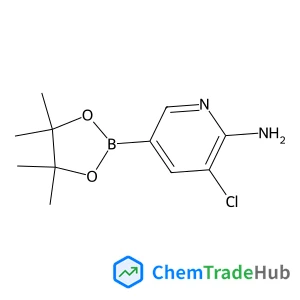
3-Chloro-5-(4,4,5,5-tetramethyl-1,3,2-dioxaborolan-2-yl)-2-pyridinamine
CAS Number:
1032758-99-8
Molecular Formula:
C11H16BClN2O2
Recommended Suppliers



Disclaimer
This page provides academic journal information for reference and research purposes only. We are not affiliated with any journal publishers and do not handle publication submissions. For publication-related inquiries, please contact the respective journal publishers directly.
If you notice any inaccuracies in the information displayed, please contact us at support@chemtradehub.com. We will promptly review and address your concerns.