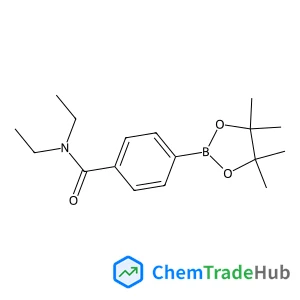
N,N-Diethyl-4-(4,4,5,5-tetramethyl-1,3,2-dioxaborolan-2-yl)benzamide
CAS Number:
325142-99-2
Molecular Formula:
C17H26BNO3
Experimental data for the vibrational relaxation NO(X2Π, v = 1) + Ar → NO(X2Π, v = 0) + Ar between 300 and 2000 K are analyzed. The measured rate coefficients k10 greatly exceed Landau–Teller values LTk10. This observation can be attributed to a mechanism involving curve-crossing of the (A′′, v = 1) and (A′, v = 0) vibronic states of the collision system. At high temperatures, the rate coefficients k10 are well represented by the thermally averaged Landau–Zener rate constant LZk10 with an apparent Arrhenius activation energy Ea/kB near 4500 K. At intermediate temperatures, around T = 900 K, the measured k10 values are a factor of two higher than the extrapolated LZk10 values. This deviation is attributed to tunneling in nonadiabatic curve-crossing transitions, which are analyzed within the Airy approximation (linear model for crossing diabatic curves) and an effective mass approach. This suggests a substantial contribution of hindered rotation of NO to the nonadiabatic perturbation. The extrapolation of the Airy probabilities to even lower temperatures (by the Landau–Lifshitz WKB tunneling expression for simple nonlinear model potentials) indicates a further marked increase of the tunneling contribution beyond the extrapolated LZk10. Near 300 K, the k10 can be two to three orders of magnitude higher than the extrapolated LZk10. This agrees with the limited available experimental data for NO–Ar relaxation near room temperature.

Nature Reviews Drug Discovery

Physical Chemistry Chemical Physics

CrystEngComm

Journal of Medical Biochemistry

Current Pharmaceutical Biotechnology

Molecular Diversity

Angewandte Chemie International Edition

European Journal of Organic Chemistry

Environmental Toxicology and Pharmacology

Foundations of Chemistry
Binxing Yu, Jill I. Tracey, Zhongkai Cheng, Martin Vacha
DOI: 10.1039/C8CP01314D
Jakob Andersson, Melanie A. Fuller, Kathleen Wood, Stephen A. Holt, Ingo Köper
DOI: 10.1039/C8CP01346B
Alexander Alijah, Thibaud Cours, Nejm-Eddine Jaidane, Najoua Derbel
DOI: 10.1039/C7CP08659H
Dinesh Mishra, Vladislav Lobodin, Chengqi Zhang, Fadi Aldeek, Eric Lochner, Hedi Mattoussi
DOI: 10.1039/C7CP08682B
Antony Cyril Arulrajan, Christophe Renault, Stanley C. S. Lai
DOI: 10.1039/C8CP01835A
Qianshun Wei, Dexia Zhou, Hongtao Bian
DOI: 10.1039/C8CP00099A
Qing-Lu Liu, Zong-Yan Zhao, Jian-Hong Yi
DOI: 10.1039/C8CP00432C
Cinzia Chiappe, Christian Silvio Pomelli
DOI: 10.1039/C7CP07289A
Yueying Chu, Xiuzhi Gao, Xin Zhang, Guangtong Xu
DOI: 10.1039/C8CP00946E
I. Alcón
DOI: 10.1039/C7CP08076J
This compound is mainly used as an intermediate in the synthesis of antipsychoti...
Waste containing 1-(D-Ribofuranosyl)-1,4-dihydro-3-pyridinecarboxamide (CAS: 191...
2-Methyl-2-propanyl 3-bromo-3-(hydroxymethyl)-1-azetidinecarboxylate (CAS: 20079...
N-(4-Chloro-2-pyridinyl)acetamide (CAS: 245056-66-0) is a chemical compound with...
5-Chloro-2-hydroxybenzoic acid, also known as 5-chlorosalicylic acid, is an arom...
When handling 1,1-Dichloro-1-fluoroethane (CAS: 1717-00-6), it is important to u...
Fmoc-(2S,3R)-3-phenylpyrrolidine-2-carboxylic acid is a white crystalline solid ...
4-Amino-5-bromo-2-pyridinecarboxylic acid is primarily used as a precursor in th...
Handling this compound should be done with personal protective equipment (PPE) i...
When handling 8-bromo-2,2-dimethyl-3,4-dihydro-2H-1,4-benzoxazin-3-one, use prop...
Physical Chemistry Chemical Physics (PCCP) is an international journal co-owned by 19 physical chemistry and physics societies from around the world. This journal publishes original, cutting-edge research in physical chemistry, chemical physics and biophysical chemistry. To be suitable for publication in PCCP, articles must include significant innovation and/or insight into physical chemistry; this is the most important criterion that reviewers and Editors will judge against when evaluating submissions. The journal has a broad scope and welcomes contributions spanning experiment, theory, computation and data science. Topical coverage includes spectroscopy, dynamics, kinetics, statistical mechanics, thermodynamics, electrochemistry, catalysis, surface science, quantum mechanics, quantum computing and machine learning. Interdisciplinary research areas such as polymers and soft matter, materials, nanoscience, energy, surfaces/interfaces, and biophysical chemistry are welcomed if they demonstrate significant innovation and/or insight into physical chemistry. Joined experimental/theoretical studies are particularly appreciated when complementary and based on up-to-date approaches.
![6-Benzyl-4,5,6,7-tetrahydro-1H-pyrazolo[3,4-c]pyridin-3(2H)-one structure](https://static.chemtradehub.com/structs/909/909187-64-0-f54f.webp "6-Benzyl-4,5,6,7-tetrahydro-1H-pyrazolo[3,4-c]pyridin-3(2H)-one structure")