


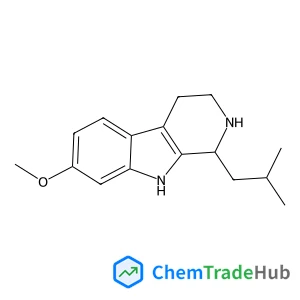
1-Isobutyl-7-methoxy-2,3,4,9-tetrahydro-1H-beta-carboline
CAS Number:
175975-76-5
Molecular Formula:
C16H22N2O
Sankar Bhattacharya, Akkihebbal K. Suresh
Research pertaining to carbon dioxide sequestration via mineral carbonation has gained significant attention, primarily due to the stability of sequestered CO2 over geological time scales. The use of industry-derived alkaline wastes as feedstocks for mineral carbonation also provides an opportunity for waste valorisation. In this review, we describe the carbonation of steel slag, a calcium-rich solid waste from iron and steel industries, whose current utilisation is below par in major crude steel-producing countries. We review ex situ mineral carbonation routes, both direct and indirect, which produce weathered aggregates suitable for the construction industry and value-added chemicals such as precipitated calcium carbonate, respectively. We present an in-depth analysis of slag characteristics and its implications for dissolution and carbonation mechanisms. Current research efforts are focused on overcoming slow carbonation kinetics under atmospheric conditions. However, a good understanding of the rate limiting step and the role of product layers in reaction kinetics is incomplete and evolving. In this review, we summarize the experimental research efforts in understanding the rate limiting step and enhancement strategies for various process routes proposed in the literature. Steel slags are chemically heterogeneous residues and pose significant challenges in modelling the dissolution kinetics. To determine the controlling mechanism using models, it is necessary to model the competitive behaviour of ions during dissolution and precipitation, temporal evolution of the reactive surface area, and coupling of the surface reaction and mass transport at the fluid–solid interface. We present mathematical models that describe the surface reaction, role of polydispersity and heterogeneous morphology in determining reactive surface area evolution, and briefly inform the readers about the non-equilibrium thermodynamics approach for modelling coupled processes. Finally, the current state-of-art in reactor technologies and a step forward for commercialisation are commented on.

Russian Chemical Reviews

Organic Preparations and Procedures International

Proceedings of the National Academy of Sciences of the United States of America

Journal of Heterocyclic Chemistry

Pure and Applied Chemistry

Pharmacological Reviews

Journal of Medicinal Chemistry

Kinetics and Catalysis

Nature

Planta Medica
Eugenius Butkus, Julė Malinauskienė, Sigitas Stončius
DOI: 10.1039/B208422H
Ismail Althagafi, Ranjay Shaw, Rahul Panwar, Shally, Chanda Sinha, Amit Kumar, Yong-Tang Zheng, Ramendra Pratap
DOI: 10.1039/C8OB01733F
Susan E. Hagen, Kun Liu, Yafei Jin, Lolita Piersimoni, Hollis D. Showalter
DOI: 10.1039/C8OB00329G
Masayuki Fujinaga, Katsushi Kumata, Yiding Zhang, Akiko Hatori, Tomoteru Yamasaki, Wakana Mori, Lin Xie, Ming-Rong Zhang
DOI: 10.1039/C8OB01700J
Ziling Ma, Yuanhua Wang
DOI: 10.1039/C8OB01997E
Gennaro Pescitelli, Nina Berova, Tom L. Xiao, Roman V. Rozhkov, Richard C. Larock, Daniel W. Armstrong
DOI: 10.1039/B207652G
Ji Liu, Qing-Yun Liu, Xing-Xiao Fang, Gong-Qing Liu, Yong Ling
DOI: 10.1039/C8OB02161A
Bastian Mechsner
DOI: 10.1039/C8OB02113A
Jennifer Frommer, Beatrice Karg, Klaus Weisz, Sabine Müller
DOI: 10.1039/C8OB02246A
N-(4-Methoxybenzyl)-2-pyridinamine (CAS: 52818-63-0) is increasingly being used ...
When handling Ethyl 4-(2-chlorophenyl)-1,3-thiazole-2-carboxylate, appropriate p...
Diethyldiselane (CAS: 628-39-7) is classified under the Globally Harmonized Syst...
The market for oxocopper (CAS: 12053-18-8) is primarily driven by its use in cat...
The market for 5-{[(2-Methyl-2-propanyl)oxy]carbonyl}-5-azaspiro[2.4]heptane-7-c...
2-(1-Pyrrolidinyl)-4-pyridinamine is a chemical compound with the CAS number 359...
2-(3-Pyridinyl)-1-azabicyclo[2.2.2]octane (CAS: 91556-75-1) is a crystalline sol...
(S)-Alpha-allyl-proline hydrochloride is usually synthesized via a Wittig reacti...
3-Methyl-1,2-oxazole-5-carboxylic acid (CAS: 4857-42-5) is an organic compound w...
Lys-SMCC-DM1 is synthesized via a multi-step process involving the coupling of S...

Reaction Chemistry & Engineering is an interdisciplinary journal reporting cutting-edge research focused on enhancing the understanding and efficiency of reactions. Reaction engineering leverages the interface where fundamental molecular chemistry meets chemical engineering and technology. Challenges in chemistry can be overcome by the application of new technologies, while engineers may find improved solutions for process development from the latest developments in reaction chemistry. Reaction Chemistry & Engineering is a unique forum for researchers whose interests span the broad areas of chemical engineering and chemical sciences to come together in solving problems of importance to wider society. All papers should be written to be approachable by readers across the engineering and chemical sciences. Papers that consider multiple scales, from the laboratory up to and including plant scale, are particularly encouraged.
![1-oxaspiro[4.4]nonan-6-one structure](https://static.chemtradehub.com/structs/134/134179-01-4-e051.webp "1-oxaspiro[4.4]nonan-6-one structure")
![1-{3-[4-Amino-3-(4-phenoxyphenyl)-1H-pyrazolo[3,4-d]pyrimidin-1-yl]-1-piperidinyl}-2,3-dihydroxy-1-propanone structure](https://static.chemtradehub.com/structs/122/1226872-27-0-e037.webp "1-{3-[4-Amino-3-(4-phenoxyphenyl)-1H-pyrazolo[3,4-d]pyrimidin-1-yl]-1-piperidinyl}-2,3-dihydroxy-1-propanone structure")







