












Precision synthesis of a fluorene-thiophene alternating copolymer by means of the Suzuki–Miyaura catalyst-transfer condensation polymerization: the importance of the position of an alkyl substituent on thiophene of the biaryl monomer to suppress disproportionation
Literature Information
Publication Date
2021-11-19
DOI
10.1039/D1PY01184G
Impact Factor
5.582
Authors
Yu Tokita, Masaru Katoh, Kentaro Kosaka, Yoshihiro Ohta, Tsutomu Yokozawa
View Original
Abstract
The Suzuki–Miyaura catalyst-transfer condensation polymerization (CTCP) of fluorene-thiophene biaryl monomers was investigated for the synthesis of well-defined poly(fluorene-alt-thiophene). Model reactions of α,ω-dibromo(fluorene-thiophene) with arylboronic acid esters showed that t-Bu3PPd and di-tert-butyl(4-dimethylaminophenyl)phosphine (AmPhos) Pd catalysts undergo intramolecular catalyst transfer from fluorene to thiophene, irrespective of the use of phenyl- or thiopheneboronate. Based on the results of the model reactions, PinB-fluorene-thiophene-Br (PinB = pinacol boronate) monomers were synthesized. The polymerization of the monomer containing the 3-octyl-5-bromothiophene-2-yl unit was accompanied by disproportionation, whereas the polymerization of the monomer containing the 4-octyl-5-bromothiophene-2-yl unit with an AmPhos Pd initiator proceeded according to the CTCP mechanism: the Mn values of the obtained polymers increased in proportion to monomer conversion and to the feed ratio of the monomer to initiator. Moreover, successive CTCP using the fluorene-thiophene monomer, dioctylfluorene monomer, and 3-hexylthiophene monomer with the AmPhos Pd initiator yielded a variety of all-conjugated di- and triblock copolymers.
Related Literature
Free volume in ionic liquids: a connection of experimentally accessible observables from PALS and PVT experiments with the molecular structure from XRD data‡
Yang Yu, Günter Dlubek, Reinhard Krause-Rehberg, Jürgen Pionteck, Dirk Pfefferkorn, Safak Bulut, Dana Bejan, Christian Friedrich
2013-04-10
Paper
DOI: 10.1039/C3CP43306D
Faceting preferences for AuN and PdN nanoclusters with high-symmetry motifs
Z. Y. Li, Roy L. Johnston
2013-04-15
Paper
DOI: 10.1039/C3CP50978H
Elucidation of structure and nature of the PdO–Pd transformation using in situ PDF and XAS techniques
Jonathan Keating, Gopinathan Sankar, Timothy I. Hyde, Shinji Kohara, Koji Ohara
2013-04-26
Paper
DOI: 10.1039/C3CP50600B
C60fullerene aggregation in aqueous solution
Yuriy I. Prylutskyy, Anatoly S. Buchelnikov, Dmitry P. Voronin, Viktor V. Kostjukov, Uwe Ritter, John A. Parkinson, Maxim P. Evstigneev
2013-04-16
Paper
DOI: 10.1039/C3CP50187F
Single-layered V2O5 a promising cathode material for rechargeable Li and Mg ion batteries: an ab initio study
Zhiguo Wang, Qiulei Su, Huiqiu Deng
2013-04-12
Communication
DOI: 10.1039/C3CP51167G
Mapping spatially inhomogeneous electrochemical reactions in battery electrodes using high energy X-rays
Olaf J. Borkiewicz, Karena W. Chapman, Peter J. Chupas
2013-04-16
Communication
DOI: 10.1039/C3CP50590A
Chemically modified ribbon edge stimulated H2 dissociation: a first-principles computational study
Ting Liao, Ziqi Sun, Aijun Du, Sean Smith
2013-04-12
Communication
DOI: 10.1039/C3CP50654A
Morphology-controlled preparation and enhanced simulated sunlight and visible-light photocatalytic activity of Pt/Bi5Nb3O15 heterostructures
Ling Chen, Wan Guo, Yuxin Yang, Ang Zhang, Shengqu Zhang, Yihang Guo, Yingna Guo
2013-03-25
Paper
DOI: 10.1039/C3CP00084B
Strain-induced Dirac cone-like electronic structures and semiconductor–semimetal transition in graphdiyne
Hui-Juan Cui, Xian-Lei Sheng, Qing-Bo Yan, Qing-Rong Zheng, Gang Su
2013-03-22
Paper
DOI: 10.1039/C3CP44457K
You might also like
Compound Q&A
How should waste containing (6-Bromo-2-naphthyl)oxy](dimethyl)(2-methyl-2-propanyl)silane be handled?
Waste containing (6-Bromo-2-naphthyl)oxy](dimethyl)(2-methyl-2-propanyl)silane (...
100751-65-3[(6-Bromo-2-naphthyl...
Compound Q&A
How is 7-Fluoro-4-isoquinolinecarboxylic acid (CAS: 1841081-40-0) typically synthesized?
7-Fluoro-4-isoquinolinecarboxylic acid can be synthesized via a multi-step proce...
1841081-40-07-Fluoro-4-isoquinol...
Compound Q&A
What are the physical and chemical properties of 2,3,5,6-Tetrabromothieno[3,2-b]thiophene (CAS: 124638-53-5)?
2,3,5,6-Tetrabromothieno[3,2-b]thiophene is a crystalline compound with a high m...
124638-53-52,3,5,6-Tetrabromoth...
Compound Q&A
Is 1-[4-(Benzylamino)-7,8-dihydro-5H-pyrano[4,3-d]pyrimidin-2-yl]-2-methyl-1H-indole-4-carboxamide (CAS: 1542705-92-9) safe?
1-[4-(Benzylamino)-7,8-dihydro-5H-pyrano[4,3-d]pyrimidin-2-yl]-2-methyl-1H-indol...
1542705-92-91-[4-(Benzylamino)-7...
Compound Q&A
What is the market or research trend for imidazo[5,1-d]-1,2,3,5-tetrazine-8-carboxylic acid, 3,4-dihydro-3-methyl-4-oxo- (CAS: 113942-30-6)?
The market for imidazo[5,1-d]-1,2,3,5-tetrazine-8-carboxylic acid, 3,4-dihydro-3...
113942-30-6Imidazo[5,1-d]-1,2,3...
Compound Q&A
What is 3-(Triisopropylsilyl)propiolaldehyde (CAS: 163271-80-5)?
3-(Triisopropylsilyl)propiolaldehyde is a synthetic organic compound with the CA...
163271-80-53-(Triisopropylsilyl...
Compound Q&A
What regulatory guidelines apply to 6-Nitro-2H-1,4-benzoxazin-3(4H)-one (CAS: 81721-87-1)?
6-Nitro-2H-1,4-benzoxazin-3(4H)-one (CAS: 81721-87-1) is subject to various regu...
81721-87-16-Nitro-2H-1,4-benzo...
Compound Q&A
How should waste containing (3-Fluorophenyl)(4-{[(2-methyl-2-propanyl)oxy]carbonyl}-1-piperazinyl)acetic acid (CAS: 885272-91-3) be handled?
Waste containing (3-Fluorophenyl)(4-{[(2-methyl-2-propanyl)oxy]carbonyl}-1-piper...
885272-91-3(3-Fluorophenyl)(4-{...
Compound Q&A
What are the physical and chemical properties of N,N'-4,4'-Biphenyldiyldiisonicotinamide (CAS: 55119-40-9)?
N,N'-4,4'-Biphenyldiyldiisonicotinamide is a white crystalline solid with a mole...
55119-40-9N,N'-4,4'-Biphenyldi...
Compound Q&A
What industries use 6-Bromo-8-fluoro-2-quinazolinol (CAS: 1036756-15-6)?
6-Bromo-8-fluoro-2-quinazolinol is primarily used in the pharmaceutical industry...
1036756-15-66-Bromo-8-fluoro-2-q...
Source Journal
Polymer Chemistry

CiteScore:
8.6
Self-citation Rate:
7.3%
Articles per Year:
457
Polymer Chemistry welcomes submissions in all areas of polymer science that have a strong focus on macromolecular chemistry. Manuscripts may cover a broad range of fields, yet no direct application focus is required.
Recommended Compounds
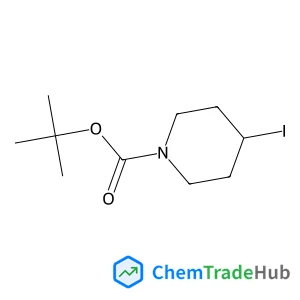
2-Methyl-2-propanyl 4-iodo-1-piperidinecarboxylate
CAS Number:
301673-14-3
Molecular Formula:
C10H18INO2
Recommended Suppliers





Disclaimer
This page provides academic journal information for reference and research purposes only. We are not affiliated with any journal publishers and do not handle publication submissions. For publication-related inquiries, please contact the respective journal publishers directly.
If you notice any inaccuracies in the information displayed, please contact us at support@chemtradehub.com. We will promptly review and address your concerns.