












![1-[6-(1H-Imidazol-1-yl)-3-pyridinyl]methanamine structure](https://static.chemtradehub.com/structs/914/914637-08-4-8825.webp "1-[6-(1H-Imidazol-1-yl)-3-pyridinyl]methanamine structure")
Recent developments in stimuli-responsive luminescent polymers composed of boron compounds
Literature Information
Publication Date
2021-10-01
DOI
10.1039/D1PY01170G
Impact Factor
5.582
Authors
Shunichiro Ito, Masayuki Gon, Kazuo Tanaka, Yoshiki Chujo
View Original
Abstract
Stimuli-responsive luminescent materials have received much attention as next-generation smart materials for various applications, including their use as biomedical probes, for the visualization of pollutants and sensing toxic gases. Boron-containing luminophores have been widely utilized to achieve such sensing materials because of their vacant 2pz orbital, which is responsible for their Lewis acidity, electron-accepting properties, and ability to form complexes. In addition, polymeric structures often enhance stimuli-responsivity because slight environmental changes around the molecules can dramatically affect their molecular motions, shapes and physical properties. This review describes the development of stimuli-responsive materials using various kinds of luminescent boron compounds, focusing on the mechanisms of the sensing abilities and the molecular designs.
Related Literature
Desktop NMR for structure elucidation and identification of strychnine adulteration
Kawarpal Singh, Bernhard Blümich
2017-03-15
Paper
DOI: 10.1039/C7AN00020K
Optimal voltage for nanoparticle detection with thin nanopores
2018-08-16
Paper
DOI: 10.1039/C8AN01270A
Pushing the frontiers: boron-11 NMR as a method for quantitative boron analysis and its application to determine boric acid in commercial biocides
Luis Manuel Aguilera-Sáez, José Raúl Belmonte-Sánchez, Roberto Romero-González, José Luis Martínez Vidal, Francisco Javier Arrebola, Antonia Garrido Frenich, Ignacio Fernández
2018-09-05
Paper
DOI: 10.1039/C8AN00505B
Determination of the transfer function of an atmospheric pressure drift tube ion mobility spectrometer for nanoparticle measurements
David T. Buckley, Christopher J. Hogan, Jr.
2017-04-25
Paper
DOI: 10.1039/C7AN00328E
A dual chemosensor for Cu2+ and Hg2+ based on a rhodamine-terminated water-soluble polymer in 100% aqueous solution
Guang Li, Liping Bai, Farong Tao, Aixia Deng, Liping Wang
2018-09-17
Paper
DOI: 10.1039/C8AN01130C
Digital enzyme assay using attoliter droplet array
Takao Ono, Takanori Ichiki
2018-09-17
Paper
DOI: 10.1039/C8AN01152D
A novel paper-based colorimetry device for the determination of the albumin to creatinine ratio
Sudkate Chaiyo, Kurt Kalcher, Amara Apilux, Orawon Chailapakul, Weena Siangproh
2018-10-09
Paper
DOI: 10.1039/C8AN01122B
The effect of common anticoagulants in detection and quantification of malaria parasitemia in human red blood cells by ATR-FTIR spectroscopy
Miguela Martin, David Perez-Guaita, Dean W. Andrew, Bayden R. Wood
2016-11-28
Paper
DOI: 10.1039/C6AN02075E
Infrared imaging of high density protein arrays
Joëlle De Meutter, Julie Vandenameele, André Matagne, Erik Goormaghtigh
2016-11-28
Paper
DOI: 10.1039/C6AN02048H
Benzimidazole-containing aramid nanofiber for naked-eye detection of heavy metal ions
Zheng Cheng, Zhenyuan Bai, Yu Dai, Longbo Luo, Xiangyang Liu
2018-09-18
Paper
DOI: 10.1039/C8AN01484A
You might also like
Compound Q&A
What is the market or research trend for N-(4-Methoxybenzyl)-2-pyridinamine (CAS: 52818-63-0)?
N-(4-Methoxybenzyl)-2-pyridinamine (CAS: 52818-63-0) is increasingly being used ...
52818-63-0N-(4-Methoxybenzyl)-...
Compound Q&A
What precautions should be taken when handling Ethyl 4-(2-chlorophenyl)-1,3-thiazole-2-carboxylate (CAS: 1050507-06-6)?
When handling Ethyl 4-(2-chlorophenyl)-1,3-thiazole-2-carboxylate, appropriate p...
1050507-06-6Ethyl 4-(2-chlorophe...
Compound Q&A
What regulatory guidelines apply to diethyldiselane (CAS: 628-39-7)?
Diethyldiselane (CAS: 628-39-7) is classified under the Globally Harmonized Syst...
628-39-7Diethyldiselane
Compound Q&A
What is the market or research trend for oxocopper (CAS: 12053-18-8)?
The market for oxocopper (CAS: 12053-18-8) is primarily driven by its use in cat...
12053-18-8oxocopper; oxo-(oxoc...
Compound Q&A
What is the market or research trend for 5-{[(2-Methyl-2-propanyl)oxy]carbonyl}-5-azaspiro[2.4]heptane-7-carboxylic acid?
The market for 5-{[(2-Methyl-2-propanyl)oxy]carbonyl}-5-azaspiro[2.4]heptane-7-c...
1268519-54-55-{[(2-Methyl-2-prop...
Compound Q&A
What is 2-(1-Pyrrolidinyl)-4-pyridinamine (CAS: 35981-63-6)?
2-(1-Pyrrolidinyl)-4-pyridinamine is a chemical compound with the CAS number 359...
35981-63-62-(1-Pyrrolidinyl)-4...
Compound Q&A
What are the physical and chemical properties of 2-(3-Pyridinyl)-1-azabicyclo[2.2.2]octane (CAS: 91556-75-1)?
2-(3-Pyridinyl)-1-azabicyclo[2.2.2]octane (CAS: 91556-75-1) is a crystalline sol...
91556-75-12-(3-Pyridinyl)-1-az...
Compound Q&A
How is (S)-Alpha-allyl-proline hydrochloride (CAS: 129704-91-2) typically synthesized?
(S)-Alpha-allyl-proline hydrochloride is usually synthesized via a Wittig reacti...
129704-91-2(S)-Alpha-allyl-prol...
Compound Q&A
What is 3-Methyl-1,2-oxazole-5-carboxylic acid (CAS: 4857-42-5)?
3-Methyl-1,2-oxazole-5-carboxylic acid (CAS: 4857-42-5) is an organic compound w...
4857-42-53-Methyl-1,2-oxazole...
Compound Q&A
How is Lys-SMCC-DM1 (CAS: 1281816-04-3) typically synthesized?
Lys-SMCC-DM1 is synthesized via a multi-step process involving the coupling of S...
1281816-04-3Lys-SMCC-DM1
Source Journal
Polymer Chemistry

CiteScore:
8.6
Self-citation Rate:
7.3%
Articles per Year:
457
Polymer Chemistry welcomes submissions in all areas of polymer science that have a strong focus on macromolecular chemistry. Manuscripts may cover a broad range of fields, yet no direct application focus is required.
Recommended Compounds
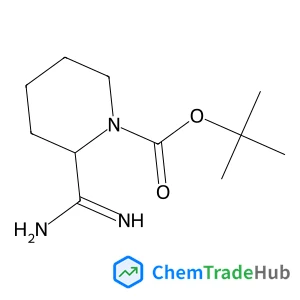
2-Methyl-2-propanyl 2-carbamimidoyl-1-piperidinecarboxylate
CAS Number:
1258640-98-0
Molecular Formula:
C11H21N3O2
Recommended Suppliers






Disclaimer
This page provides academic journal information for reference and research purposes only. We are not affiliated with any journal publishers and do not handle publication submissions. For publication-related inquiries, please contact the respective journal publishers directly.
If you notice any inaccuracies in the information displayed, please contact us at support@chemtradehub.com. We will promptly review and address your concerns.