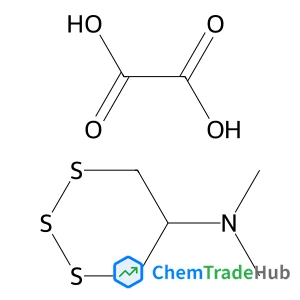
Oxalic acid compound with cyclohexylsulfamothioic O-acid (11)
CAS Number:
31895-22-4
Molecular Formula:
C7H13NO4S3
Yidan Cheng, Takeshi Wakiya, Shinsuke Inagi, Toshikazu Takata, Ikuyoshi Tomita
The spontaneous formation, via living coordination block copolymerization, of polymeric nanostructures that possess outer fluorous segments and their application as transparent superhydrophobic coatings are described. The block copolymers (BCPs) consisting of both fluorous and hydrophobic segments were prepared via the π-allylnickel-catalyzed living coordination block copolymerization of a fluoroalkyl-substituted allene, 1-(1H,1H,2H,2H-heptadecafluorodecyoxy)-2,3-butadiene, and a hydrophobic allene, phenoxyallene, in a selective fluorous solvent, 1,1,1,2,2,3,4,5,5,5-decafluoro-3-methoxy-4-(trifluoromethyl)pentane, via a polymerization-induced self-assembly (PISA) process. It was found that nanostructured materials were produced during the block copolymerization whose morphologies changed from spherical micelles to network micelles by reducing the length of the fluoroalkyl-containing (i.e., the solvophilic) segments. An optically transparent superhydrophobic surface with a static contact angle for a water droplet over 150° and a sliding angle below 5° was effectively obtained simply by dip-coating a glass substrate into the suspension of the resulting nanostructured block copolymers under appropriate conditions.
Senbo Xiao, Shijun Xiao
DOI: 10.1039/C3CP00067B
Z. Y. Li, Roy L. Johnston
DOI: 10.1039/C3CP50978H
Hui-Juan Cui, Xian-Lei Sheng, Qing-Bo Yan, Qing-Rong Zheng, Gang Su
DOI: 10.1039/C3CP44457K
Chunhui Li, Lei Yang, Junyan Xiao, Yih-Chyng Wu, Martin Søndergaard, Yanhong Luo, Dongmei Li, Qingbo Meng, Bo Brummerstedt Iversen
DOI: 10.1039/C3CP50365H
Piotr Bernatowicz
DOI: 10.1039/C3CP50963J
Johan Gustafson, Marco Di Michiel, Mark A. Newton
DOI: 10.1039/C3CP44289F
Choong-Shik Yoo
DOI: 10.1039/C3CP50761K
Andrzej Lewandowski, Pawel Jakobczyk, Maciej Galinski, Marcin Biegun
DOI: 10.1039/C3CP44612C
Alexander J. Cowan, Wenhua Leng, Piers R. F. Barnes, David R. Klug, James R. Durrant
DOI: 10.1039/C3CP50318F
Waste containing (6-Bromo-2-naphthyl)oxy](dimethyl)(2-methyl-2-propanyl)silane (...
7-Fluoro-4-isoquinolinecarboxylic acid can be synthesized via a multi-step proce...
2,3,5,6-Tetrabromothieno[3,2-b]thiophene is a crystalline compound with a high m...
1-[4-(Benzylamino)-7,8-dihydro-5H-pyrano[4,3-d]pyrimidin-2-yl]-2-methyl-1H-indol...
The market for imidazo[5,1-d]-1,2,3,5-tetrazine-8-carboxylic acid, 3,4-dihydro-3...
3-(Triisopropylsilyl)propiolaldehyde is a synthetic organic compound with the CA...
6-Nitro-2H-1,4-benzoxazin-3(4H)-one (CAS: 81721-87-1) is subject to various regu...
Waste containing (3-Fluorophenyl)(4-{[(2-methyl-2-propanyl)oxy]carbonyl}-1-piper...
N,N'-4,4'-Biphenyldiyldiisonicotinamide is a white crystalline solid with a mole...
6-Bromo-8-fluoro-2-quinazolinol is primarily used in the pharmaceutical industry...

Polymer Chemistry welcomes submissions in all areas of polymer science that have a strong focus on macromolecular chemistry. Manuscripts may cover a broad range of fields, yet no direct application focus is required.
![2,9-Dichloro-5,12-dihydroquinolino[2,3-b]acridine-7,14-dione structure](https://static.chemtradehub.com/structs/308/3089-17-6-750b.webp "2,9-Dichloro-5,12-dihydroquinolino[2,3-b]acridine-7,14-dione structure")
![5-Bromoimidazo[1,2-a]pyridine structure](https://static.chemtradehub.com/structs/692/69214-09-1-d8e2.webp "5-Bromoimidazo[1,2-a]pyridine structure")