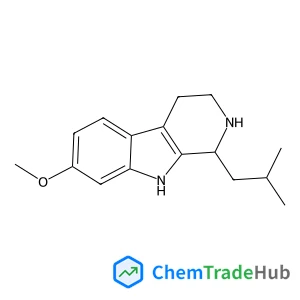
1-Isobutyl-7-methoxy-2,3,4,9-tetrahydro-1H-beta-carboline
CAS Number:
175975-76-5
Molecular Formula:
C16H22N2O
Maximilian Felix Toni Meier, Franck Thetiot, Narsimhulu Pittala, Ingo Lieberwirth, Cleiton Kunzler, Smail Triki, Ulrich Jonas
We have designed novel macromolecular coordination ligands (MCLs) by conjugation of thermoresponsive polymers based on poly(N-isopropylacrylamide) (n around 3 to 25 kg mol−1) with 1,2,4-triazole coordination sites. These triazole units were integrated into two fundamentally different MCL architectures via reversible addition–fragmentation chain transfer polymerization following two synthetic strategies: (I) The customized chain transfer agent 1-{[3-(4H-1,2,4-triazol-4-yl)propyl]amino}-2-methyl-1-oxopropan-2-yl dodecyl carbonotrithioate (DMP-APTRZ) was employed for hemi-telechelic MCLs with a single triazole end group. (II) A tailored comonomer N-[3-(4H-1,2,4-triazol-4-yl)propyl]methacrylamide (APTRZMAAm) provides access to multidentate MCLs with a controllable number of triazole side groups along the polymer backbone. The thermally controlled variation of the MCL volume demand in aqueous solution was exploited for reversible aggregate formation upon Fe2+ complexation. Thermal response was studied via UV/Vis turbidity measurements, aggregate dimensions were determined via DLS, while the aggregate morphology was analyzed via customized TEM.
Lin Ma, Mengyue Zhang, Aijun Yang, Qin Wang, Fei Qu, Fengli Qu, Rong-Mei Kong
DOI: 10.1039/C8AN01556B
Jay G. Tarolli, Benjamin E. Naes, Lamar Butler, Keeyahna Foster, Caleb M. Gumbs, Andrea L. Howard, David Willingham
DOI: 10.1039/C7AN00175D
Joëlle De Meutter, Julie Vandenameele, André Matagne, Erik Goormaghtigh
DOI: 10.1039/C6AN02048H
G. R. Lloyd, J. Nallala, M. Isabelle, L. M. Almond, N. A. Shepherd, C. A. Kendall, A. C. Shore, N. Stone
DOI: 10.1039/C6AN01871H
Zanying Peng, Jin Lu, Ling Zhang, Yang Liu, Jinghong Li
DOI: 10.1039/C8AN01534A
Daojin Li, Zijun Bie, Fangfang Wang, Enhui Guo
DOI: 10.1039/C8AN01044G
Guolan Tian, Lan Chen, Renxiao Liu, Guanglu Ge
DOI: 10.1039/C8AN01068D
N-(4-Methoxybenzyl)-2-pyridinamine (CAS: 52818-63-0) is increasingly being used ...
When handling Ethyl 4-(2-chlorophenyl)-1,3-thiazole-2-carboxylate, appropriate p...
Diethyldiselane (CAS: 628-39-7) is classified under the Globally Harmonized Syst...
The market for oxocopper (CAS: 12053-18-8) is primarily driven by its use in cat...
The market for 5-{[(2-Methyl-2-propanyl)oxy]carbonyl}-5-azaspiro[2.4]heptane-7-c...
2-(1-Pyrrolidinyl)-4-pyridinamine is a chemical compound with the CAS number 359...
2-(3-Pyridinyl)-1-azabicyclo[2.2.2]octane (CAS: 91556-75-1) is a crystalline sol...
(S)-Alpha-allyl-proline hydrochloride is usually synthesized via a Wittig reacti...
3-Methyl-1,2-oxazole-5-carboxylic acid (CAS: 4857-42-5) is an organic compound w...
Lys-SMCC-DM1 is synthesized via a multi-step process involving the coupling of S...

Polymer Chemistry welcomes submissions in all areas of polymer science that have a strong focus on macromolecular chemistry. Manuscripts may cover a broad range of fields, yet no direct application focus is required.