













Hybrid aptamer-molecularly imprinted polymer (AptaMIP) nanoparticles selective for the antibiotic moxifloxacin
Literature Information
Publication Date
2021-07-13
DOI
10.1039/D1PY00607J
Impact Factor
5.582
Authors
Mark V. Sullivan, David Bunka, Arron Tolley, Paula M. Mendes, James H. R. Tucker, Nicholas W. Turner
View Original
Abstract
Modified thymine bases, each containing a polymerizable group (either carboxymethylvinyl or acrylamide) at the 5-position, have been incorporated multiple times into an aptamer sequence allowing the sequence to act as the key recognition element in an aptamer-molecularly imprinted polymer (MIP) hybrid nanoparticle (aptaMIP NP) system for the molecular recognition of the antibiotic moxifloxacin. These materials combine the recognition properties of an aptamer, with the robustness and stability of a MIP, offering a “best-of-both-worlds” approach. Both aptaMIP nanoparticles offer 10-fold superior binding affinity and selectivity over conventional MIP nanoparticles (nanoMIPs), with KD values of 3.65 × ±0.9 nM, 5.72 ± 0.6 nM and 48.60 ± 7.0 nM for the carboxy aptaMIP, acrylamide aptaMIP and nanoMIP, respectively; and 100-fold superior affinity compared to the unfunctionalized aptamer only (0.325 ± 0.16 μM), all with excellent selectivity for the template antibiotic. When applied to a sensor platform (Surface Plasmon Resonance), the limit of detection based on the aptaMIP nanoparticles was approximately three-fold lower (0.51 nM and 0.56 nM for the carboxy aptaMIP and acrylamide aptaMIP, respectively) compared to the nanoMIP (1.4 nM). The introduction of the aptamer as a “macro-monomer” into the imprinted polymer scaffold is a promising strategy for significantly improving the properties of both components of the hybrid material (aptamer and MIP). These hybrid polymers, bearing nucleic acid recognition materials offer a powerful tool for robust high affinity selective molecular recognition.
Recommended Journals
Related Literature
Polarity governed selective amplification of through plane proton shuttling in proton exchange membrane fuel cells
Manu Gautam, Mruthyunjayachari Chattanahalli Devendrachari, Ravikumar Thimmappa, Alagar Raja Kottaichamy, Shahid Pottachola Shafi, Pramod Gaikwad, Harish Makri Nimbegondi Kotresh, Musthafa Ottakam Thotiyl
2017-02-20
Paper
DOI: 10.1039/C6CP07724B
Structural, optical and phonon properties of formate-based MOF phosphors with ethylammonium cations
M. Ptak, K. Pasińska, P. Głuchowski, A. Łukowiak, A. Ciupa
2017-08-14
Paper
DOI: 10.1039/C7CP04005A
In- and Ga-based inorganic double perovskites with direct bandgaps for photovoltaic applications
Jun Dai, Liang Ma, Minggang Ju, Jinsong Huang
2017-07-18
Paper
DOI: 10.1039/C7CP03448B
Approaching complexity of alkyl hydrogenation on Pd via density-functional modelling
Sergey M. Kozlov, Georgi N. Vayssilov
2017-07-18
Paper
DOI: 10.1039/C7CP03516K
Two-photon absorption in a series of 2,6-disubstituted BODIPY dyes
Leonardo W. T. Barros, Thiago A. S. Cardoso, Angela Bihlmeier, Dominik K. Kölmel, Carlos H. Brito Cruz, Lazaro A. Padilha
2017-07-20
Paper
DOI: 10.1039/C6CP07849D
Compositional phase diagram and microscopic mechanism of Ba1−xCaxZryTi1−yO3 relaxor ferroelectrics
Shi-Yu Liu, Yang Meng, Shiyang Liu, De-Jun Li, Yaping Li, Yingdi Liu, Yaogen Shen, Sanwu Wang
2017-07-27
Paper
DOI: 10.1039/C7CP04530A
A high-resolution natural abundance 33S MAS NMR study of the cementitious mineral ettringite
Akiko Sasaki, Luis Baquerizo Ibarra, Stephen Wimperis
2017-08-22
Paper
DOI: 10.1039/C7CP04435F
Accurate prediction of energetic properties of ionic liquid clusters using a fragment-based quantum mechanical method
Jinfeng Liu
2017-07-12
Paper
DOI: 10.1039/C7CP03356G
Cyclodextrin-assisted modulation of the photophysical properties and acidity constant of pyrene-armed calix[4]arene
V. S. Kalyani, D. D. Malkhede
2017-07-25
Paper
DOI: 10.1039/C7CP01894K
The excited-state decay mechanism of 2,4-dithiothymine in the gas phase, microsolvated surroundings, and aqueous solution
Bin-Bin Xie, Qian Wang, Wei-Wei Guo, Ganglong Cui
2017-02-16
Paper
DOI: 10.1039/C7CP00478H
You might also like
Compound Q&A
What are the main uses of 4-Nitrophenyl phosphate disodium salt hexahydrate (CAS: 333338-18-4)?
4-Nitrophenyl phosphate disodium salt hexahydrate is primarily used as a substra...
333338-18-44-Nitrophenyl phosph...
Compound Q&A
What are the main uses of 2-(Trifluoromethyl)-1,3-oxazole-4-carboxylic Acid (CAS: 1060816-01-4)?
2-(Trifluoromethyl)-1,3-oxazole-4-carboxylic Acid (CAS: 1060816-01-4) is widely ...
1060816-01-42-(Trifluoromethyl)-...
Compound Q&A
How should 2-Fluoro-4-biphenylcarboxylic acid (CAS: 137045-30-8) be stored?
2-Fluoro-4-biphenylcarboxylic acid should be stored in a cool, dry place at room...
137045-30-82-Fluoro-4-biphenylc...
Compound Q&A
What industries use Prednisolone-21-Carboxylic Acid (CAS: 61549-70-0)?
Prednisolone-21-Carboxylic Acid is primarily used in the pharmaceutical industry...
61549-70-0Prednisolone-21-Carb...
Compound Q&A
How should 4-(Hydrazinomethyl)-1,2,3-benzenetriol (CAS: 3614-72-0) be stored?
4-(Hydrazinomethyl)-1,2,3-benzenetriol (CAS: 3614-72-0) should be stored in a co...
3614-72-04-(Hydrazinomethyl)-...
Compound Q&A
What industries use 4-Amino-1-methyl-1H-pyrazole-5-carboxylic acid hydrochloride (CAS: 92534-70-8)?
4-Amino-1-methyl-1H-pyrazole-5-carboxylic acid hydrochloride (CAS: 92534-70-8) i...
92534-70-84-Amino-1-methyl-1H-...
Compound Q&A
What regulatory guidelines apply to dehydropachymic acid (CAS: 77012-31-8)?
Dehydropachymic acid (CAS: 77012-31-8) is regulated by various agencies. It fall...
77012-31-8Dehydropachymic acid
Compound Q&A
What is the market or research trend for 6-[(2,2-Dimethylpropanoyl)amino]nicotinic acid (CAS: 898561-66-5)?
The market and research trends for 6-[(2,2-Dimethylpropanoyl)amino]nicotinic aci...
898561-66-56-[(2,2-Dimethylprop...
Compound Q&A
How should 1,10-Phenanthroline-2,9-dicarbaldehyde (CAS: 57709-62-3) be stored?
1,10-Phenanthroline-2,9-dicarbaldehyde should be stored in a cool, dry place awa...
57709-62-31,10-Phenanthroline-...
Compound Q&A
How is 5-Carbamoyl-11-oxo-10,11-dihydro-5H-dibenzo[b,f]azepin-10-yl acetate (CAS: 113952-21-9) typically synthesized?
5-Carbamoyl-11-oxo-10,11-dihydro-5H-dibenzo[b,f]azepin-10-yl acetate can be synt...
113952-21-95-Carbamoyl-11-oxo-1...
Source Journal
Polymer Chemistry

CiteScore:
8.6
Self-citation Rate:
7.3%
Articles per Year:
457
Polymer Chemistry welcomes submissions in all areas of polymer science that have a strong focus on macromolecular chemistry. Manuscripts may cover a broad range of fields, yet no direct application focus is required.
Recommended Compounds
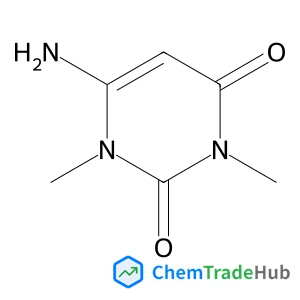
6-amino-1,3-dimethyl-1,2,3,4-tetrahydropyrimidine-2,4-dione
CAS Number:
6642-31-5
Molecular Formula:
C6H9N3O2
Recommended Suppliers






Disclaimer
This page provides academic journal information for reference and research purposes only. We are not affiliated with any journal publishers and do not handle publication submissions. For publication-related inquiries, please contact the respective journal publishers directly.
If you notice any inaccuracies in the information displayed, please contact us at support@chemtradehub.com. We will promptly review and address your concerns.