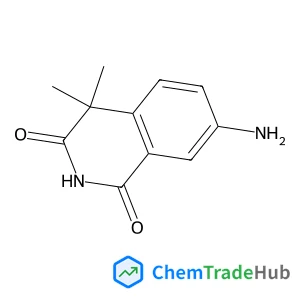
1,3(2H,4H)-Isoquinolinedione, 7-amino-4,4-dimethyl-
CAS Number:
14576-22-8
Molecular Formula:
C11H12N2O2
Leonardo W. T. Barros, Thiago A. S. Cardoso, Angela Bihlmeier, Dominik K. Kölmel, Carlos H. Brito Cruz, Lazaro A. Padilha
We report on the two-photon absorption spectra of a series of 2,6-disubstituted BODIPY dyes. Depending on the substituents, we observe increasing two-photon absorption cross sections with values up to 350 GM compared to 70 GM in the unsubstituted dye. Quantum chemical calculations are performed to assign the absorption bands and to understand the factors controlling the size of the two-photon absorption cross section. Both the maximum of the two-photon absorption band as well as the red-shift of the whole spectrum correlate with the ability of the substituents to extend the π-electron system of the dye. The above-mentioned intense two-photon absorption band corresponds to the absorption of photons with 1.3 eV, which is at the first near-infrared transparency window for biological tissues. The dyes could thus be suitable for bio-imaging applications.
Emily A. Hoff, Brooks A. Abel, Chase A. Tretbar, Charles L. McCormick, Derek L. Patton
DOI: 10.1039/C6PY01563H
Reem A. Alshumrani, Nikos Hadjichristidis
DOI: 10.1039/C7PY01079F
Ryoto Tanaka, Kodai Watanabe, Takuya Yamamoto, Kenji Tajima, Takuya Isono, Toshifumi Satoh
DOI: 10.1039/C7PY00646B
Liuyan Tang, Xiuli Chen, Lei Wang, Jinqing Qu
DOI: 10.1039/C7PY00739F
Hong Du, Xuxia Yao, Xiaodong Li, Zhiquan Shen
DOI: 10.1039/C6PY01346E
4-Nitrophenyl phosphate disodium salt hexahydrate is primarily used as a substra...
2-(Trifluoromethyl)-1,3-oxazole-4-carboxylic Acid (CAS: 1060816-01-4) is widely ...
2-Fluoro-4-biphenylcarboxylic acid should be stored in a cool, dry place at room...
Prednisolone-21-Carboxylic Acid is primarily used in the pharmaceutical industry...
4-(Hydrazinomethyl)-1,2,3-benzenetriol (CAS: 3614-72-0) should be stored in a co...
4-Amino-1-methyl-1H-pyrazole-5-carboxylic acid hydrochloride (CAS: 92534-70-8) i...
Dehydropachymic acid (CAS: 77012-31-8) is regulated by various agencies. It fall...
The market and research trends for 6-[(2,2-Dimethylpropanoyl)amino]nicotinic aci...
1,10-Phenanthroline-2,9-dicarbaldehyde should be stored in a cool, dry place awa...
5-Carbamoyl-11-oxo-10,11-dihydro-5H-dibenzo[b,f]azepin-10-yl acetate can be synt...

Physical Chemistry Chemical Physics (PCCP) is an international journal co-owned by 19 physical chemistry and physics societies from around the world. This journal publishes original, cutting-edge research in physical chemistry, chemical physics and biophysical chemistry. To be suitable for publication in PCCP, articles must include significant innovation and/or insight into physical chemistry; this is the most important criterion that reviewers and Editors will judge against when evaluating submissions. The journal has a broad scope and welcomes contributions spanning experiment, theory, computation and data science. Topical coverage includes spectroscopy, dynamics, kinetics, statistical mechanics, thermodynamics, electrochemistry, catalysis, surface science, quantum mechanics, quantum computing and machine learning. Interdisciplinary research areas such as polymers and soft matter, materials, nanoscience, energy, surfaces/interfaces, and biophysical chemistry are welcomed if they demonstrate significant innovation and/or insight into physical chemistry. Joined experimental/theoretical studies are particularly appreciated when complementary and based on up-to-date approaches.