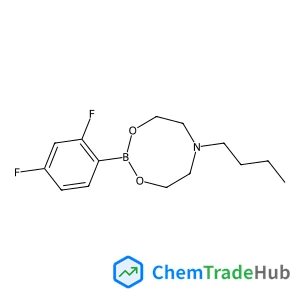
6-Butyl-2-(2,4-difluorophenyl)-1,3,6,2-dioxazaborocane
CAS Number:
1190988-98-7
Molecular Formula:
C14H20BF2NO2
Lewis D. Turner, Lucy Lin, Sabine Pellett, Takashi Sugane, Eric A. Johnson, Kim D. Janda
Botulinum neurotoxin A (BoNT/A) is categorized as a Tier 1 bioterrorism agent and persists within muscle neurons for months, causing paralysis. A readily available treatment that abrogates BoNT/A's toxicity and longevity is a necessity in the event of a widespread BoNT/A attack and for clinical treatment of botulism, yet remains an unmet need. Herein, we describe a comprehensive warhead screening campaign of bifunctional hydroxamate-based inhibitors for the irreversible inhibition of the BoNT/A light chain (LC). Using the 2,4-dichlorocinnamic hydroxamic acid (DCHA) metal-binding pharmacophore modified with a pendent warhead, a total of 37 compounds, possessing 13 distinct warhead types, were synthesized and evaluated for time-dependent inhibition against the BoNT/A LC. Iodoacetamides, maleimides, and an epoxide were found to exhibit time-dependent inhibition and their kGSH measured as a description of reactivity. The epoxide exhibited superior time-dependent inhibition over the iodoacetamides, despite reacting with glutathione (GSH) 51-fold slower. The proximity-driven covalent bond achieved with the epoxide inhibitor was contingent upon the vital hydroxamate–Zn2+ anchor in placing the warhead in an optimal position for reaction with Cys165. Monofunctional control compounds exemplified the necessity of the bifunctional approach, and Cys165 modification was confirmed through high-resolution mass spectrometry (HRMS) and ablation of time-dependent inhibitory activity against a C165A variant. Compounds were also evaluated against BoNT/A-intoxicated motor neuron cells, and their cell toxicity, serum stability, and selectivity against matrix metalloproteinases (MMPs) were characterized. The bifunctional approach allows the use of less intrinsically reactive electrophiles to intercept Cys165, thus expanding the toolbox of potential warheads for selective irreversible BoNT/A LC inhibition. We envision that this dual-targeted strategy is amenable to other metalloproteases that also possess non-catalytic cysteines proximal to the active-site metal center.
Dongpo Xu, Mingxia Gao, Chunhui Deng, Xiangmin Zhang
DOI: 10.1039/C6AN00361C
Xiaochun Wang, Zhengkun Lu, Lu Tan, Guifen Jie
DOI: 10.1039/C6AN00279J
Nikola Mielniczek, Magdalena Jarosz, Joanna Denbigh, Renata Budzynska
DOI: 10.1039/C9AN01456J
Yingchao Liu, Feiyi Wang, Qiang Fei, Ben Shi, Jiancai An, Chunchang Zhao, Chen-Ho Tung
DOI: 10.1039/C6AN00369A
Shan Chen
DOI: 10.1039/C6AN00474A
Maowei Dou, Juan Lopez, Misael Rios, Oscar Garcia, Chuan Xiao, Michael Eastman, XiuJun Li
DOI: 10.1039/C6AN00370B
Jing Wang, Xu Xu, Xiaolin Qiu, Shuaishuai Zhang, Yinxian Peng
DOI: 10.1039/C9AN01541H
Claire V. Crowther, Viola Sanderlin, Mark A. Hayes, Gillian H. Gile
DOI: 10.1039/C9AN01186B
Yao Qin, Daxiu Li, Ruo Yuan, Yun Xiang
DOI: 10.1039/C9AN01674K
Jing Han, Zhihua Wang, Lihui Yin, Wei Zhang, You Peng, Zongxiu Nie
DOI: 10.1039/C9AN01612K
Waste containing 6-Chloro-5-(2'-hydroxy-3'-methoxy-4-biphenylyl)-3-(3-methoxyphe...
(3alpha,5alpha)-3-Hydroxypregnane-11,20-dione is primarily used in the pharmaceu...
The market for 4-Amino-6-chloro-2-pyridinecarboxylic acid (CAS: 546141-56-4) is ...
Alternatives to (2-Benzoylethyl)trimethylammonium chloride (CAS: 24472-88-6) in ...
N-[4-Nitro-3-(trifluoromethyl)phenyl]acetamide (CAS: 393-12-4) is generally safe...
Alternative reagents such as other phosphates or similar functional groups can b...
There are alternatives to N,N'-Bis(3-aminopropyl)-1,3-propanediamine (CAS: 4605-...
When handling Aluminium trihexadecanoate, it is important to use appropriate per...
(1,1-Dioxido-3-oxo-1,2-benzothiazol-2(3H)-yl)acetic acid is a chemical compound ...
Several alternatives to 5,5-dimethyloxolan-2-one (CAS: 3123-97-5) can be used in...
![4-{[4-(Trifluoromethoxy)benzyl]oxy}benzonitrile structure](https://static.chemtradehub.com/structs/103/1036629-63-6-2172.webp "4-{[4-(Trifluoromethoxy)benzyl]oxy}benzonitrile structure")