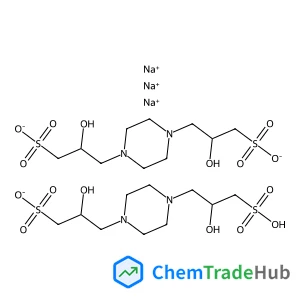
3,3'-(Piperazine-1,4-diyl)bis(2-hydroxypropane-1-sulfonic acid) Sodium Salt
CAS Number:
108321-08-0
Molecular Formula:
C20H41N4Na3O16S4
Ryota Sato, Hajime Okajima, Shinya Sugiura, Yohei Haketa, Yusuke Kinoshita, Hitoshi Tamiaki, Akira Sakamoto, Hiromitsu Maeda, Yoichi Kobayashi
Anion-responsive photofunctional materials have been extensively studied because anions are important for biotic activity and constitute the building blocks of elegant supramolecular architectures. A number of fluorescent anion receptors that can probe anions in their environments have been reported, but the excited states of many of these molecules remain elusive. Studies on excited-state dynamics provide fruitful information for optimizing the emission properties, minimizing the photodegradation and photorelease of anions, and exploring novel photofunctions. In this study, we investigated the excited-state dynamics of an aryl-substituted dipyrrolyldiketone difluoroboron complex, a π-conjugated anion receptor, by time-resolved visible and infrared absorption spectroscopy and emission decay measurements combined with quantum chemical calculations. Anion binding was found to alter the radiative and nonradiative rate constants and the excited-state absorption of the anion receptor. In contrast, the molecular structures and binding abilities were similar in the S0 and S1 states.
Srinivas Samala, Do Hyun Ryu, Choong Eui Song, Eun Jeong Yoo
DOI: 10.1039/C8OB02463D
Fan Lv, Yang Yu, Erhong Hao, Changjiang Yu, Hua Wang, Noёl Boens, Lijuan Jiao
DOI: 10.1039/C9OB00927B
Feng-Teng Gao, Zheng Fang, Rui-Rui Su, Pei-Xin Rui
DOI: 10.1039/C8OB02721H
Qiong Wu, Gui-Lin Li, Shuang Yang, Xiao-Qin Shi, Tian-Zi Huang, Xi-Hua Du, Yan Chen
DOI: 10.1039/C9OB00283A
Chunfeng Jiang, Quan Liu, Jiaming Liu, Kaixuan Liu, Liangliang Tian, Mingfei Duan, Ying Wang, Zhufang Shen, Youjun Xu
DOI: 10.1039/C9OB00762H
Neeraj N. Patwardhan, Zhengguo Cai, Colby N. Newson, Amanda E. Hargrove
DOI: 10.1039/C8OB02467G
Shun Masuda, Shugo Tsuda, Taku Yoshiya
DOI: 10.1039/C8OB02778A
Wei Jiao, Huawu Shao
DOI: 10.1039/C8OB01953C
W. Rush Scaggs, Toya D. Scaggs, Thomas N. Snaddon
DOI: 10.1039/C8OB02600A
3-Fluoro-2-methylbenzylamine is an organic compound with the CAS number 771573-3...
Tert-butyl 2-(oxetan-3-ylidene)acetate is considered safe for its intended uses ...
Proper personal protective equipment (PPE) such as gloves, goggles, and a lab co...
2-Ethyl-4-methyl-1,3-thiazole is commonly synthesized via the reaction of thiour...
This compound should be stored in a cool, dry place away from direct sunlight an...
L-Lysine Acetate Salt (CAS: 52315-92-1) is subject to various regulatory guideli...
6-Fluoro-3-hydroxy-2-pyrazinecarboxamide (CAS: 259793-96-9) is generally conside...
1,1'-Sulfonylbis(1H-imidazole) is a crystalline solid with a molecular weight of...
4-Methyl-7-nitro-1H-indole-3-carbonitrile (CAS: 289483-82-5) is primarily used i...
Waste containing 5-Bromo-3-indolyl-beta-galactoside (CAS: 97753-82-7) should be ...

Physical Chemistry Chemical Physics (PCCP) is an international journal co-owned by 19 physical chemistry and physics societies from around the world. This journal publishes original, cutting-edge research in physical chemistry, chemical physics and biophysical chemistry. To be suitable for publication in PCCP, articles must include significant innovation and/or insight into physical chemistry; this is the most important criterion that reviewers and Editors will judge against when evaluating submissions. The journal has a broad scope and welcomes contributions spanning experiment, theory, computation and data science. Topical coverage includes spectroscopy, dynamics, kinetics, statistical mechanics, thermodynamics, electrochemistry, catalysis, surface science, quantum mechanics, quantum computing and machine learning. Interdisciplinary research areas such as polymers and soft matter, materials, nanoscience, energy, surfaces/interfaces, and biophysical chemistry are welcomed if they demonstrate significant innovation and/or insight into physical chemistry. Joined experimental/theoretical studies are particularly appreciated when complementary and based on up-to-date approaches.
![5-(2-Phenylpyrazolo[1,5-a]pyridin-3-yl)-2H-pyrazolo[3,4-c]pyridazin-3-amine structure](https://static.chemtradehub.com/structs/865/865362-74-9-0091.webp "5-(2-Phenylpyrazolo[1,5-a]pyridin-3-yl)-2H-pyrazolo[3,4-c]pyridazin-3-amine structure")