












Dissociative photodetachment of H3O2−: a full-dimensional quantum dynamics study
Literature Information
Publication Date
2021-09-13
DOI
10.1039/D1CP03495B
Impact Factor
3.676
Authors
Hongwei Song, Yongfa Zhu
View Original
Abstract
The transition state is a central concept of chemistry. Photoelectron–photofragment coincidence (PPC) spectroscopy has been proven as an attractive method to study the transition state dynamics. Within a state-of-the-art full-dimensional quantum mechanical model, the dissociative photodetachment dynamics of H3O2− is investigated on accurate anion and neutral potential energy surfaces. The calculated PPC spectrum of H3O2− agrees well with the experimental measurement. The dissociative product OH is exclusively populated on the ground vibrational state, implying the character of the spectator bond. In contrast, the product H2O is predominantly populated in the ground and fundamental states of the symmetric and antisymmetric stretching modes, which is caused by the strong coupling between the antisymmetric motion of the transferred H atom in the transient intermediate [H3O2]* and both stretching modes of the product H2O.
Related Literature
Conducting behavior of chalcopyrite-type CuGaS2 crystals under visible light
Jorge L. Cholula-Díaz, José Barzola-Quiquia, Christian Kranert, Tom Michalsky, Pablo Esquinazi, Marius Grundmann, Harald Krautscheid
2014-09-01
Paper
DOI: 10.1039/C4CP03103B
Measuring the Brønsted acid strength of zeolites – does it correlate with the O–H frequency shift probed by a weak base?
Carlos O. Arean, Montserrat R. Delgado, Petr Nachtigall, Ho Viet Thang, Miroslav Rubeš, Roman Bulánek, Pavla Chlubná-Eliášová
2014-01-30
Paper
DOI: 10.1039/C3CP54738H
Dispersion corrected DFT approaches for anharmonic vibrational frequency calculations: nucleobases and their dimers
Teresa Fornaro, Malgorzata Biczysko, Vincenzo Barone
2014-01-28
Paper
DOI: 10.1039/C3CP54724H
Ultrafast resonance energy transfer in the umbelliferone–alizarin bichromophore
Pierangelo Fabbrizzi, Luisa Lascialfari, Stefano Cicchi, Malgorzata Biczysko, Fabrizio Santoro
2014-01-23
Paper
DOI: 10.1039/C3CP54609H
ωB97X-V: A 10-parameter, range-separated hybrid, generalized gradient approximation density functional with nonlocal correlation, designed by a survival-of-the-fittest strategy
Narbe Mardirossian, Martin Head-Gordon
2013-12-18
Paper
DOI: 10.1039/C3CP54374A
Destabilization effect of transition metal fluorides on sodium borohydride
Georgios N. Kalantzopoulos, Matylda N. Guzik, Stefano Deledda, Jiri Muller, Bjørn C. Hauback
2014-08-12
Paper
DOI: 10.1039/C4CP02899F
Quantum Monte Carlo for noncovalent interactions: an efficient protocol attaining benchmark accuracy
Matúš Dubecký, René Derian, Petr Jurečka, Lubos Mitas, Michal Otyepka
2014-08-01
Paper
DOI: 10.1039/C4CP02093F
Properties of two-dimensional insulators: a DFT study of Co adsorption on NaCl and MgO ultrathin films
Hsin-Yi Tiffany Chen, Gianfranco Pacchioni
2014-08-28
Paper
DOI: 10.1039/C4CP03470H
Temperature-dependent dynamics of water in aqueous NaPF6 solution
Dayoung Nam, Chiho Lee
2014-08-21
Paper
DOI: 10.1039/C4CP02823F
Geometric and electronic properties of graphene modified by “external” N-containing groups
Xinde Wang, Qiuxia Cai, Guilin Zhuang, Xing Zhong, Donghai Mei, Xiaonian Li, Jianguo Wang
2014-08-14
Paper
DOI: 10.1039/C4CP03069A
You might also like
Compound Q&A
Is 4-Benzyl-2,2-dimethylmorpholine (CAS: 84761-04-6) safe?
4-Benzyl-2,2-dimethylmorpholine is generally considered safe when handled under ...
84761-04-64-Benzyl-2,2-dimethy...
Compound Q&A
What is (5,6-Dimethoxy-3-pyridinyl)boronic acid (CAS: 1346526-61-1)?
(5,6-Dimethoxy-3-pyridinyl)boronic acid is a chemical compound with the molecula...
1346526-61-1(5,6-Dimethoxy-3-pyr...
Compound Q&A
How is 1,1,3,3-Tetramethyl-1,3-bis(2-methyl-2-propanyl)disiloxane (CAS: 67875-55-2) typically synthesized?
1,1,3,3-Tetramethyl-1,3-bis(2-methyl-2-propanyl)disiloxane is synthesized throug...
67875-55-21,1,3,3-Tetramethyl-...
Compound Q&A
What are the main uses of (2R,4S)-1-Boc-4-methylpyrrolidine-2-carboxylic acid (CAS: 1018818-04-6)?
(2R,4S)-1-Boc-4-methylpyrrolidine-2-carboxylic acid is primarily used as a build...
1018818-04-6(2R,4S)-1-Boc-4-meth...
Compound Q&A
What precautions should be taken when handling 2,3-Dichloroacrylonitrile (CAS: 22410-58-8)?
When handling 2,3-Dichloroacrylonitrile, it is crucial to wear appropriate perso...
22410-58-82,3-Dichloroacryloni...
Compound Q&A
How should (S)-1-(o-Tolyl)ethanamine hydrochloride (CAS: 1332832-16-2) be stored?
(S)-1-(o-Tolyl)ethanamine hydrochloride should be stored in a cool, dry place to...
1332832-16-2(S)-1-(o-Tolyl)ethan...
Compound Q&A
What are the physical and chemical properties of Benzyl [1-(hydroxyamino)-1-imino-2-methyl-2-propanyl]carbamate (CAS: 518047-98-8)?
Benzyl [1-(hydroxyamino)-1-imino-2-methyl-2-propanyl]carbamate (CAS: 518047-98-8...
518047-98-8Benzyl [1-(hydroxyam...
Compound Q&A
What industries use 2-Methyloxazole-5-carbaldehyde (CAS: 885273-42-7)?
2-Methyloxazole-5-carbaldehyde is used in the pharmaceutical industry for the sy...
885273-42-72-Methyloxazole-5-ca...
Compound Q&A
What is the market or research trend for 2-Methyl-2-propanyl 4-[(1S)-1-hydroxyethyl]-1-piperidinecarboxylate (CAS: 389889-82-1)?
The market for 2-Methyl-2-propanyl 4-[(1S)-1-hydroxyethyl]-1-piperidinecarboxyla...
389889-82-12-Methyl-2-propanyl ...
Compound Q&A
Is 1-Butyl-3-methylpyridinium bromide (CAS: 26576-85-2) safe?
1-Butyl-3-methylpyridinium bromide is generally considered safe for laboratory u...
26576-85-21-Butyl-3-methylpyri...
Source Journal
Physical Chemistry Chemical Physics

CiteScore:
5.5
Self-citation Rate:
10.3%
Articles per Year:
3036
Physical Chemistry Chemical Physics (PCCP) is an international journal co-owned by 19 physical chemistry and physics societies from around the world. This journal publishes original, cutting-edge research in physical chemistry, chemical physics and biophysical chemistry. To be suitable for publication in PCCP, articles must include significant innovation and/or insight into physical chemistry; this is the most important criterion that reviewers and Editors will judge against when evaluating submissions. The journal has a broad scope and welcomes contributions spanning experiment, theory, computation and data science. Topical coverage includes spectroscopy, dynamics, kinetics, statistical mechanics, thermodynamics, electrochemistry, catalysis, surface science, quantum mechanics, quantum computing and machine learning. Interdisciplinary research areas such as polymers and soft matter, materials, nanoscience, energy, surfaces/interfaces, and biophysical chemistry are welcomed if they demonstrate significant innovation and/or insight into physical chemistry. Joined experimental/theoretical studies are particularly appreciated when complementary and based on up-to-date approaches.
Recommended Compounds
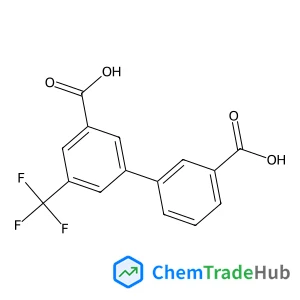
3-(3-Carboxyphenyl)-5-(trifluoromethyl)benzoic acid
CAS Number:
1261930-96-4
Molecular Formula:
C15H9F3O4
Recommended Suppliers





Disclaimer
This page provides academic journal information for reference and research purposes only. We are not affiliated with any journal publishers and do not handle publication submissions. For publication-related inquiries, please contact the respective journal publishers directly.
If you notice any inaccuracies in the information displayed, please contact us at support@chemtradehub.com. We will promptly review and address your concerns.