













Dispersion corrected DFT approaches for anharmonic vibrational frequency calculations: nucleobases and their dimers
Literature Information
Publication Date
2014-01-28
DOI
10.1039/C3CP54724H
Impact Factor
3.676
Authors
Teresa Fornaro, Malgorzata Biczysko, Vincenzo Barone
View Original
Abstract
Computational spectroscopy techniques have become in the last few years an effective means to analyze and assign infrared (IR) spectra of molecular systems of increasing dimensions and in different environments. However, transition from compilation of harmonic data to fully anharmonic simulations of spectra is still underway. The most promising results for large systems have been obtained, in our opinion, by perturbative vibrational approaches based on potential energy surfaces computed by hybrid (especially B3LYP) density functionals and medium size (e.g. SNSD) basis sets. In this framework, we are actively developing a comprehensive and robust computational protocol aimed at quantitative reproduction of the spectra of nucleic acid base complexes and their adsorption on solid supports (organic/inorganic). In this contribution we report the essential results of the first step devoted to isolated monomers and dimers. It is well known that in order to model the vibrational spectra of weakly bound molecular complexes dispersion interactions should be taken into proper account. In this work we have chosen two popular and inexpensive approaches to model dispersion interactions, namely the semi-empirical dispersion correction (D3) and pseudopotential based (DCP) methodologies both in conjunction with the B3LYP functional. These have been used for simulating fully anharmonic IR spectra of nucleobases and their dimers through generalized second order vibrational perturbation theory (GVPT2). We have studied, in particular, isolated adenine, hypoxanthine, uracil, thymine and cytosine, the hydrogen-bonded and stacked adenine and uracil dimers, and the stacked adenine–naphthalene heterodimer. Anharmonic frequencies are compared with standard B3LYP results and experimental findings, while the computed interaction energies and structures of complexes are compared to the best available theoretical estimates.
Recommended Journals
Related Literature
An optimised assay for quantitative, high-throughput analysis of polysialyltransferase activity
Sara M. Elkashef, Mark Sutherland, Laurence H. Patterson, Paul M. Loadman, Robert A. Falconer
2016-08-08
Paper
DOI: 10.1039/C6AN01073C
Time-dependent SERS spectra monitoring the dynamic adsorption behavior of bipyridine isomerides combined with bianalyte method
2016-04-27
Paper
DOI: 10.1039/C6AN00771F
Fragmentation, auto-modification and post ionisation proton bound dimer ion formation: the differential mobility spectrometry of low molecular weight alcohols
D. M. Ruszkiewicz, C. L. P. Thomas, G. A. Eiceman
2016-05-19
Paper
DOI: 10.1039/C6AN00435K
Rapid detection of Clostridium difficile via magnetic bead aggregation in cost-effective polyester microdevices with cell phone image analysis
Jacquelyn A. DuVall, Scott T. Cabaniss, Morgan L. Angotti, John H. Moore, Mayuresh Abhyankar, Nishant Shukla, Daniel L. Mills, Bryan G. Kessel, Gavin T. Garner, Nathan S. Swami
2016-07-20
Paper
DOI: 10.1039/C6AN00674D
Temporal drift in Raman signal intensity during SERS measurements performed on analytes in liquid solutions
G. O. Setti, E. Joanni, R. J. Poppi, D. P. dos Santos, D. P. de Jesus
2016-07-20
Communication
DOI: 10.1039/C6AN00876C
Multiple gas-phase conformations of proline-containing peptides: is it always cis/trans isomerization?
Christopher B. Lietz, Zhengwei Chen, Chang Yun Son, Xueqin Pang, Qiang Cui
2016-07-12
Communication
DOI: 10.1039/C5AN00835B
Ultrasensitive detection of thyrotropin-releasing hormone based on azo coupling and surface-enhanced resonance Raman spectroscopy
Huimin Sui, Yue Wang, Xiaolei Zhang, Xiaolei Wang, Weina Cheng, Hongyang Su, Xu Wang, Xiaoying Sun, Xiao Xia Han, Bing Zhao, Yukihiro Ozaki
2016-06-14
Paper
DOI: 10.1039/C6AN00884D
Nanoparticles and intracellular applications of surface-enhanced Raman spectroscopy
Jack Taylor, Li Li, Jonathan Wingfield, Sumeet Mahajan
2016-07-19
Critical Review
DOI: 10.1039/C6AN01003B
You might also like
Compound Q&A
What precautions should be taken when handling 2-Chloro-1,2-bis(4-methylphenyl)ethanone (CAS: 71193-32-3)?
When handling 2-Chloro-1,2-bis(4-methylphenyl)ethanone (CAS: 71193-32-3), it is ...
71193-32-32-Chloro-1,2-bis(4-m...
Compound Q&A
What industries use 4-Ethoxy-3-(5-methyl-4-oxo-7-propyl-1,4-dihydroimidazo[5,1-f][1,2,4]triazin-2-yl)benzenesulfonyl chloride (CAS: 224789-26-8)?
4-Ethoxy-3-(5-methyl-4-oxo-7-propyl-1,4-dihydroimidazo[5,1-f][1,2,4]triazin-2-yl...
224789-26-84-Ethoxy-3-(5-methyl...
Compound Q&A
How should Methyl 3-Oxo-4-Androsten-17-Carboxylate (CAS: 2681-55-2) be stored?
Methyl 3-Oxo-4-Androsten-17-Carboxylate (CAS: 2681-55-2) should be stored in a c...
2681-55-2Methyl 3-Oxo-4-Andro...
Compound Q&A
What are the main uses of (R)-3-Amino-4-(3-hexylphenylamino)-4-oxobutylphosphonic acid (CAS: 909725-61-7)?
(R)-3-Amino-4-(3-hexylphenylamino)-4-oxobutylphosphonic acid is primarily used i...
909725-61-7(R)-3-Amino-4-(3-hex...
Compound Q&A
What regulatory guidelines apply to 2-Methyl-2-propanyl 3-amino-3-carbamoyl-1-azetidinecarboxylate (CAS: 1254120-14-3)?
2-Methyl-2-propanyl 3-amino-3-carbamoyl-1-azetidinecarboxylate (CAS: 1254120-14-...
1254120-14-32-Methyl-2-propanyl ...
Compound Q&A
Are there alternatives to (E)-4-(tert-Butoxy)-4-oxobut-2-enoic acid (CAS: 135355-96-3) in synthesis?
There are alternative reagents that can be used in synthesis instead of (E)-4-(t...
135355-96-3(E)-4-(tert-Butoxy)-...
Compound Q&A
What are the physical and chemical properties of [2-(3-Chlorophenyl)-1,3-thiazol-4-yl]methanol (CAS: 121202-20-8)?
[2-(3-Chlorophenyl)-1,3-thiazol-4-yl]methanol (CAS: 121202-20-8) is a crystallin...
121202-20-8[2-(3-Chlorophenyl)-...
Compound Q&A
What is the market or research trend for Methyl (2S)-[(4S)-2,2-dimethyl-1,3-dioxolan-4-yl]{[(4-methylphenyl)sulfonyl]oxy}acetate (CAS: 166249-17-8)?
The market and research trends for Methyl (2S)-[(4S)-2,2-dimethyl-1,3-dioxolan-4...
166249-17-8Methyl (2S)-[(4S)-2,...
Compound Q&A
What is the market or research trend for 1-Bromo-2-isocyanatoethane (CAS: 42865-19-0)?
The market for 1-Bromo-2-isocyanatoethane (CAS: 42865-19-0) is driven by its use...
42865-19-01-Bromo-2-isocyanato...
Compound Q&A
What are the main uses of 4-Nitro-D-phenylalanine hydrochloride (CAS: 147065-06-3)?
4-Nitro-D-phenylalanine hydrochloride (CAS: 147065-06-3) is primarily used in re...
147065-06-34-Nitro-D-phenylalan...
Source Journal
Physical Chemistry Chemical Physics

CiteScore:
5.5
Self-citation Rate:
10.3%
Articles per Year:
3036
Physical Chemistry Chemical Physics (PCCP) is an international journal co-owned by 19 physical chemistry and physics societies from around the world. This journal publishes original, cutting-edge research in physical chemistry, chemical physics and biophysical chemistry. To be suitable for publication in PCCP, articles must include significant innovation and/or insight into physical chemistry; this is the most important criterion that reviewers and Editors will judge against when evaluating submissions. The journal has a broad scope and welcomes contributions spanning experiment, theory, computation and data science. Topical coverage includes spectroscopy, dynamics, kinetics, statistical mechanics, thermodynamics, electrochemistry, catalysis, surface science, quantum mechanics, quantum computing and machine learning. Interdisciplinary research areas such as polymers and soft matter, materials, nanoscience, energy, surfaces/interfaces, and biophysical chemistry are welcomed if they demonstrate significant innovation and/or insight into physical chemistry. Joined experimental/theoretical studies are particularly appreciated when complementary and based on up-to-date approaches.
Recommended Compounds
![4-[2-(3,4-Dihydro-2H-chromen-6-yl)-1,3-oxazol-5-yl]-1-(3-{[(2,5-dioxo-1-pyrrolidinyl)oxy]carbonyl}benzyl)pyridinium bromide structure](https://static.chemtradehub.com/structs/155/155863-03-9-8183.webp "4-[2-(3,4-Dihydro-2H-chromen-6-yl)-1,3-oxazol-5-yl]-1-(3-{[(2,5-dioxo-1-pyrrolidinyl)oxy]carbonyl}benzyl)pyridinium bromide structure")
4-[2-(3,4-Dihydro-2H-chromen-6-yl)-1,3-oxazol-5-yl]-1-(3-{[(2,5-dioxo-1-pyrrolidinyl)oxy]carbonyl}benzyl)pyridinium bromide
CAS Number:
155863-03-9
Molecular Formula:
C29H24BrN3O6
![4-[(2-Oxo-1,2,3,4-tetrahydroquinolin-7-yl)oxy]butanoic acid structure](https://static.chemtradehub.com/structs/588/58899-27-7-1f86.webp "4-[(2-Oxo-1,2,3,4-tetrahydroquinolin-7-yl)oxy]butanoic acid structure")
4-[(2-Oxo-1,2,3,4-tetrahydroquinolin-7-yl)oxy]butanoic acid
CAS Number:
58899-27-7
Molecular Formula:
C18H24N2O7
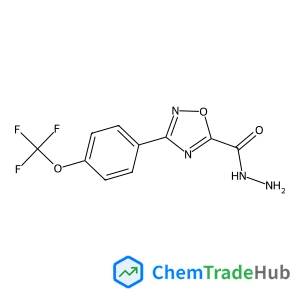
3-(4-(Trifluoromethoxy)phenyl)-1,2,4-oxadiazole-5-carbohydrazide
CAS Number:
883028-82-8
Molecular Formula:
C10H7F3N4O3
Recommended Suppliers





Disclaimer
This page provides academic journal information for reference and research purposes only. We are not affiliated with any journal publishers and do not handle publication submissions. For publication-related inquiries, please contact the respective journal publishers directly.
If you notice any inaccuracies in the information displayed, please contact us at support@chemtradehub.com. We will promptly review and address your concerns.