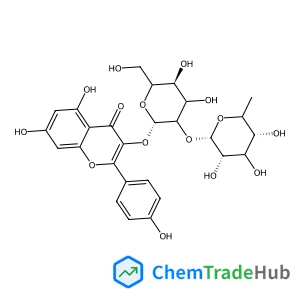
5,7-Dihydroxy-2-(4-hydroxyphenyl)-4-oxo-4H-chromen-3-yl 2-O-(6-deoxy-alpha-L-mannopyranosyl)-beta-D-glucopyranoside
CAS Number:
32602-81-6
Molecular Formula:
C27H30O15
Gu-Dan Zhang, Jian-Guo Zhang, Dong Chen, Qi Zhang
In order to understand the relationship between laser initiation and charge transfer of metal tetrazine complexes (MTCs), several sets of MTCs with different metals and ligands were designed and their charge transfer (CT) characters were examined using a time-dependent density functional theory method (TD-DFT) in combination with UV-vis spectra, hole–electron distribution, interfragment charge transition, and transition density matrix analyses. Results show that Fe(II), Mn(II), and Cu(II) are suitable divalent transition metal cores in constructing the optical initiation tetrazine complexes. By replacing the divalent metal cores with a monovalent center, new sets of complexes are proved to possess metal-to-ligand charge transfer (MLCT) character and stronger absorption intensity in the near-infrared (NIR) region, which implies that monovalent MTCs are more in favor of low-energy laser initiation than divalent MTCs. Reasonable tuning of the structure of pyrazole substituent can expect to enhance the explosive performance while preserving the optical characteristics, which is an important design principle. This work thoroughly depicts the photoactive states for MTCs and gives a train of thought to explore new desirable laser initiation explosives.
Conrad P. Corbyn, Paul D. I. Fletcher, Rabia Gemici, Rita S. Dias, Maria G. Miguel
DOI: 10.1039/B916116C
Peter D. Zoon, Ivo H. M. van Stokkum, Albert M. Brouwer
DOI: 10.1039/B921322H
Jihun Kim, Soon Man Hong, Soonjong Kwak, Yongsok Seo
DOI: 10.1039/B913527H
Xiaohong Li, Elena Koukharenko, Iris S. Nandhakumar, John Tudor, Steve P. Beeby, Neil M. White
DOI: 10.1039/B818040G
Manfred Martin
DOI: 10.1039/B900162J
P. Träskelin, T. L. Kuhl, R. Faller
DOI: 10.1039/B911311H
Kirstin Sonnenburg, Bernd M. Smarsly, Torsten Brezesinski
DOI: 10.1039/B822437D
Daniel J. Cole, Mike C. Payne
DOI: 10.1039/B816125A
Rahul K. Das, Anatoly B. Kolomeisky
DOI: 10.1039/B921303A
When handling 2-Chloro-1,2-bis(4-methylphenyl)ethanone (CAS: 71193-32-3), it is ...
4-Ethoxy-3-(5-methyl-4-oxo-7-propyl-1,4-dihydroimidazo[5,1-f][1,2,4]triazin-2-yl...
Methyl 3-Oxo-4-Androsten-17-Carboxylate (CAS: 2681-55-2) should be stored in a c...
(R)-3-Amino-4-(3-hexylphenylamino)-4-oxobutylphosphonic acid is primarily used i...
2-Methyl-2-propanyl 3-amino-3-carbamoyl-1-azetidinecarboxylate (CAS: 1254120-14-...
There are alternative reagents that can be used in synthesis instead of (E)-4-(t...
[2-(3-Chlorophenyl)-1,3-thiazol-4-yl]methanol (CAS: 121202-20-8) is a crystallin...
The market and research trends for Methyl (2S)-[(4S)-2,2-dimethyl-1,3-dioxolan-4...
The market for 1-Bromo-2-isocyanatoethane (CAS: 42865-19-0) is driven by its use...
4-Nitro-D-phenylalanine hydrochloride (CAS: 147065-06-3) is primarily used in re...

Physical Chemistry Chemical Physics (PCCP) is an international journal co-owned by 19 physical chemistry and physics societies from around the world. This journal publishes original, cutting-edge research in physical chemistry, chemical physics and biophysical chemistry. To be suitable for publication in PCCP, articles must include significant innovation and/or insight into physical chemistry; this is the most important criterion that reviewers and Editors will judge against when evaluating submissions. The journal has a broad scope and welcomes contributions spanning experiment, theory, computation and data science. Topical coverage includes spectroscopy, dynamics, kinetics, statistical mechanics, thermodynamics, electrochemistry, catalysis, surface science, quantum mechanics, quantum computing and machine learning. Interdisciplinary research areas such as polymers and soft matter, materials, nanoscience, energy, surfaces/interfaces, and biophysical chemistry are welcomed if they demonstrate significant innovation and/or insight into physical chemistry. Joined experimental/theoretical studies are particularly appreciated when complementary and based on up-to-date approaches.