












Re-dissolution and de-compaction of DNA–cationic surfactant complexes using non-ionic surfactants
Literature Information
Publication Date
2009-11-06
DOI
10.1039/B916116C
Impact Factor
3.676
Authors
Conrad P. Corbyn, Paul D. I. Fletcher, Rabia Gemici, Rita S. Dias, Maria G. Miguel
View Original
Abstract
Addition of a cationic surfactant to a solution of DNA causes the formation of compacted DNA–cationic surfactant complexes which precipitate from aqueous solution. It has been shown previously that addition of anionic surfactant will re-dissolve and de-compact the DNA–cationic surfactant complexes and we find that addition of non-ionic surfactants of the alkylpolyoxyethylene type can be used similarly. In principle, these de-compaction and re-dissolution processes could occur either by stripping of the cationic surfactant from the DNA into mixed micelles with the non-ionic surfactant or by solubilisation of the DNA–cationic surfactant complexes within the non-ionic micelles. Solubility phase-boundary measurements, fluorescence microscopy observations of the de-compaction process and light scattering results indicate that de-compaction and re-dissolution occur by the stripping mechanism, even for non-ionic surfactants where the favourable attractive electrostatic interaction between the two surfactants is absent. Using measurements of critical micelle concentrations and calculations based on regular solution mixed micelle theory, we show that re-dissolution and de-compaction of the DNA–cationic surfactant complexes occurs when the concentration of free monomeric cationic surfactant is reduced (by incorporation into mixed micelles) below a critical value.
Related Literature
Determination of element–deuterium bond lengths in Zintl phase deuterides by 2H-NMR
Henry Auer, Holger Kohlmann, Jürgen Haase, Marko Bertmer
2019-05-03
Paper
DOI: 10.1039/C9CP00292H
On the interaction of hyaluronic acid with synovial fluid lipid membranes
Paul Smith, Robert M. Ziolek, Elena Gazzarrini, Dylan M. Owen, Christian D. Lorenz
2019-04-17
Paper
DOI: 10.1039/C9CP01532A
Superior spin-polarized electronic structure in MoS2/MnO2 heterostructures with an efficient hole injection
Baozeng Zhou, Zheng Li, Jiaming Wang, Kangqiang Wang
2019-04-27
Paper
DOI: 10.1039/C9CP01146C
Lithium ion diffusion mechanism in covalent organic framework based solid state electrolyte
Kecheng Zhang, Bingkai Zhang, Mouyi Weng, Jiaxin Zheng, Shunning Li, Feng Pan
2019-04-23
Paper
DOI: 10.1039/C9CP02117E
How does the flexibility of pyrrolidinium cations affect the phase behaviour of 1-alkyl-1-methylpyrrolidinium bis(trifluoromethanesulfonyl)imide homologues under stressful conditions?
Yoshihiro Koyama, Kiyoto Matsuishi, Takahiro Takekiyo, Hiroshi Abe, Yukihiro Yoshimura
2019-05-13
Paper
DOI: 10.1039/C9CP01730E
Insights into how the aqueous environment influences the kinetics and mechanisms of heterogeneously-catalyzed COH* and CH3OH* dehydrogenation reactions on Pt(111)
Cameron J. Bodenschatz, Tianjun Xie, Xiaohong Zhang, Rachel B. Getman
2019-04-18
Paper
DOI: 10.1039/C9CP00824A
Detailed kinetic model for hexyl sulfide pyrolysis and its desulfurization by supercritical water
Caleb A. Class, AnGayle K. Vasiliou, Yuko Kida, Michael T. Timko, William H. Green
2019-04-26
Paper
DOI: 10.1039/C9CP00234K
Stanene on a SiC(0001) surface: a candidate for realizing quantum anomalous Hall effect
2019-04-30
Paper
DOI: 10.1039/C9CP01509D
You might also like
Compound Q&A
What precautions should be taken when handling 2-Chloro-1,2-bis(4-methylphenyl)ethanone (CAS: 71193-32-3)?
When handling 2-Chloro-1,2-bis(4-methylphenyl)ethanone (CAS: 71193-32-3), it is ...
71193-32-32-Chloro-1,2-bis(4-m...
Compound Q&A
What industries use 4-Ethoxy-3-(5-methyl-4-oxo-7-propyl-1,4-dihydroimidazo[5,1-f][1,2,4]triazin-2-yl)benzenesulfonyl chloride (CAS: 224789-26-8)?
4-Ethoxy-3-(5-methyl-4-oxo-7-propyl-1,4-dihydroimidazo[5,1-f][1,2,4]triazin-2-yl...
224789-26-84-Ethoxy-3-(5-methyl...
Compound Q&A
How should Methyl 3-Oxo-4-Androsten-17-Carboxylate (CAS: 2681-55-2) be stored?
Methyl 3-Oxo-4-Androsten-17-Carboxylate (CAS: 2681-55-2) should be stored in a c...
2681-55-2Methyl 3-Oxo-4-Andro...
Compound Q&A
What are the main uses of (R)-3-Amino-4-(3-hexylphenylamino)-4-oxobutylphosphonic acid (CAS: 909725-61-7)?
(R)-3-Amino-4-(3-hexylphenylamino)-4-oxobutylphosphonic acid is primarily used i...
909725-61-7(R)-3-Amino-4-(3-hex...
Compound Q&A
What regulatory guidelines apply to 2-Methyl-2-propanyl 3-amino-3-carbamoyl-1-azetidinecarboxylate (CAS: 1254120-14-3)?
2-Methyl-2-propanyl 3-amino-3-carbamoyl-1-azetidinecarboxylate (CAS: 1254120-14-...
1254120-14-32-Methyl-2-propanyl ...
Compound Q&A
Are there alternatives to (E)-4-(tert-Butoxy)-4-oxobut-2-enoic acid (CAS: 135355-96-3) in synthesis?
There are alternative reagents that can be used in synthesis instead of (E)-4-(t...
135355-96-3(E)-4-(tert-Butoxy)-...
Compound Q&A
What are the physical and chemical properties of [2-(3-Chlorophenyl)-1,3-thiazol-4-yl]methanol (CAS: 121202-20-8)?
[2-(3-Chlorophenyl)-1,3-thiazol-4-yl]methanol (CAS: 121202-20-8) is a crystallin...
121202-20-8[2-(3-Chlorophenyl)-...
Compound Q&A
What is the market or research trend for Methyl (2S)-[(4S)-2,2-dimethyl-1,3-dioxolan-4-yl]{[(4-methylphenyl)sulfonyl]oxy}acetate (CAS: 166249-17-8)?
The market and research trends for Methyl (2S)-[(4S)-2,2-dimethyl-1,3-dioxolan-4...
166249-17-8Methyl (2S)-[(4S)-2,...
Compound Q&A
What is the market or research trend for 1-Bromo-2-isocyanatoethane (CAS: 42865-19-0)?
The market for 1-Bromo-2-isocyanatoethane (CAS: 42865-19-0) is driven by its use...
42865-19-01-Bromo-2-isocyanato...
Compound Q&A
What are the main uses of 4-Nitro-D-phenylalanine hydrochloride (CAS: 147065-06-3)?
4-Nitro-D-phenylalanine hydrochloride (CAS: 147065-06-3) is primarily used in re...
147065-06-34-Nitro-D-phenylalan...
Source Journal
Physical Chemistry Chemical Physics

CiteScore:
5.5
Self-citation Rate:
10.3%
Articles per Year:
3036
Physical Chemistry Chemical Physics (PCCP) is an international journal co-owned by 19 physical chemistry and physics societies from around the world. This journal publishes original, cutting-edge research in physical chemistry, chemical physics and biophysical chemistry. To be suitable for publication in PCCP, articles must include significant innovation and/or insight into physical chemistry; this is the most important criterion that reviewers and Editors will judge against when evaluating submissions. The journal has a broad scope and welcomes contributions spanning experiment, theory, computation and data science. Topical coverage includes spectroscopy, dynamics, kinetics, statistical mechanics, thermodynamics, electrochemistry, catalysis, surface science, quantum mechanics, quantum computing and machine learning. Interdisciplinary research areas such as polymers and soft matter, materials, nanoscience, energy, surfaces/interfaces, and biophysical chemistry are welcomed if they demonstrate significant innovation and/or insight into physical chemistry. Joined experimental/theoretical studies are particularly appreciated when complementary and based on up-to-date approaches.
Recommended Compounds
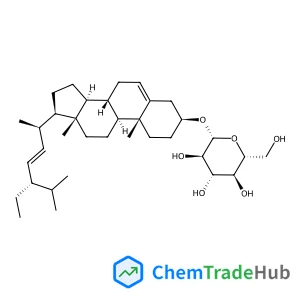
(3beta,22E)-Stigmasta-5,22-dien-3-yl beta-D-glucopyranoside
CAS Number:
19716-26-8
Molecular Formula:
C35H58O6
Recommended Suppliers




Disclaimer
This page provides academic journal information for reference and research purposes only. We are not affiliated with any journal publishers and do not handle publication submissions. For publication-related inquiries, please contact the respective journal publishers directly.
If you notice any inaccuracies in the information displayed, please contact us at support@chemtradehub.com. We will promptly review and address your concerns.