












Fast photo-processes in triazole-based push–pull systems
Literature Information
Publication Date
2010-01-27
DOI
10.1039/B921322H
Impact Factor
3.676
Authors
Peter D. Zoon, Ivo H. M. van Stokkum, Albert M. Brouwer
View Original
Abstract
Electron donor–acceptor compounds 1 (asymmetrical push–pull derivative) and 2 (symmetrical push–pull–push derivative) were studied in which one (push–pull) or two aniline units (push–pull–push) are connected to a biphenyl group via triazole linkers, made by “click” chemistry. Steady-state and time-resolved spectroscopies indicate that highly dipolar charge separated excited states are populated in moderately polar solvents. The very similar photophysical behavior of both compounds implies symmetry breaking in the excited state of 2. The polarity of the solvent determines the efficiency of formation of the charge separated state. While in toluene it is very low, it becomes very high in acetonitrile. The bis-triazole substituted biphenyl unit in 2 behaves as a better electron acceptor than the mono-triazole substituted biphenyl in 1, which leads to a more facile charge separation in 2. Rates of charge separation are of the order of 1011–1012 s−1, and increase with solvent polarity.
Recommended Journals
Related Literature
Rotational dynamics of Li+ ions encapsulated in C60 cages at low temperatures
Hal Suzuki, Misaki Ishida, Masatsugu Yamashita, Chiko Otani, Kazuhiko Kawachi, Yasuhiko Kasama, Eunsang Kwon
2016-11-07
Communication
DOI: 10.1039/C6CP06949E
How does ammonia bind to the oxygen-evolving complex in the S2 state of photosynthetic water oxidation? Theoretical support and implications for the W1 substitution mechanism
Yu Guo, Lan-Lan He, Dong-Xia Zhao, Li-Dong Gong, Cui Liu, Zhong-Zhi Yang
2016-10-21
Paper
DOI: 10.1039/C6CP05725J
Improved electromagnetic wave absorption of Co nanoparticles decorated carbon nanotubes derived from synergistic magnetic and dielectric losses
Nannan Wu, Hailong Lv, Jiurong Liu, Yuzhen Liu, Shenyu Wang, Wei Liu
2016-10-28
Paper
DOI: 10.1039/C6CP06066H
High-performance printable hybrid perovskite solar cells with an easily accessible n-doped fullerene as a cathode interfacial layer
Chih-Yu Chang, Bo-Chou Tsai, Yu-Cheng Hsiao, Yu-Ching Huang
2016-10-28
Paper
DOI: 10.1039/C6CP06486H
Novel metal-free organic dyes possessing fused heterocyclic structural motifs for efficient molecular photovoltaics
Ayyanar Karuppasamy, Kesavan Stalindurai, Jia-De Peng, Kuo-Chuan Ho, Chennan Ramalingan
2016-10-10
Paper
DOI: 10.1039/C6CP05722E
Reaction dynamics inside superfluid helium nanodroplets: the formation of the Ne2 molecule from Ne + Ne@(4He)N
Arnau Vilà, Miguel González
2016-10-10
Paper
DOI: 10.1039/C6CP03942A
Extensive H-atom abstraction from benzoate by OH-radicals at the air–water interface
Shinichi Enami, Michael R. Hoffmann, Agustín J. Colussi
2016-11-02
Paper
DOI: 10.1039/C6CP06652F
A stochastic study of electron transfer kinetics in nano-particulate photocatalysis: a comparison of the quasi-equilibrium approximation with a random walking model
Baoshun Liu, Xiujian Zhao, Jiaguo Yu, Akira Fujishima
2016-11-15
Paper
DOI: 10.1039/C6CP06320A
Columnar shifts as symmetry-breaking degrees of freedom in molecular perovskites
Hanna L. B. Boström, Joshua A. Hill, Andrew L. Goodwin
2016-10-20
Paper
DOI: 10.1039/C6CP05730F
Formation of lamellar micelle-like oligomers and membrane disruption revealed by the study of short peptide hIAPP18–27
Ying Wei, Jun Lu, Tong Lu, Feihong Meng, Jia Xu, Li Wang, Yang Li, Liping Wang, Fei Li
2016-09-29
Paper
DOI: 10.1039/C6CP04431J
You might also like
Compound Q&A
What are the main uses of (3.beta.)-3-Hydroxy-N,N-dimethyl-chol-5-en-24-amide (CAS: 79066-03-8)?
(3.beta.)-3-Hydroxy-N,N-dimethyl-chol-5-en-24-amide (CAS: 79066-03-8) is primari...
79066-03-8(3.beta.)-3-Hydroxy-...
Compound Q&A
What regulatory guidelines apply to 5-(aminomethyl)-2-methoxyphenol (CAS: 89702-89-6)?
5-(Aminomethyl)-2-methoxyphenol (CAS: 89702-89-6) is classified under GHS as a s...
89702-89-65-(aminomethyl)-2-me...
Compound Q&A
What is Thieno[2,3-c]pyridin-7(6H)-one (CAS: 28981-13-7)?
Thieno[2,3-c]pyridin-7(6H)-one (CAS: 28981-13-7) is a heterocyclic organic compo...
28981-13-7Thieno[2,3-c]pyridin...
Compound Q&A
Is 1-[(6-Methoxy-3-pyridinyl)methyl]-4-piperidinamine dihydrochloride (CAS: 1185311-28-7) safe?
1-[(6-Methoxy-3-pyridinyl)methyl]-4-piperidinamine dihydrochloride is generally ...
1185311-28-71-[(6-Methoxy-3-pyri...
Compound Q&A
What regulatory guidelines apply to [(2E)-3-Phenyl-2-propen-1-yl]phosphonic acid (CAS: 146404-58-2)?
[(2E)-3-Phenyl-2-propen-1-yl]phosphonic acid (CAS: 146404-58-2) is regulated und...
146404-58-2[(2E)-3-Phenyl-2-pro...
Compound Q&A
What regulatory guidelines apply to 6-Bromo-7-methoxyquinoline (CAS: 1620515-86-7)?
6-Bromo-7-methoxyquinoline (CAS: 1620515-86-7) falls under the scope of the Glob...
1620515-86-76-Bromo-7-methoxyqui...
Compound Q&A
What industries use (2R)-1-(1-Benzofuran-2-yl)-N-propyl-2-pentanamine (CAS: 260550-89-8)?
This compound is primarily used in the pharmaceutical industry for the developme...
260550-89-8(2R)-1-(1-Benzofuran...
Compound Q&A
What are the main uses of 1-Ethyl-7-[2-methyl-6-(4H-1,2,4-triazol-3-yl)-3-pyridinyl]-3,5-dihydropyrazino[2,3-b]pyrazin-2(1H)-one (CAS: 1228013-15-7)?
1-Ethyl-7-[2-methyl-6-(4H-1,2,4-triazol-3-yl)-3-pyridinyl]-3,5-dihydropyrazino[2...
1228013-15-71-Ethyl-7-[2-methyl-...
Compound Q&A
Are there alternatives to {5-(Acryloylamino)-2-[(dimethylamino)methyl]phenyl}boronic acid (CAS: 1217500-78-1) in synthesis?
Alternative reagents such as 2-[(dimethylamino)methyl]phenylboronic acid or rela...
1217500-78-1{5-(Acryloylamino)-2...
Compound Q&A
What is 3-(Piperidin-4-yloxy)pyridine (CAS: 310881-48-2)?
3-(Piperidin-4-yloxy)pyridine (CAS: 310881-48-2) is an organic compound with the...
310881-48-23-(Piperidin-4-yloxy...
Source Journal
Physical Chemistry Chemical Physics

CiteScore:
5.5
Self-citation Rate:
10.3%
Articles per Year:
3036
Physical Chemistry Chemical Physics (PCCP) is an international journal co-owned by 19 physical chemistry and physics societies from around the world. This journal publishes original, cutting-edge research in physical chemistry, chemical physics and biophysical chemistry. To be suitable for publication in PCCP, articles must include significant innovation and/or insight into physical chemistry; this is the most important criterion that reviewers and Editors will judge against when evaluating submissions. The journal has a broad scope and welcomes contributions spanning experiment, theory, computation and data science. Topical coverage includes spectroscopy, dynamics, kinetics, statistical mechanics, thermodynamics, electrochemistry, catalysis, surface science, quantum mechanics, quantum computing and machine learning. Interdisciplinary research areas such as polymers and soft matter, materials, nanoscience, energy, surfaces/interfaces, and biophysical chemistry are welcomed if they demonstrate significant innovation and/or insight into physical chemistry. Joined experimental/theoretical studies are particularly appreciated when complementary and based on up-to-date approaches.
Recommended Compounds
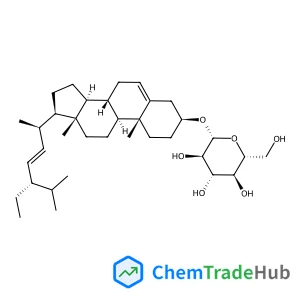
(3beta,22E)-Stigmasta-5,22-dien-3-yl beta-D-glucopyranoside
CAS Number:
19716-26-8
Molecular Formula:
C35H58O6
Recommended Suppliers







Disclaimer
This page provides academic journal information for reference and research purposes only. We are not affiliated with any journal publishers and do not handle publication submissions. For publication-related inquiries, please contact the respective journal publishers directly.
If you notice any inaccuracies in the information displayed, please contact us at support@chemtradehub.com. We will promptly review and address your concerns.