


Water structuring and collagen adsorption at hydrophilic and hydrophobic silicon surfaces
Literature Information
Publication Date
2009-10-20
DOI
10.1039/B816125A
Impact Factor
3.676
Authors
Daniel J. Cole, Mike C. Payne
View Original
Abstract
The adsorption of a collagen fragment on both a hydrophobic, hydrogen-terminated and a hydrophilic, natively oxidised Si surface is investigated using all-atom molecular dynamics. While favourable direct protein–surface interactions via localised contact points characterise adhesion to the hydrophilic surface, evenly spread surface/molecule contacts and stabilisation of the helical structure occurs upon adsorption on the hydrophobic surface. In the latter case, we find that adhesion is accompanied by a mutual fit between the hydrophilic/hydrophobic pattern within the protein and the layered water structure at the solid/liquid interface, which may provide an additional driving force to the classic hydrophobic effect.
Recommended Journals

Journal of the Indian Institute of Science

Journal of Chemical Sciences

Bioorganic & Medicinal Chemistry

Bioorganic & Medicinal Chemistry Letters

Acta Metallurgica Sinica-English Letters

Heteroatom Chemistry

Biocatalysis and Biotransformation

Chinese Journal of Chemistry

Medicinal Chemistry Research

Colloid Journal
Related Literature
Intramolecular torque, an indicator of the internal rotation direction of rotor molecules and similar systems
Rui-Qin Zhang, Yan-Ling Zhao, Fei Qi, Klaus Hermann, Michel A. Van Hove
2016-10-10
Communication
DOI: 10.1039/C6CP05996A
Ab initio thermodynamic study of the SnO2(110) surface in an O2 and NO environment: a fundamental understanding of the gas sensing mechanism for NO and NO2
Song-Nam Hong, Yun-Hyok Kye, Chol-Jun Yu, Un-Gi Jong, Gum-Chol Ri, Chang-Song Choe, Kwang-Hui Kim, Ju-Myong Han
2016-10-12
Paper
DOI: 10.1039/C6CP05433A
Microscopic investigations of site and functional selectivity of triazole for CO2 capture and catalytic applications
Reda Boulmène, Muthuramalingam Prakash, Majdi Hochlaf
2016-10-07
Paper
DOI: 10.1039/C6CP04650A
Reaction dynamics inside superfluid helium nanodroplets: the formation of the Ne2 molecule from Ne + Ne@(4He)N
Arnau Vilà, Miguel González
2016-10-10
Paper
DOI: 10.1039/C6CP03942A
Improved electromagnetic wave absorption of Co nanoparticles decorated carbon nanotubes derived from synergistic magnetic and dielectric losses
Nannan Wu, Hailong Lv, Jiurong Liu, Yuzhen Liu, Shenyu Wang, Wei Liu
2016-10-28
Paper
DOI: 10.1039/C6CP06066H
Pushing the limit for the grid-based treatment of Schrödinger's equation: a sparse Numerov approach for one, two and three dimensional quantum problems
Ulrich Kuenzer, Jan-Andrè Sorarù, Thomas S. Hofer
2016-10-20
Paper
DOI: 10.1039/C6CP06698D
Magnetic anisotropy of a CoII single ion magnet with distorted trigonal prismatic coordination: theory and experiment
Karin Fink, Valeriu Mereacre, Christopher E. Anson
2016-10-11
Paper
DOI: 10.1039/C6CP03157A
The effect of C–OH functionality on the surface chemistry of biomass-derived molecules: ethanol chemistry on Rh(100)
C. J. (Kees-Jan) Weststrate
2016-10-12
Paper
DOI: 10.1039/C6CP06069B
Energy frameworks and a topological analysis of the supramolecular features in in situ cryocrystallized liquids: tuning the weak interaction landscape via fluorination
Dhananjay Dey, Subhrajyoti Bhandary, Sajesh P. Thomas, Mark A. Spackman, Deepak Chopra
2016-10-31
Paper
DOI: 10.1039/C6CP05917A
You might also like
Compound Q&A
What precautions should be taken when handling 2-Chloro-1,2-bis(4-methylphenyl)ethanone (CAS: 71193-32-3)?
When handling 2-Chloro-1,2-bis(4-methylphenyl)ethanone (CAS: 71193-32-3), it is ...
71193-32-32-Chloro-1,2-bis(4-m...
Compound Q&A
What industries use 4-Ethoxy-3-(5-methyl-4-oxo-7-propyl-1,4-dihydroimidazo[5,1-f][1,2,4]triazin-2-yl)benzenesulfonyl chloride (CAS: 224789-26-8)?
4-Ethoxy-3-(5-methyl-4-oxo-7-propyl-1,4-dihydroimidazo[5,1-f][1,2,4]triazin-2-yl...
224789-26-84-Ethoxy-3-(5-methyl...
Compound Q&A
How should Methyl 3-Oxo-4-Androsten-17-Carboxylate (CAS: 2681-55-2) be stored?
Methyl 3-Oxo-4-Androsten-17-Carboxylate (CAS: 2681-55-2) should be stored in a c...
2681-55-2Methyl 3-Oxo-4-Andro...
Compound Q&A
What are the main uses of (R)-3-Amino-4-(3-hexylphenylamino)-4-oxobutylphosphonic acid (CAS: 909725-61-7)?
(R)-3-Amino-4-(3-hexylphenylamino)-4-oxobutylphosphonic acid is primarily used i...
909725-61-7(R)-3-Amino-4-(3-hex...
Compound Q&A
What regulatory guidelines apply to 2-Methyl-2-propanyl 3-amino-3-carbamoyl-1-azetidinecarboxylate (CAS: 1254120-14-3)?
2-Methyl-2-propanyl 3-amino-3-carbamoyl-1-azetidinecarboxylate (CAS: 1254120-14-...
1254120-14-32-Methyl-2-propanyl ...
Compound Q&A
Are there alternatives to (E)-4-(tert-Butoxy)-4-oxobut-2-enoic acid (CAS: 135355-96-3) in synthesis?
There are alternative reagents that can be used in synthesis instead of (E)-4-(t...
135355-96-3(E)-4-(tert-Butoxy)-...
Compound Q&A
What are the physical and chemical properties of [2-(3-Chlorophenyl)-1,3-thiazol-4-yl]methanol (CAS: 121202-20-8)?
[2-(3-Chlorophenyl)-1,3-thiazol-4-yl]methanol (CAS: 121202-20-8) is a crystallin...
121202-20-8[2-(3-Chlorophenyl)-...
Compound Q&A
What is the market or research trend for Methyl (2S)-[(4S)-2,2-dimethyl-1,3-dioxolan-4-yl]{[(4-methylphenyl)sulfonyl]oxy}acetate (CAS: 166249-17-8)?
The market and research trends for Methyl (2S)-[(4S)-2,2-dimethyl-1,3-dioxolan-4...
166249-17-8Methyl (2S)-[(4S)-2,...
Compound Q&A
What is the market or research trend for 1-Bromo-2-isocyanatoethane (CAS: 42865-19-0)?
The market for 1-Bromo-2-isocyanatoethane (CAS: 42865-19-0) is driven by its use...
42865-19-01-Bromo-2-isocyanato...
Compound Q&A
What are the main uses of 4-Nitro-D-phenylalanine hydrochloride (CAS: 147065-06-3)?
4-Nitro-D-phenylalanine hydrochloride (CAS: 147065-06-3) is primarily used in re...
147065-06-34-Nitro-D-phenylalan...
Source Journal
Physical Chemistry Chemical Physics

CiteScore:
5.5
Self-citation Rate:
10.3%
Articles per Year:
3036
Physical Chemistry Chemical Physics (PCCP) is an international journal co-owned by 19 physical chemistry and physics societies from around the world. This journal publishes original, cutting-edge research in physical chemistry, chemical physics and biophysical chemistry. To be suitable for publication in PCCP, articles must include significant innovation and/or insight into physical chemistry; this is the most important criterion that reviewers and Editors will judge against when evaluating submissions. The journal has a broad scope and welcomes contributions spanning experiment, theory, computation and data science. Topical coverage includes spectroscopy, dynamics, kinetics, statistical mechanics, thermodynamics, electrochemistry, catalysis, surface science, quantum mechanics, quantum computing and machine learning. Interdisciplinary research areas such as polymers and soft matter, materials, nanoscience, energy, surfaces/interfaces, and biophysical chemistry are welcomed if they demonstrate significant innovation and/or insight into physical chemistry. Joined experimental/theoretical studies are particularly appreciated when complementary and based on up-to-date approaches.
Recommended Compounds

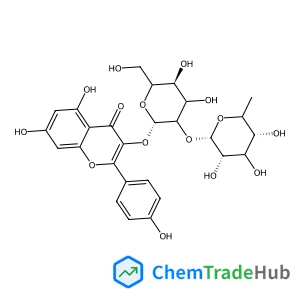
5,7-Dihydroxy-2-(4-hydroxyphenyl)-4-oxo-4H-chromen-3-yl 2-O-(6-deoxy-alpha-L-mannopyranosyl)-beta-D-glucopyranoside
CAS Number:
32602-81-6
Molecular Formula:
C27H30O15
Recommended Suppliers





Disclaimer
This page provides academic journal information for reference and research purposes only. We are not affiliated with any journal publishers and do not handle publication submissions. For publication-related inquiries, please contact the respective journal publishers directly.
If you notice any inaccuracies in the information displayed, please contact us at support@chemtradehub.com. We will promptly review and address your concerns.