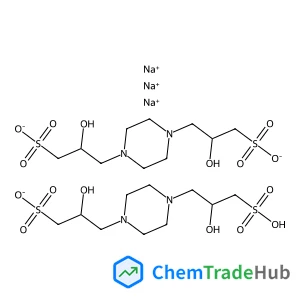
3,3'-(Piperazine-1,4-diyl)bis(2-hydroxypropane-1-sulfonic acid) Sodium Salt
CAS Number:
108321-08-0
Molecular Formula:
C20H41N4Na3O16S4
Darwin Barayang Putungan, Jer-Lai Kuo
In this work, we probed the lithium and sodium intercalation properties in monolayer-stacked NbSe2 bilayer homostructure configurations for their potential application as anode materials in lithium and sodium ion batteries. Similar to known monolayer transition metal dichalcogenides, such as VS2, the structural phase transition barrier of NbSe2 from 1H to 1T is strengthened by lithium and sodium adsorption, implying that it is robust under multiple charging and discharging processes. As multi-layer, stacked 2D materials are more relevant to experiments and their intended applications, four bilayer homostructure stackings were constructed based on the alignment of Nb and Se. All four bilayer homostructure stackings were found to significantly enhance the binding of lithium and sodium at the van der Waals interface, and thus potentially increase the theoretical specific energy capacity of NbSe2via bilayer stacking. In terms of ionic diffusion, it is observed that for all of the bilayer homostructure configurations the diffusion energy barrier for lithium and sodium generally increased compared to the monolayer case. The nature of the stacking appears to affect the diffusion energy barrier with a value of as high as 1.94 eV in the case of sodium for the AB full stacking (compared to 0.08 eV for the monolayer). It is inferred that although the bilayer homostructure stacking of NbSe2 could significantly increase the theoretical specific energy capacity for both lithium and sodium, its drawback is the slowing down of the ion kinetics at the van der Waals interface, which are also important in the charging and discharging processes of a battery system.
Qiong Wu, Gui-Lin Li, Shuang Yang, Xiao-Qin Shi, Tian-Zi Huang, Xi-Hua Du, Yan Chen
DOI: 10.1039/C9OB00283A
Mio Takagi, Ayako Watanabe, Shigeo Murata, Ryo Takita
DOI: 10.1039/C8OB02708K
Anshu Kalwar, Babulal Das
DOI: 10.1039/C9OB01035A
Chen Zhang, Junxia Pi, Lei Wang, Ping Liu, Peipei Sun
DOI: 10.1039/C8OB02670J
Radhakrishna Gattu, Santa Mondal, Saghir Ali, Abu T. Khan
DOI: 10.1039/C8OB02333F
Cheng Zhang, Yu Qian
DOI: 10.1039/C8OB02420K
Andrey G. Lvov, Vadim V. Kachala, Konstantin A. Lyssenko, Valerii Z. Shirinian
DOI: 10.1039/C9OB00690G
Esther Matamoros, Pedro Cintas, Juan Carlos Palacios
DOI: 10.1039/C9OB01011D
Anne-Laure Vallet, Emmanuel Lacôte
DOI: 10.1039/C9OB00578A
3-Fluoro-2-methylbenzylamine is an organic compound with the CAS number 771573-3...
Tert-butyl 2-(oxetan-3-ylidene)acetate is considered safe for its intended uses ...
Proper personal protective equipment (PPE) such as gloves, goggles, and a lab co...
2-Ethyl-4-methyl-1,3-thiazole is commonly synthesized via the reaction of thiour...
This compound should be stored in a cool, dry place away from direct sunlight an...
L-Lysine Acetate Salt (CAS: 52315-92-1) is subject to various regulatory guideli...
6-Fluoro-3-hydroxy-2-pyrazinecarboxamide (CAS: 259793-96-9) is generally conside...
1,1'-Sulfonylbis(1H-imidazole) is a crystalline solid with a molecular weight of...
4-Methyl-7-nitro-1H-indole-3-carbonitrile (CAS: 289483-82-5) is primarily used i...
Waste containing 5-Bromo-3-indolyl-beta-galactoside (CAS: 97753-82-7) should be ...

Physical Chemistry Chemical Physics (PCCP) is an international journal co-owned by 19 physical chemistry and physics societies from around the world. This journal publishes original, cutting-edge research in physical chemistry, chemical physics and biophysical chemistry. To be suitable for publication in PCCP, articles must include significant innovation and/or insight into physical chemistry; this is the most important criterion that reviewers and Editors will judge against when evaluating submissions. The journal has a broad scope and welcomes contributions spanning experiment, theory, computation and data science. Topical coverage includes spectroscopy, dynamics, kinetics, statistical mechanics, thermodynamics, electrochemistry, catalysis, surface science, quantum mechanics, quantum computing and machine learning. Interdisciplinary research areas such as polymers and soft matter, materials, nanoscience, energy, surfaces/interfaces, and biophysical chemistry are welcomed if they demonstrate significant innovation and/or insight into physical chemistry. Joined experimental/theoretical studies are particularly appreciated when complementary and based on up-to-date approaches.
![(1R,3S,5R)-2-{[(2-Methyl-2-propanyl)oxy]carbonyl}-2-azabicyclo[3.1.0]hexane-3-carboxylic acid structure](https://static.chemtradehub.com/structs/197/197142-34-0-6a44.webp "(1R,3S,5R)-2-{[(2-Methyl-2-propanyl)oxy]carbonyl}-2-azabicyclo[3.1.0]hexane-3-carboxylic acid structure")
![5-Methoxy-1H-pyrrolo[3,2-b]pyridine structure](https://static.chemtradehub.com/structs/172/17288-40-3-a8d1.webp "5-Methoxy-1H-pyrrolo[3,2-b]pyridine structure")