


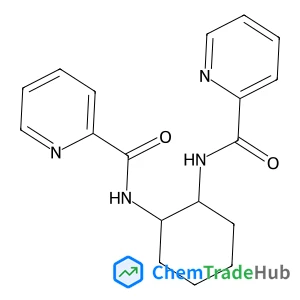
N,N'-(1R,2R)-1,2-Cyclohexanediyldi(2-pyridinecarboxamide)
CAS Number:
218290-24-5
Molecular Formula:
C18H20N4O2
Lina Uribe, Sara Gómez, Tommaso Giovannini, Franco Egidi, Albeiro Restrepo
Accurate calculation of absorption spectra of aqueous NO2− requires rigorously sampling the quantum potential energy surfaces for microsolvation of NO2− with at least five explicit water molecules and embedding the resulting clusters in a continuum solvent accounting for the statistical weighted contributions of individual isomers. This method, which we address as ASCEC + PCM, introduces several desired features when compared against MD simulations derived QM/MM spectra: comparatively fewer explicit solvent molecules to be treated with expensive QM methods, the identification of equilibrium structures in the quantum PES to be used in further vibrational spectroscopy, and the unequivocal identification of cluster orbitals undergoing electronic transitions and charge transfer that originate the spectral bands.

Journal of Peptide Science

Chemistry Education Research and Practice

Journal of Saudi Chemical Society

Russian Chemical Bulletin

Current Opinion in Solid State & Materials Science

Nature Medicine

Russian Journal of Organic Chemistry

Russian Journal of Bioorganic Chemistry

Crystallography Reports

Organic Process Research & Development
Xinghao Wang, Zifeng Wang, Min Xiao, Zhanhong Li, Zhigang Zhu
DOI: 10.1039/D3BM01551C
Nilvan A. Silva, Ivo M. Raimundo, Jr
DOI: 10.1039/D3AY01457F
Xinke Li, Caiyun Liu, Hanchuang Zhu, Kun Wang, Xiaohua Ren, Lixue Ma, Xiaohui Zhang, Mengyuan Liu, Baocun Zhu
DOI: 10.1039/D3AY01387A
Mengrui Su, Zichen Hu, Yujie Sun, Bingran Yu, Fu-Jian Xu
DOI: 10.1039/D3BM01394D
I. Álvarez-Freire, P. Cabarcos-Fernández, N. C. Rubio, A. Moreda-Piñeiro, M. J. Tabernero-Duque, I. Sánchez-Sellero, P. Bermejo-Barrera, A. M. Bermejo-Barrera
DOI: 10.1039/D3AY01298K
Fengjiao Hao, Yuanyuan Luo, Fengshou Dong, Xinglu Pan, Xiaohu Wu, Yongquan Zheng, Jun Xu
DOI: 10.1039/D3AY01473H
Mengwei Li, Banglian Hu, Zhaojie Wu, Ziwei Wang, Jian Weng, Honghua Zheng, Liping Sun
DOI: 10.1039/D3BM01154B
Faisal K. Algethami, Basant H. Koraim, Ehab A. Abdelrahman, Yasmeen G. Abou El-Reash, Mahmoud S. Rizk
DOI: 10.1039/D3AY01320K
6-Bromo-2-methylimidazo[1,2-a]pyrimidine (CAS: 1111638-05-1) falls under various...
While there are no direct alternatives, similar compounds like 1-Pyrrolidineetha...
4-Methyl-2,6-bis(2-methyl-2-propanyl)phenyl methylcarbamate (CAS: 1918-11-2) is ...
2-(3-Bromo-4-fluorophenyl)-1,3-dioxolane (CAS: 77771-04-1) should be stored in a...
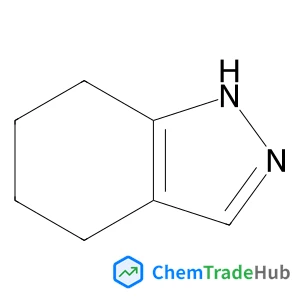
4,5,6,7-Tetrahydro-1H-indazole hydrochloride is a white crystalline solid with a...
(2R)-1-Methoxy-3-phenyl-2-propanamine is a chiral organic compound with the CAS ...
Ethyl 1-(1-phenylethyl)-1H-imidazole-5-carboxylate is used in various industries...
4-[(1E,3S)-1-(4-Hydroxyphenyl)-1,4-pentadien-3-yl]phenol (CAS: 17676-24-3) falls...
(S)-3-Amino-5-phenylpentanoic acid hydrochloride is primarily used in the pharma...
7-Methoxy-1-benzothiophene-2-carboxylic acid is typically synthesized by reactin...

Physical Chemistry Chemical Physics (PCCP) is an international journal co-owned by 19 physical chemistry and physics societies from around the world. This journal publishes original, cutting-edge research in physical chemistry, chemical physics and biophysical chemistry. To be suitable for publication in PCCP, articles must include significant innovation and/or insight into physical chemistry; this is the most important criterion that reviewers and Editors will judge against when evaluating submissions. The journal has a broad scope and welcomes contributions spanning experiment, theory, computation and data science. Topical coverage includes spectroscopy, dynamics, kinetics, statistical mechanics, thermodynamics, electrochemistry, catalysis, surface science, quantum mechanics, quantum computing and machine learning. Interdisciplinary research areas such as polymers and soft matter, materials, nanoscience, energy, surfaces/interfaces, and biophysical chemistry are welcomed if they demonstrate significant innovation and/or insight into physical chemistry. Joined experimental/theoretical studies are particularly appreciated when complementary and based on up-to-date approaches.
![9H-Fluoren-9-ylmethyl {15-[(2,5-dioxo-1-pyrrolidinyl)oxy]-15-oxo-3,6,9,12-tetraoxapentadec-1-yl}carbamate structure](https://static.chemtradehub.com/structs/131/1314378-14-7-4316.webp "9H-Fluoren-9-ylmethyl {15-[(2,5-dioxo-1-pyrrolidinyl)oxy]-15-oxo-3,6,9,12-tetraoxapentadec-1-yl}carbamate structure")





