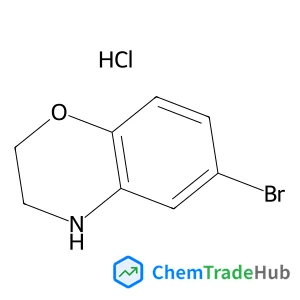
6-Bromo-3,4-dihydro-2H-1,4-benzoxazine hydrochloride (1:1)
CAS Number:
1260803-10-8
Molecular Formula:
C8H9BrClNO
Faisal K. Algethami, Basant H. Koraim, Ehab A. Abdelrahman, Yasmeen G. Abou El-Reash, Mahmoud S. Rizk
Sulfite is a very important species, affecting human health, plant and animal life, and environmental sustainability. In this study, for the first time, an ionophore-based ion-selective optode was constructed for hydrogen sulfite determination in beverages, such as Birell® and Sprite®, water, and soil samples; instead of normal pH-chromoionophores, polyaniline film was precipitated on a glass slide and used for the transduction of the sensation mechanism. The ionophore-modified polyaniline-based optode incorporated thiourea derivative as an ionophore and tridodecyl methyl ammonium chloride as an ion-exchanger. The optode film was prepared in situ with a modified chemical polymerization method, and it was characterized using atomic force microscopy (AFM), scanning electron microscopy (SEM), and X-ray diffraction (XRD); also, FTIR spectroscopy was performed for the film before and after interaction with hydrogen sulfite for mechanism elucidation. The optode was applied in the hydrogen sulfite concentration range of 10−1 to 10−5 M with a low detection limit of 8.0 × 10⁻⁶ M and minimum interference of other interfering species, such as salicylate, iodide, and sulphide. The response mechanism was due to the ion-exchange of hydrogen sulfite with the anion exchanger, followed by the molecular recognition between thiourea ionophore and hydrogen sulfite, with concomitant redox reaction via the protonation of the polyaniline that causes a decrease in absorbance at 685 nm. The optode was applied successfully for the determination of hydrogen sulfite in real beverages, Birell® and Sprite® without any pretreatment steps. Also, it was applied successfully for the environmental monitoring of hydrogen sulfite in real wastewater and soil samples.
Mohammad Mofared, Elnaz Irani, Rasoul Sadighi-Bonabi
DOI: 10.1039/C8CP07619G
Thomas J. Wood, Ronald I. Smith, Claire A. Murray
DOI: 10.1039/C8CP02824A
Rositsa Yakimova
DOI: 10.1039/C8CP03306D
Saurabh Mishra, Jer-Lai Kuo, G. Naresh Patwari
DOI: 10.1039/C8CP02448K
Kristen D. Fulfer, Daniel G. Kuroda
DOI: 10.1039/C8CP03315C
Dominik Legut, Timothy C. Germann, Shiyu Du, Joseph S. Francisco
DOI: 10.1039/C8CP06458J
Monika Schönhoff, Cornelia Cramer, Florian Schmidt
DOI: 10.1039/C8CP06075D
Hrushikesh M. Gade, Piyush P. Wanjari, Srihas V. V. Velpuri
DOI: 10.1039/C8CP02394H
Jaime Suárez, L. Méndez, I. Rabadán
DOI: 10.1039/C8CP03725F
Davide Avagliano, Pedro A. Sánchez-Murcia, Leticia González
DOI: 10.1039/C8CP07508E
4-Nitrophenyl phosphate disodium salt hexahydrate is primarily used as a substra...
2-(Trifluoromethyl)-1,3-oxazole-4-carboxylic Acid (CAS: 1060816-01-4) is widely ...
2-Fluoro-4-biphenylcarboxylic acid should be stored in a cool, dry place at room...
Prednisolone-21-Carboxylic Acid is primarily used in the pharmaceutical industry...
4-(Hydrazinomethyl)-1,2,3-benzenetriol (CAS: 3614-72-0) should be stored in a co...
4-Amino-1-methyl-1H-pyrazole-5-carboxylic acid hydrochloride (CAS: 92534-70-8) i...
Dehydropachymic acid (CAS: 77012-31-8) is regulated by various agencies. It fall...
The market and research trends for 6-[(2,2-Dimethylpropanoyl)amino]nicotinic aci...
1,10-Phenanthroline-2,9-dicarbaldehyde should be stored in a cool, dry place awa...
5-Carbamoyl-11-oxo-10,11-dihydro-5H-dibenzo[b,f]azepin-10-yl acetate can be synt...
Analytical Methods welcomes early applications of new analytical and bioanalytical methods and technology demonstrating the potential for societal impact. We require that methods and technology reported in the journal are sufficiently innovative, robust, accurate, and compared to other available methods for the intended application. Developments with interdisciplinary approaches are particularly welcome. Systems should be proven with suitably complex and analytically challenging samples. We encourage developments within, but not limited to, the following technologies and applications: global health, point-of-care and molecular diagnostics biosensors and bioengineering drug development and pharmaceutical analysis applied microfluidics and nanotechnology omics studies, such as proteomics, metabolomics or glycomics environmental, agricultural and food science neuroscience biochemical and clinical analysis forensic analysis industrial process and method development