
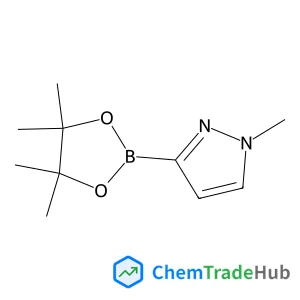
1-Methyl-3-(4,4,5,5-tetramethyl-1,3,2-dioxaborolan-2-yl)-1H-pyrazole
CAS Number:
1020174-04-2
Molecular Formula:
C10H17BN2O2
Karmel Sofia Gkika, Anna Kargaard, Ciaran Dolan, Tia E. Keyes
Oxygen is a crucial reagent in many biochemical processes within living cells and its concentration can be an effective marker in disease, particularly in cancer where tissue hypoxia has been shown to indicate tumour growth. Probes that can reflect the oxygen concentration and distribution using ratiometric signals can be applied to a range of conventional methods without the need for specialised equipment and are particularly useful. The preparation and in cellulo study of luminescent ratiometric core–shell nanoparticles are presented. Here, a new lipophilic and oxygen-responsive Ru(II) tris-heteroleptic polypyridyl complex is co-encapsulated with a reference BODIPY dye into the core of poly-L-lysine-coated polystyrene particles. The co-core encapsulation ensures oxygen response but reduces the impact of the environment on both probes. Single wavelength excitation of the particles, suspended in aqueous buffer, at 480 nm, triggers well-resolved dual emission from both dyes with peak maxima at 515 nm and 618 nm. A robust ratiometric oxygen response is observed from water, with a linear dynamic range of 3.6–262 μM which matches well with typical biological ranges. The uptake of RuBDP NPs was found to be cell-line dependent, but in cancerous cell lines, the particles were strongly permeable with late endosomal and partial lysosomal co-staining observed within 3 to 4 hours, eventually leading to extensive staining of the cytoplasm. The co-localisation of the ruthenium and BODIPY emission confirms that the particles remain intact in cellulo with no indication of dye leaching. The ratiometric O2 sensing response of the particles in cellulo was demonstrated using a plate-based assay and by confocal xyλ scanning of cells exposed to hypoxic conditions.
Norberto Salazar, Igor Beinik, Jeppe V. Lauritsen
DOI: 10.1039/C7CP00958E
Périne Landois, Tianlin Wang, Abir Nachawaty, Maxime Bayle, Jean-Manuel Decams, Wilfried Desrat, Ahmed-Azmi Zahab, Benoît Jouault, Matthieu Paillet, Sylvie Contreras
DOI: 10.1039/C7CP01012E
Elena Castellucci, Laura Bussotti, Lorenzo Zani, Gianna Reginato
DOI: 10.1039/C7CP01956D
Chang Zhou, Qiang Zhang, Saiyue Liu, Bingcheng Luo, Eongyu Yi, Enke Tian, Guowu Li, Longtu Li, Gaohui Wu
DOI: 10.1039/C7CP00676D
Anik Sen
DOI: 10.1039/C7CP00472A
Lhoussain Khrouz, Yi Zhou, Bin Shen, Chunyang Dong, Mingyang Xing, Shashank Mishra, Stéphane Daniele, Jinlong Zhang
DOI: 10.1039/C7CP01212H
W. D. Stevenson, Z. Ahmed, X. B. Zeng, C. Welch, G. H. Mehl
DOI: 10.1039/C7CP01404J
Victor Gray, Ambra Dreos, Paul Erhart, Bo Albinsson, Kasper Moth-Poulsen, Maria Abrahamsson
DOI: 10.1039/C7CP01368J
Tianhui Liu, Bina Fu, Dong H. Zhang
DOI: 10.1039/C7CP01770G
Waste containing N-Methoxy-N-methyl-1,3-thiazole-5-carboxamide (CAS: 898825-89-3...
N-(4-Biphenylyl)dibenzo[b,d]furan-4-amine should be stored in a tightly sealed c...
The market for 3-Acetamido-5-amino-2,4,6-triiodobenzoic acid (CAS: 1713-07-1) is...
Benzyl 2-O-acetyl-3,4,6-tri-O-benzyl-beta-D-galactopyranoside (CAS: 61820-03-9) ...
2-Ethylpiperazine dihydrochloride (CAS: 438050-52-3) is regulated under the Glob...
1,1'-[1,3-Phenylenebis(methylene)]bis(3-methyl-1H-pyrrole-2,5-dione) (CAS: 11946...
Several alternatives can be used in the synthesis of 5-Fluoro-2-(1-pyrrolidinyl)...
Proper personal protective equipment (PPE) must be worn when handling this compo...
When handling 6-Bromoimidazo[1,2-a]pyridin-8-amine, it is important to wear appr...
Alternatives to (2S,4R)-4-(4-Nitrobenzyl)pyrrolidine-2-carboxylic acid hydrochlo...

![1-Naphthalenesulfonic acid, 2-[(2-hydroxy-1-naphthalenyl)azo]-, bariumsalt (2:1) structure](https://static.chemtradehub.com/structs/110/1103-38-4-0b33.webp "1-Naphthalenesulfonic acid, 2-[(2-hydroxy-1-naphthalenyl)azo]-, bariumsalt (2:1) structure")