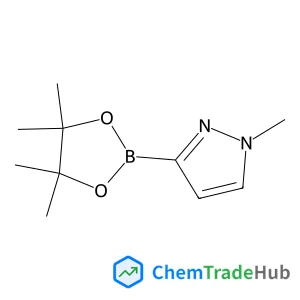
1-Methyl-3-(4,4,5,5-tetramethyl-1,3,2-dioxaborolan-2-yl)-1H-pyrazole
CAS Number:
1020174-04-2
Molecular Formula:
C10H17BN2O2
Norberto Salazar, Igor Beinik, Jeppe V. Lauritsen
The sulfidation of a MoO3 precursor into MoS2 is an important step in the preparation of catalysts for the hydrodesulfurization process that is widely utilized in oil refineries. Molybdenum oxides are also the most commonly used precursors for MoS2 growth in, e.g., the synthesis of novel two-dimensional materials. In the present study, we investigate the transformation of MoOx into MoS2 on a model Au(111) surface through sulfidation in H2S gas atmosphere using in situ scanning tunneling microscopy and X-ray photoemission spectroscopy. We find that progressive annealing steps of physical vapor deposited MoO3 powder allow us to control the stoichiometry and oxidation state of the precursor oxide. Subsequently, we investigate the sulfidation of the compounds ranging from pure low-oxygen Mo to fully oxidized MoO3 oxide sulfidation using two different methods. We find that the prerequisite for the efficient formation of MoS2 is that Mo stays in the highest Mo6+ state before sulfidation, whereas the presence of the reduced MoOx phase impedes the MoS2 growth. We also find that it is more efficient to form MoS2 by post-sulfidation of MoOx rather than its reactive deposition in H2S gas, which leads to rather stable amorphous oxysulfide phases.
Chunlei Wang, Fanning Meng, Mingxing Wu, Xiao Lin, Tonghua Wang, Jieshan Qiu, Tingli Ma
DOI: 10.1039/C3CP52525B
Bas C. van der Wiel, René M. Williams
DOI: 10.1039/C3CP52148F
Devin T. Edwards, Zhidong Ma, Daniella Goldfarb
DOI: 10.1039/C3CP43787F
Daeil Yoon, Qing Su, Haiyan Wang, Arumugam Manthiram
DOI: 10.1039/C3CP52679H
Izabela Czekaj, Katarzyna A. Kacprzak, John Mantzaras
DOI: 10.1039/C3CP51085A
Huangjing Zhao, Youngjune Park, Dong Hyun Lee, Ah-Hyung Alissa Park
DOI: 10.1039/C3CP52459K
Bruce F. Milne, Patrick Norman, Fernando Nogueira, Cláudia Cardoso
DOI: 10.1039/C3CP52528G
Minqiang Hou, Jianling Zhang, Buxing Han, Qingqing Mei, Hui Ning, Dezhong Yang
DOI: 10.1039/C3CP44670K
Hui-Hsuan Hsieh, You-Cheng Hseu, Ko-Shao Chen, Gou-Jen Wang, Yi-Syuan Wei, Ko Hsin Chang, Yeu-Wei Harn
DOI: 10.1039/C3CP50956G
Esther Rebollar, Javier R. Vázquez de Aldana, Ignacio Martín-Fabiani, Margarita Hernández, Daniel R. Rueda, Tiberio A. Ezquerra, Concepción Domingo, Pablo Moreno, Marta Castillejo
DOI: 10.1039/C3CP51523K
Waste containing N-Methoxy-N-methyl-1,3-thiazole-5-carboxamide (CAS: 898825-89-3...
N-(4-Biphenylyl)dibenzo[b,d]furan-4-amine should be stored in a tightly sealed c...
The market for 3-Acetamido-5-amino-2,4,6-triiodobenzoic acid (CAS: 1713-07-1) is...
Benzyl 2-O-acetyl-3,4,6-tri-O-benzyl-beta-D-galactopyranoside (CAS: 61820-03-9) ...
2-Ethylpiperazine dihydrochloride (CAS: 438050-52-3) is regulated under the Glob...
1,1'-[1,3-Phenylenebis(methylene)]bis(3-methyl-1H-pyrrole-2,5-dione) (CAS: 11946...
Several alternatives can be used in the synthesis of 5-Fluoro-2-(1-pyrrolidinyl)...
Proper personal protective equipment (PPE) must be worn when handling this compo...
When handling 6-Bromoimidazo[1,2-a]pyridin-8-amine, it is important to wear appr...
Alternatives to (2S,4R)-4-(4-Nitrobenzyl)pyrrolidine-2-carboxylic acid hydrochlo...

Physical Chemistry Chemical Physics (PCCP) is an international journal co-owned by 19 physical chemistry and physics societies from around the world. This journal publishes original, cutting-edge research in physical chemistry, chemical physics and biophysical chemistry. To be suitable for publication in PCCP, articles must include significant innovation and/or insight into physical chemistry; this is the most important criterion that reviewers and Editors will judge against when evaluating submissions. The journal has a broad scope and welcomes contributions spanning experiment, theory, computation and data science. Topical coverage includes spectroscopy, dynamics, kinetics, statistical mechanics, thermodynamics, electrochemistry, catalysis, surface science, quantum mechanics, quantum computing and machine learning. Interdisciplinary research areas such as polymers and soft matter, materials, nanoscience, energy, surfaces/interfaces, and biophysical chemistry are welcomed if they demonstrate significant innovation and/or insight into physical chemistry. Joined experimental/theoretical studies are particularly appreciated when complementary and based on up-to-date approaches.

![1,2-Diphenyl-4-[2-(phenylsulfinyl)ethyl]-3,5-pyrazolidinedione structure](https://static.chemtradehub.com/structs/57-/57-96-5-efcc.webp "1,2-Diphenyl-4-[2-(phenylsulfinyl)ethyl]-3,5-pyrazolidinedione structure")