













Sustainable production of nano α-Fe2O3/N-doped biochar hybrid nanosheets for supercapacitors
Literature Information
Publication Date
2020-06-15
DOI
10.1039/D0SE00627K
Impact Factor
6.367
Authors
Panyu Li, Hongyang Xie, Xuqian Wang, Yi Xie, Yabo Wang, Yongkui Zhang
View Original
Abstract
Transition metal oxide (TMO)/carbon hybrid materials have shown great potential in energy storage applications. However, their facile, environmentally friendly, cost-efficient and scalable production still remains a challenge. Herein, two-dimensional nano α-Fe2O3/N-doped biochar hybrid nanosheets (α-Fe2O3/NBCS) derived from biomass waste were successfully fabricated via a molten salt route. The molten salt would hinder the decomposition of the carbon framework so that the direct one-step fabrication of an iron oxide/biochar hybrid in an air atmosphere at high temperature could be achieved. The introduction of biomass waste could reduce the crystallite size of α-Fe2O3, and the O2 in air could facilitate the formation of α-Fe2O3, while Fe3O4 was obtained in Ar due to the presence of reducing power of biomass carbon. Compared to the pure α-Fe2O3 sample, the hybrid material showed a much-improved electrochemical performance because of the synergistic effect of α-Fe2O3 and N-doped biochar nanosheets. When applied as the negative electrode material, it exhibited a high specific capacitance of 452.3 F g−1 at 2 A g−1 with a good rate capability in a three-electrode system, and a satisfactory energy density of 17.9 W h kg−1 was obtained in an asymmetric supercapacitor with a fungal manganese oxide-based positive electrode. The satisfactory results suggested that the fabricated α-Fe2O3/NBCS could be a candidate of negative electrode materials for supercapacitor applications. Overall, this work provides an environmentally friendly and cost-efficient route to synthesize TMO/carbon hybrid materials with a simplified synthetic procedure for large-scale production accompanied by the high value-added conversion of biomass waste.
Related Literature
Enhanced fluorescence of phthalimide compounds induced by the incorporation of electron-donating alicyclic amino groups
Ryoji Orita, Marius Franckevičius, Aurimas Vyšniauskas, Vidmantas Gulbinas, Haruki Sugiyama, Hidehiro Uekusa, Kenta Kanosue, Ryohei Ishige, Shinji Ando
2018-05-14
Paper
DOI: 10.1039/C8CP01999A
Constructing organic superacids from superhalogens is a rational route as verified by DFT calculations
Fu-Qiang Zhou, Ru-Fang Zhao, Jin-Feng Li, Wen-Hua Xu, Chao-Chao Li, Lan Luo, Jian-Li Li, Bing Yin
2019-01-04
Paper
DOI: 10.1039/C8CP07313A
Effect of oscillation dynamics on long-range electron transfer in a helical peptide monolayer
Daisuke Matsushita, Hirotaka Uji, Shunsaku Kimura
2018-05-23
Paper
DOI: 10.1039/C8CP02315H
Anchoring of carboxyl-functionalized porphyrins on MgO, TiO2, and Co3O4 nanoparticles
Fabian Kollhoff, Johannes Schneider, Gao Li, Sami Barkaoui, Wenjie Shen, Thomas Berger, Oliver Diwald
2018-09-11
Paper
DOI: 10.1039/C8CP04873H
Ferroelectric-mediated filamentary resistive switching in P(VDF-TrFE)/ZnO nanocomposite films
Tae Yeon Kim, Gopinathan Anoop, Yeong Jun Son, Soo Hyeon Kim, Eunji Lee, Ji Young Jo
2018-04-30
Paper
DOI: 10.1039/C8CP02024H
Mechanism and modeling of poly[vinylpyrrolidone] (PVP) facilitated synthesis of silver nanoplates
Neethu Thomas, Ethayaraja Mani
2018-05-16
Paper
DOI: 10.1039/C8CP01610K
Understanding the interactions of imidazolium-based ionic liquids with cell membrane models
Carlos M. N. Mendonça, Debora T. Balogh, Simone C. Barbosa, Tânia E. Sintra, Sónia P. M. Ventura, Pedro Morgado, Eduardo J. M. Filipe, João A. P. Coutinho, Osvaldo N. Oliveira, Jr., Ana Barros-Timmons
2018-11-09
Paper
DOI: 10.1039/C8CP05035J
White-light generation from all-solution-processed OLEDs using a benzothiazole–salophen derivative reactive to the ESIPT process
José Carlos Germino, Jônatas Faleiro Berbigier, Cristina Aparecida Barboza, Marcelo Meira Faleiros, Deborah de Alencar Simoni, Miguel Tayar Galante, Matheus Serra de Holanda, Fabiano Severo Rodembusch, Teresa Dib Zambon Atvars
2018-11-27
Paper
DOI: 10.1039/C8CP06485G
Strain and defect engineering on phase transition of monolayer black phosphorene
Yan Chen, Xiaoyang Shi, Mingjia Li, Yilun Liu
2018-06-06
Paper
DOI: 10.1039/C8CP01334A
You might also like
Compound Q&A
Is 2-(2-chloroacetamido)-3-phenylpropanoic acid (CAS: 7765-11-9) safe?
2-(2-Chloroacetamido)-3-phenylpropanoic acid (CAS: 7765-11-9) is generally consi...
7765-11-92-(2-chloroacetamido...
Compound Q&A
Is 2-(Benzyloxy)-5-bromobenzoic acid (CAS: 62176-31-2) safe?
2-(Benzyloxy)-5-bromobenzoic acid can be handled safely if appropriate precautio...
62176-31-22-(Benzyloxy)-5-brom...
Compound Q&A
What is (4-Methyl-1,2,5-oxadiazol-3-yl)methanamine hydrochloride (CAS: 1159825-48-5)?
(4-Methyl-1,2,5-oxadiazol-3-yl)methanamine hydrochloride is a chemical compound ...
1159825-48-5(4-Methyl-1,2,5-oxad...
Compound Q&A
What is 2-(5-Hexylthiophen-2-yl)-4,4,5,5-tetramethyl-1,3,2-dioxaborolane (CAS: 917985-54-7)?
2-(5-Hexylthiophen-2-yl)-4,4,5,5-tetramethyl-1,3,2-dioxaborolane (CAS: 917985-54...
917985-54-72-(5-Hexylthiophen-2...
Compound Q&A
Are there alternatives to 4-(8-Methyl-9H-1,3-dioxolo[4,5-h][2,3]benzodiazepin-5-yl)benzenamine (CAS: 102771-26-6) in synthesis?
While 4-(8-Methyl-9H-1,3-dioxolo[4,5-h][2,3]benzodiazepin-5-yl)benzenamine (CAS:...
102771-26-64-(8-Methyl-9H-1,3-d...
Compound Q&A
What is the market or research trend for tert-butyl 3-hydroxy-4,5,7,8-tetrahydro-2H-pyrazolo[3,4-d]azepine-6-carboxylate (CAS: 851376-80-2)?
The market for tert-butyl 3-hydroxy-4,5,7,8-tetrahydro-2H-pyrazolo[3,4-d]azepine...
851376-80-2tert-butyl 3-hydroxy...
Compound Q&A
How should waste containing 3,5-Diamino-1H-pyrazole-4-carbonitrile (CAS: 6844-58-2) be handled?
Waste containing 3,5-Diamino-1H-pyrazole-4-carbonitrile (CAS: 6844-58-2) should ...
6844-58-23,5-Diamino-1H-pyraz...
Compound Q&A
How is (6-Fluoro-3-pyridinyl)boronic acid (CAS: 351019-18-6) typically synthesized?
(6-Fluoro-3-pyridinyl)boronic acid can be synthesized through the reaction of 6-...
351019-18-6(6-Fluoro-3-pyridiny...
Compound Q&A
What industries use Dibenzyl carbonimidoylbiscarbamate (CAS: 10065-79-9)?
Dibenzyl carbonimidoylbiscarbamate (CAS: 10065-79-9) finds applications in vario...
10065-79-9Dibenzyl carbonimido...
Compound Q&A
What is the market or research trend for (beta,beta,2,3,4,5,6-~2~H_7_)Phenylalanine (CAS: 74228-83-4)?
The market for (beta,beta,2,3,4,5,6-~2~H_7_)Phenylalanine (CAS: 74228-83-4) is g...
74228-83-4(beta,beta,2,3,4,5,6...
Source Journal
Recommended Compounds

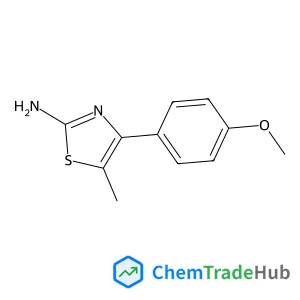
4-(4-Methoxyphenyl)-5-methyl-1,3-thiazol-2-amine
CAS Number:
105512-88-7
Molecular Formula:
C11H12N2OS
![[3-Fluoro-4-(1-pyrrolidinylcarbonyl)phenyl]boronic acid structure](https://static.chemtradehub.com/structs/874/874289-09-5-e3d4.webp "[3-Fluoro-4-(1-pyrrolidinylcarbonyl)phenyl]boronic acid structure")
[3-Fluoro-4-(1-pyrrolidinylcarbonyl)phenyl]boronic acid
CAS Number:
874289-09-5
Molecular Formula:
C11H13BFNO3
Recommended Suppliers





Disclaimer
This page provides academic journal information for reference and research purposes only. We are not affiliated with any journal publishers and do not handle publication submissions. For publication-related inquiries, please contact the respective journal publishers directly.
If you notice any inaccuracies in the information displayed, please contact us at support@chemtradehub.com. We will promptly review and address your concerns.