












Radical generation from electroreduction of aryl and benzyl ammonium salts: synthesis of organoboronates
Literature Information
Publication Date
2020-12-12
DOI
10.1039/D0QO00979B
Impact Factor
5.281
Authors
Long Lin, Qianjin Chen, Bo Xu
View Original
Abstract
We report a direct electrocatalytic borylation of aryl and benzyl trimethylammonium salts with bis(pinacolato)diboron at room temperature. The protocol is compatible with substrates bearing a variety of functional groups, including halides (Cl and Br), which are not tolerated by previously reported methods involving nickel catalysis or photocatalysis. The protocol does not require stoichiometric metals, external reducing agents, or sacrificial anodes and can be carried out on a gram scale.
Related Literature
Facile preparation of linear polystyrene-stabilized Pd nanoparticles in water
Atsushi Ohtaka, Takuto Teratani, Ryohei Fujii, Kanako Ikeshita, Osamu Shimomura
2009-10-15
Communication
DOI: 10.1039/B915039K
Asymmetric epoxidation of 2-arylidene-1,3-diketones: facile access to synthetically useful epoxides
Alessio Russo, Alessandra Lattanzi
2010-04-01
Paper
DOI: 10.1039/C002587A
Reversible circularization of an anthracene-modified DNA conjugate through bimolecular triplex formation and its analytical application
Pelin Arslan, Akinori Jyo
2010-08-24
Paper
DOI: 10.1039/C0OB00282H
Theoretical investigations on the formation of nitrobenzanthrone-DNA Adducts
Volker M. Arlt, David H. Phillips, Jóhannes Reynisson
2011-05-26
Paper
DOI: 10.1039/C1OB05570D
The influence of a 1,1-diarylvinyl moiety on the photochromism of naphthopyrans
Christopher D. Gabbutt, B. Mark Heron, Colin Kilner, Suresh B. Kolla
2010-08-16
Paper
DOI: 10.1039/C0OB00141D
Radical formation of amino acid precursors in interstellar regions? Ser, Cys and Asp
Daniel J. Knowles, Tianfang Wang, John H. Bowie
2010-08-31
Paper
DOI: 10.1039/C0OB00232A
Strategies for the synthesis of bioactive pyran naphthoquinones
Vitor Francisco Ferreira, Sabrina Baptista Ferreira, Fernando de Carvalho da Silva
2010-09-13
Perspective
DOI: 10.1039/C0OB00277A
Synthesis of 3-amino-thiochromanes from 4-benzyl 2-thiazolines, via an unprecedented intramolecular electrophilic aromatic substitution
Guillaume Mercey, Remi Legay, Jean-François Lohier, Jana Sopkova-de Oliveira Santos, Jocelyne Levillain, Annie-Claude Gaumont, Mihaela Gulea
2010-04-22
Communication
DOI: 10.1039/C003050C
Pyrophosphate selective fluorescent chemosensors based on coumarin–DPA–Cu(ii) complexes
Min Jung Kim, Kyung Mi Lee, Arun R. Jagdale, Youngmee Kim, Sung-Jin Kim, Kyung Ho Yoo
2009-10-22
Communication
DOI: 10.1039/B913809A
You might also like
Compound Q&A
What industries use (1R,3S)-1,3-Cyclopentanediol (CAS: 16326-97-9)?
(1R,3S)-1,3-Cyclopentanediol finds applications in various industries. In the ph...
16326-97-9(1R,3S)-1,3-Cyclopen...
Compound Q&A
What precautions should be taken when handling N'-[4-(Dimethylamino)phenyl]-N,N-dimethyl-1,4-benzenediamine (CAS: 637-31-0)?
When handling N'-[4-(Dimethylamino)phenyl]-N,N-dimethyl-1,4-benzenediamine, it i...
637-31-0N'-[4-(Dimethylamino...
Compound Q&A
Are there alternatives to 5-(2,4-Difluorophenyl)-2-methoxypyrimidine (CAS: 1352318-16-1) in synthesis?
There are several alternatives to 5-(2,4-Difluorophenyl)-2-methoxypyrimidine in ...
1352318-16-15-(2,4-Difluoropheny...
Compound Q&A
What regulatory guidelines apply to 1-(3-Methoxyphenoxy)propan-2-ol (CAS: 382141-68-6)?
1-(3-Methoxyphenoxy)propan-2-ol (CAS: 382141-68-6) must comply with the Globally...
382141-68-61-(3-Methoxyphenoxy)...
Compound Q&A
Is Tetrodotoxin Citrate (CAS: 18660-81-6) safe?
Tetrodotoxin Citrate is extremely dangerous and should be handled with extreme c...
18660-81-6Tetrodotoxin Citrate
Compound Q&A
What are the main uses of 2-Methyl-2-propanyl [(1R,3S)-3-hydroxycyclopentyl]carbamate (CAS: 225641-84-9)?
2-Methyl-2-propanyl [(1R,3S)-3-hydroxycyclopentyl]carbamate (CAS: 225641-84-9) i...
225641-84-92-Methyl-2-propanyl ...
Compound Q&A
How should waste containing 4-(2-Hydroxyhexafluoroisopropyl)Benzoic Acid (CAS: 16261-80-6) be handled?
Waste containing 4-(2-Hydroxyhexafluoroisopropyl)Benzoic Acid (CAS: 16261-80-6) ...
16261-80-64-(2-Hydroxyhexafluo...
Compound Q&A
How is 2-Methyl-2-proanyl {(2S)-1-[(benzyloxy)amino]-3-hydroxy-3-methyl-1-oxo-2-butanyl}carbamate (CAS: 102507-19-7) typically synthesized?
2-Methyl-2-proanyl {(2S)-1-[(benzyloxy)amino]-3-hydroxy-3-methyl-1-oxo-2-butanyl...
102507-19-72-Methyl-2-propanyl ...
Compound Q&A
What is Benzeneethanamine, α-ethyl-, hydrochloride (1:1) (CAS: 20735-15-3)?
Benzeneethanamine, α-ethyl-, hydrochloride (1:1) is an organic compound with the...
20735-15-3Benzeneethanamine, α...
Compound Q&A
Are there alternatives to 3-{(E)-[4-(Dimethylamino)phenyl]diazenyl}benzoic acid (CAS: 20691-84-3) in synthesis?
In the synthesis of compounds similar to 3-{(E)-[4-(Dimethylamino)phenyl]diazeny...
20691-84-33-{(E)-[4-(Dimethyla...
Source Journal
Organic Chemistry Frontiers

CiteScore:
7.8
Self-citation Rate:
8.7%
Articles per Year:
724
Organic Chemistry Frontiers publishes high-quality research from across organic chemistry. Emphases are placed on studies that make significant contributions to the field of organic chemistry by reporting either new or significantly improved protocols or methodologies. Topics include, but are not limited to the following: Organic synthesis Development of synthetic methodologies Catalysis Natural products Functional organic materials Supramolecular and macromolecular chemistry Physical and computational organic chemistry
Recommended Compounds
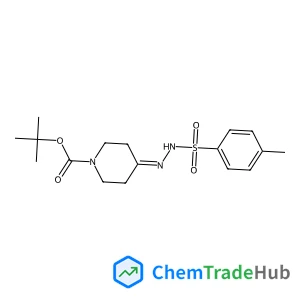
tert-Butyl 4-(2-(p-Tolylsulfonyl)hydrazono)piperidine-1-carboxylate
CAS Number:
1046478-89-0
Molecular Formula:
C17H25N3O4S
Recommended Suppliers





Disclaimer
This page provides academic journal information for reference and research purposes only. We are not affiliated with any journal publishers and do not handle publication submissions. For publication-related inquiries, please contact the respective journal publishers directly.
If you notice any inaccuracies in the information displayed, please contact us at support@chemtradehub.com. We will promptly review and address your concerns.