












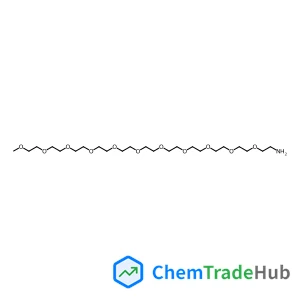
2,5,8,11,14,17,20,23,26,29,32-Undecaoxatetratriacontan-34-amine
CAS Number:
854601-60-8
Molecular Formula:
C23H49NO11
Thi Huong Le, Thanh-Tuân Bui, Frédéric Dumur, Fabrice Goubard
Three thioxanthone derivatives differing by their peripheral groups have been investigated as visible light photoinitiators of polymerisation. Their reactivity and efficiency have been compared with that of a commercial type II photoinitiator (2-isopropylthioxanthone – ITX) in the case of free radical polymerisation, cationic polymerisation and interpenetrated polymer networks synthesis for 25 μm or 1.4 mm thick samples under 405 nm LED irradiation. They are incorporated into either, a two-component system with an iodonium salt or an amine, or a three-component system combining an iodonium salt and an amine. Using absorption and fluorescence spectroscopies, laser flash photolysis and molecular modelling, optical properties, excited state energies and lifetimes of these thioxanthone derivatives have been determined allowing a better understanding of the associated chemical mechanisms. Interestingly, the main reaction pathway for one of these thioxanthone derivatives in the photoinitiating systems was determined as involving its singlet state S1 whereas ITX and thioxanthones are known to react from their triplet excited state T1. The high efficiency of the new initiating systems was found as being worthwhile for laser write applications @405 nm but also for high migration stability.
Mateusz Rebarz, Martin Rohrmüller, Shirly Espinoza, Miroslav Kloz, Norman Kretzschmar, Adam Neuba, Jochen Ortmeyer, Roland Schoch, Matthias Bauer, Wolf Gero Schmidt, Gerald Henkel
DOI: 10.1039/C7CP04880G
Stanka V. Jerosimić, Franco A. Gianturco, Roland Wester
DOI: 10.1039/C7CP05573K
Maolin Yu, Xiaofei Liu, Wanlin Guo
DOI: 10.1039/C7CP07912E
DOI: 10.1039/C8CP01552J
Elisa Y. M. Ang, Teng Yong Ng, Rongming Lin, Zishun Liu, K. R. Geethalakshmi
DOI: 10.1039/C8CP01191E
Andreas Meyer, Jean Jacques Jassoy, Sebastian Spicher, Andreas Berndhäuser, Olav Schiemann
DOI: 10.1039/C8CP01276H
Ting-Jun Bi, Long-Kun Xu, Fan Wang, Xiang-Yuan Li
DOI: 10.1039/C8CP00930A
Christoph Nançoz, Giuseppe Licari, Joseph S. Beckwith, Magnus Soederberg, Bogdan Dereka, Arnulf Rosspeintner, Oleksandr Yushchenko, Romain Letrun, Sabine Richert, Bernhard Lang, Eric Vauthey
DOI: 10.1039/C7CP08390D
Alexey Koltsov, Jean-Michel Mataigne
DOI: 10.1039/C7CP08636A
3-Fluoro-2-methylbenzylamine is an organic compound with the CAS number 771573-3...
Tert-butyl 2-(oxetan-3-ylidene)acetate is considered safe for its intended uses ...
Proper personal protective equipment (PPE) such as gloves, goggles, and a lab co...
2-Ethyl-4-methyl-1,3-thiazole is commonly synthesized via the reaction of thiour...
This compound should be stored in a cool, dry place away from direct sunlight an...
L-Lysine Acetate Salt (CAS: 52315-92-1) is subject to various regulatory guideli...
6-Fluoro-3-hydroxy-2-pyrazinecarboxamide (CAS: 259793-96-9) is generally conside...
1,1'-Sulfonylbis(1H-imidazole) is a crystalline solid with a molecular weight of...
4-Methyl-7-nitro-1H-indole-3-carbonitrile (CAS: 289483-82-5) is primarily used i...
Waste containing 5-Bromo-3-indolyl-beta-galactoside (CAS: 97753-82-7) should be ...

Polymer Chemistry welcomes submissions in all areas of polymer science that have a strong focus on macromolecular chemistry. Manuscripts may cover a broad range of fields, yet no direct application focus is required.
![1,1'-[(E)-1,2-Ethenediyl]bis(4-bromobenzene) structure](https://static.chemtradehub.com/structs/188/18869-30-2-c907.webp "1,1'-[(E)-1,2-Ethenediyl]bis(4-bromobenzene) structure")
![trans,trans-4-n-Propyl-4-[4-(trifluoromethoxy)phenyl]bicyclohexyl structure](https://static.chemtradehub.com/structs/133/133937-72-1-25ef.webp "trans,trans-4-n-Propyl-4-[4-(trifluoromethoxy)phenyl]bicyclohexyl structure")
![(3R)-3-(3-Fluorophenyl)-3-({[(2-methyl-2-propanyl)oxy]carbonyl}amino)propanoic acid structure](https://static.chemtradehub.com/structs/500/500789-04-8-20dd.webp "(3R)-3-(3-Fluorophenyl)-3-({[(2-methyl-2-propanyl)oxy]carbonyl}amino)propanoic acid structure")



