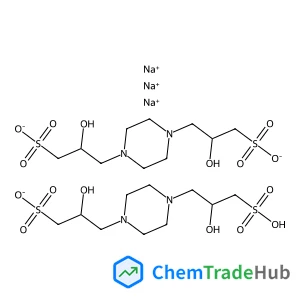
3,3'-(Piperazine-1,4-diyl)bis(2-hydroxypropane-1-sulfonic acid) Sodium Salt
CAS Number:
108321-08-0
Molecular Formula:
C20H41N4Na3O16S4
Diana C. M. Ribeiro, Carlos M. R. Abreu, Rafael A. C. Rebelo, Abdirisak A. Isse, Arménio C. Serra, Armando Gennaro, Krzysztof Matyjaszewski, Jorge F. J. Coelho
The stringent control over the polymerization of less activated monomers remains one major challenge for Reversible Deactivation Radical Polymerizations (RDRP), including Atom Transfer Radical Polymerization (ATRP). Electrochemically mediated ATRP (eATRP) of a gaseous monomer, vinyl chloride (VC), was successfully achieved for the first time using a stainless-steel 304 (SS304) electrochemical reactor equipped with a simplified electrochemical setup. Controlled polymerizations were confirmed by the good agreement between theoretical and measured molecular weights, as well as the relatively narrow molecular weight distributions. Preservation of chain-end fidelity was verified by chain extension experiments, yielding poly(vinyl chloride) (PVC) homopolymers, block and statistical copolymers. The possibility of synthesizing PVC by eATRP is a promising alternative to afford cleaner (co)polymers, with low catalyst concentration. The metal body of the reactor was also successfully used as a cathode. The setup proposed in this contribution opens an avenue for the polymerization of other gaseous monomers.
Aimal Khan, Shuhua Zou, Ting Wang, Jerosha Ifthikar, Ali Jawad, Zhuwei Liao, Ajmal Shahzad, Audrey Ngambia, Zhuqi Chen
DOI: 10.1039/C8CP02080A
Satyajit Patra, Christian Anders, Paul Hendrik Schummel, Roland Winter
DOI: 10.1039/C8CP00907D
C. Prior, L. Danilāne, V. S. Oganesyan
DOI: 10.1039/C7CP08625C
Thomas Loerting
DOI: 10.1039/C7CP08677F
Palash Jana, Mithun Radhakrishna, Saumyakanti Khatua, Sriram Kanvah
DOI: 10.1039/C7CP06300H
A. Moissette
DOI: 10.1039/C7CP07968K
DOI: 10.1039/C7CP08239H
Jesper Norell, Raphael M. Jay, Markus Hantschmann, Meiyuan Guo, Philippe Wernet, Michael Odelius
DOI: 10.1039/C7CP08326B
Matthew D. Ward, Haw-Tyng Huang, Li Zhu, Arani Biswas, Dmitry Popov, Timothy A. Strobel
DOI: 10.1039/C7CP07852H
Alexey Koltsov, Jean-Michel Mataigne
DOI: 10.1039/C7CP08636A
3-Fluoro-2-methylbenzylamine is an organic compound with the CAS number 771573-3...
Tert-butyl 2-(oxetan-3-ylidene)acetate is considered safe for its intended uses ...
Proper personal protective equipment (PPE) such as gloves, goggles, and a lab co...
2-Ethyl-4-methyl-1,3-thiazole is commonly synthesized via the reaction of thiour...
This compound should be stored in a cool, dry place away from direct sunlight an...
L-Lysine Acetate Salt (CAS: 52315-92-1) is subject to various regulatory guideli...
6-Fluoro-3-hydroxy-2-pyrazinecarboxamide (CAS: 259793-96-9) is generally conside...
1,1'-Sulfonylbis(1H-imidazole) is a crystalline solid with a molecular weight of...
4-Methyl-7-nitro-1H-indole-3-carbonitrile (CAS: 289483-82-5) is primarily used i...
Waste containing 5-Bromo-3-indolyl-beta-galactoside (CAS: 97753-82-7) should be ...

Polymer Chemistry welcomes submissions in all areas of polymer science that have a strong focus on macromolecular chemistry. Manuscripts may cover a broad range of fields, yet no direct application focus is required.
![trans,trans-4-n-Propyl-4-[4-(trifluoromethoxy)phenyl]bicyclohexyl structure](https://static.chemtradehub.com/structs/133/133937-72-1-25ef.webp "trans,trans-4-n-Propyl-4-[4-(trifluoromethoxy)phenyl]bicyclohexyl structure")
![5-(2-Phenylpyrazolo[1,5-a]pyridin-3-yl)-2H-pyrazolo[3,4-c]pyridazin-3-amine structure](https://static.chemtradehub.com/structs/865/865362-74-9-0091.webp "5-(2-Phenylpyrazolo[1,5-a]pyridin-3-yl)-2H-pyrazolo[3,4-c]pyridazin-3-amine structure")