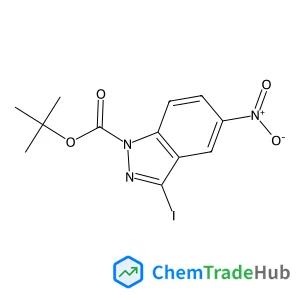
Tert-butyl 3-iodo-5-nitro-1H-indazole-1-carboxylate
CAS Number:
459133-69-8
Molecular Formula:
C12H12IN3O4
A. Moissette
The confinement effects of a zeolite framework on the adsorption of a bidentate 4,4′-bipyridine (44BPY) ligand on the straight channel of H-ZSM-5 have been investigated by density functional theory calculations using B3LYP, B3LYP-D3, M06-2X, M06-2X-D3 functionals, and the MP2 method with two basis sets 6-31+G* and 6-31++G(2d,2p). The straight channel is simulated by a realistic cluster model of 32 tetrahedra (T), having two aluminum atoms located in the straight and intersection regions, respectively. The potential energy surface of the double proton transfer reaction from the Brønsted acid sites of H-ZSM-5 to 44BPY is characterized by three minima corresponding to two monodentate ion pair complexes 44BPYH+/32T− and one bidentate ion pair complex 44BPYH22+/32T2− formed consecutively via two distinct pathways. No energy minimum is found for a neutral hydrogen bonding structure. The relative stabilities of these 44BPY adsorption complexes and the transition states connecting them do not exceed 4.9 and 4.2 kcal mol−1, respectively. Consequently equilibrium between the mono and bidentate complexes could be established. Our results clearly show that the adsorption energy for all complexes is substantially governed by the confinement effects executed through steric constraints and dispersive van der Waals interactions. The calculated vibrational frequencies and frequency shifts of 44BPY adsorbed as mono or diprotonated species are in good agreement with our Raman spectra of 44BPY occluded in H-ZSM-5 of different Si/Al ratios.
Jutta Frank, Michael Krachler, William Shotyk
DOI: 10.1039/B514268G
Marius Grundmann, Tillmann Stralka, Michael Lorenz, Susanne Selle, Christian Patzig, Thomas Höche
DOI: 10.1039/D1MA00204J
DOI: 10.1039/C3TB20284D
Wesley Sattler, Gerard Parkin
DOI: 10.1039/B917156H
Mohd Saiful Asmal Rani, Nur Athirah Abdullah, Muhammad Hanif Sainorudin, Masita Mohammad, Salmiah Ibrahim
DOI: 10.1039/D1MA00206F
Qinzheng Yang, Hua Yue, Bin Wang, Zhiguo Su, Wei Wei, Guanghui Ma
DOI: 10.1039/C3TB20406E
Srikanth Ponnada, Maryam Sadat Kiai, Demudu Babu Gorle, Annapurna Nowduri
DOI: 10.1039/D1MA00332A
Sujit Jain, Sumedh P. Surwade, Srikanth Rao Agnihotra, Vineet Dua, Pamela A. Eliason, Gregory J. Morose, Sanjeev K. Manohar
DOI: 10.1039/B923400D
Qiankun Zhong, Wensheng Liu, Yong Yang, Wenkang Pan, Mingzai Wu, Fangcai Zheng, Xiao Lian, Helin Niu
DOI: 10.1039/D1MA00390A
When handling 4-Methyl-6-(trifluoromethyl)quinoline (CAS: 40716-16-3), safety go...
4-(3,5-Difluorophenyl)aniline is an aromatic organic compound with the CAS numbe...
5-{[4-(Trifluoromethyl)phenyl]sulfanyl}-1,2,3-thiadiazole-4-carboxylic acid can ...
The market for 4-Benzylaniline hydrochloride (CAS: 6317-57-3) is steadily growin...
[3-(Diethylsulfamoyl)phenyl]boronic acid is generally considered safe when handl...
3-Bromo-2,5-dimethoxyaniline is mainly used in the pharmaceutical and chemical i...
N-Methyl-1-(5-methyl-1H-indol-3-yl)methanamine (CAS: 915922-67-7) is subject to ...
This compound is primarily used in the pharmaceutical industry for the synthesis...
2-Methyl-2-propanyl [(1S,3R)-3-aminocyclohexyl]carbamate (CAS: 1298101-47-9) sho...
Ethyl 2-bromo-4,4,4-trifluorobutanoate (CAS: 367-33-9) is utilized in the pharma...

Physical Chemistry Chemical Physics (PCCP) is an international journal co-owned by 19 physical chemistry and physics societies from around the world. This journal publishes original, cutting-edge research in physical chemistry, chemical physics and biophysical chemistry. To be suitable for publication in PCCP, articles must include significant innovation and/or insight into physical chemistry; this is the most important criterion that reviewers and Editors will judge against when evaluating submissions. The journal has a broad scope and welcomes contributions spanning experiment, theory, computation and data science. Topical coverage includes spectroscopy, dynamics, kinetics, statistical mechanics, thermodynamics, electrochemistry, catalysis, surface science, quantum mechanics, quantum computing and machine learning. Interdisciplinary research areas such as polymers and soft matter, materials, nanoscience, energy, surfaces/interfaces, and biophysical chemistry are welcomed if they demonstrate significant innovation and/or insight into physical chemistry. Joined experimental/theoretical studies are particularly appreciated when complementary and based on up-to-date approaches.
![(4aR,5S,6R,8aS)-5-[2-(3-Furyl)ethyl]-8a-(hydroxymethyl)-5,6-dimethyl-3,4,4a,5,6,7,8,8a-octahydro-1-naphthalenecarboxylic acid structure](https://static.chemtradehub.com/structs/184/18411-75-1-d4cd.webp "(4aR,5S,6R,8aS)-5-[2-(3-Furyl)ethyl]-8a-(hydroxymethyl)-5,6-dimethyl-3,4,4a,5,6,7,8,8a-octahydro-1-naphthalenecarboxylic acid structure")