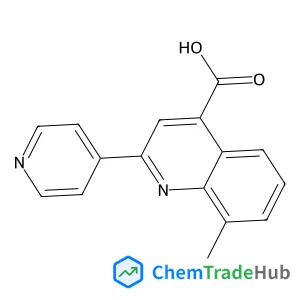
8-Methyl-2-pyridin-4-ylquinoline-4-carboxylic acid
CAS Number:
107027-42-9
Molecular Formula:
C16H12N2O2
Sam Parkinson, Stephen T. Knox, Richard A. Bourne, Nicholas J. Warren
Ultrafast RAFT polymerisation is exploited under dispersion polymerisation conditions for the synthesis of poly(dimethylacrylamide)-b-poly(diacetoneacrylamide) (PDMAmx-b-PDAAmy) diblock copolymer nanoparticles. This process is conducted within continuous-flow reactors, which are well suited to fast reactions and can easily dissipate exotherms making the process potentially scalable. Transient kinetic profiles obtained in-line via low-field flow nuclear magnetic resonance spectroscopy (flow-NMR) confirmed the rapid rate of polymerisation whilst still maintaining pseudo first order kinetics. Gel permeation chromatography (GPC) reported molar mass dispersities, Đ < 1.3 for a series of PDMAmx-b-PDAAmy diblock copolymers (x = 46, or 113; y = 50, 75, 100, 150 and 200) confirming control over molecular weight was maintained. Particle characterisation by dynamic light scattering (DLS) and transmission electron microscopy (TEM) indicated successful preparation of spheres and a majority worm phase at 90 °C but the formation of vesicular morphologies was only possible at 70 °C. To maintain the rapid rate of reaction at this lower temperature, initiator concentration was increased which was also required to overcome the gradual ingress of oxygen into the PFA tubing which was quenching the reaction at low radical concentrations. Ill-defined morphologies observed at PDAAm DPs close to the worm-vesicle boundary, combined with a peak in molar mass dispersity suggested poor mixing prevented an efficient morphological transition for these samples. However, by targeting higher PDAAm DPs, the additional monomer present during the transition plasticises the chains to facilitate formation of vesicles at PDAAm DPs of ≥300.

Atomization and Sprays

Bioorganic & Medicinal Chemistry

Chinese Journal of Chemistry

Journal of the Indian Institute of Science

Polycyclic Aromatic Compounds

Heteroatom Chemistry

Main Group Chemistry

Herald of the Russian Academy of Sciences

Critical Reviews in Solid State and Materials Sciences

Colloid Journal
Dagmar Stumpfe, Alexander Hoch, Jürgen Bajorath
DOI: 10.1039/D1MD00056J
Ronel Müller, Tiaan M. Gerwel, Magambo Phillip Kimuda, Özlem Tastan Bishop, Clinton G. L. Veale, Heinrich C. Hoppe
DOI: 10.1039/D1MD00237F
Hyunsoo Kim, Yoon Soo Hwang, Mingi Kim
DOI: 10.1039/D1MD00068C
Jay Prakash Soni, Yogesh Yeole, Nagula Shankaraiah
DOI: 10.1039/D0MD00422G
Shahinda S. R. Alsayed, Amreena Suri, Anders W. Bailey, Samuel Lane, Chiang-Ching Huang, Li-Fang Yu, Michael Kassiou, Hendra Gunosewoyo
DOI: 10.1039/D1MD00065A
Rachael Zigweid, Bart L. Staker
DOI: 10.1039/D0MD00303D
Utsav Garg, Yasser Azim
DOI: 10.1039/D0MD00400F
Nattawadee Panyain, Aurélien Godinat, Aditya Raymond Thawani, Sofía Lachiondo-Ortega, Katie Mason, Sarah Elkhalifa, Lisa M. Smith, Jeanine A. Harrigan
DOI: 10.1039/D1MD00218J
Koushik Roy, Syamal Roy, Siddhartha Roy
DOI: 10.1039/D1MD00099C
William L. Neumann, Karin E. Sandoval, Shirin Mobayen, Mahsa Minaeian, Stephen G. Kukielski, Khush N. Srabony, Rafael Frare, Olivia Slater, Susan A. Farr, Michael L. Niehoff, Audrey Hospital, Maria Kontoyianni, A. Michael Crider, Ken A. Witt
DOI: 10.1039/D1MD00044F
Waste containing 6-Chloro-5-(2'-hydroxy-3'-methoxy-4-biphenylyl)-3-(3-methoxyphe...
(3alpha,5alpha)-3-Hydroxypregnane-11,20-dione is primarily used in the pharmaceu...
The market for 4-Amino-6-chloro-2-pyridinecarboxylic acid (CAS: 546141-56-4) is ...
Alternatives to (2-Benzoylethyl)trimethylammonium chloride (CAS: 24472-88-6) in ...
N-[4-Nitro-3-(trifluoromethyl)phenyl]acetamide (CAS: 393-12-4) is generally safe...
Alternative reagents such as other phosphates or similar functional groups can b...
There are alternatives to N,N'-Bis(3-aminopropyl)-1,3-propanediamine (CAS: 4605-...
When handling Aluminium trihexadecanoate, it is important to use appropriate per...
(1,1-Dioxido-3-oxo-1,2-benzothiazol-2(3H)-yl)acetic acid is a chemical compound ...
Several alternatives to 5,5-dimethyloxolan-2-one (CAS: 3123-97-5) can be used in...

Polymer Chemistry welcomes submissions in all areas of polymer science that have a strong focus on macromolecular chemistry. Manuscripts may cover a broad range of fields, yet no direct application focus is required.