












Synthesis and structure–activity relationships of 3,4,5-trisubstituted-1,2,4-triazoles: high affinity and selective somatostatin receptor-4 agonists for Alzheimer's disease treatment
Literature Information
Publication Date
2021-05-26
DOI
10.1039/D1MD00044F
Impact Factor
0
Authors
William L. Neumann, Karin E. Sandoval, Shirin Mobayen, Mahsa Minaeian, Stephen G. Kukielski, Khush N. Srabony, Rafael Frare, Olivia Slater, Susan A. Farr, Michael L. Niehoff, Audrey Hospital, Maria Kontoyianni, A. Michael Crider, Ken A. Witt
View Original
Abstract
Somatostatin receptor-4 (SST4) is highly expressed in brain regions affiliated with learning and memory. SST4 agonist treatment may act to mitigate Alzheimer's disease (AD) pathology. An integrated approach to SST4 agonist lead optimization is presented herein. High affinity and selective agonists with biological efficacy were identified through iterative cycles of a structure-based design strategy encompassing computational methods, chemistry, and preclinical pharmacology. 1,2,4-Triazole derivatives of our previously reported hit (4) showed enhanced SST4 binding affinity, activity, and selectivity. Thirty-five compounds showed low nanomolar range SST4 binding affinity, 12 having a Ki < 1 nM. These compounds showed >500-fold affinity for SST4 as compared to SST2A. SST4 activities were consistent with the respective SST4 binding affinities (EC50 < 10 nM for 34 compounds). Compound 208 (SST4Ki = 0.7 nM; EC50 = 2.5 nM; >600-fold selectivity over SST2A) display a favorable physiochemical profile, and was advanced to learning and memory behavior evaluations in the senescence accelerated mouse-prone 8 model of AD-related cognitive decline. Chronic administration enhanced learning with i.p. dosing (1 mg kg−1) compared to vehicle. Chronic administration enhanced memory with both i.p. (0.01, 0.1, 1 mg kg−1) and oral (0.01, 10 mg kg−1) dosing compared to vehicle. This study identified a novel series of SST4 agonists with high affinity, selectivity, and biological activity that may be useful in the treatment of AD.
Related Literature
Screening of DNA G-quadruplex stabilizing ligands by nano differential scanning fluorimetry
Bruno Pagano, Nunzia Iaccarino, Anna Di Porzio, Antonio Randazzo, Jussara Amato
2019-10-07
Communication
DOI: 10.1039/C9AN01463B
Styrylpyridine salts-based red emissive two-photon turn-on probe for imaging the plasma membrane in living cells and tissues
Lifang Guo, Ruoyao Zhang, Yuming Sun, Minggang Tian, Ge Zhang, Ruiqing Feng, Xuechen Li, Xiaoqiang Yu, Xiuquan He
2016-04-26
Communication
DOI: 10.1039/C6AN00147E
Surface-enhanced Raman spectroscopy (SERS) characterisation of abasic sites in DNA duplexes
Luca Guerrini
2019-11-05
Communication
DOI: 10.1039/C9AN02040C
Ambient electrospray deposition Raman spectroscopy (AESD RS) using soft landed preformed silver nanoparticles for rapid and sensitive analysis
Tripti Ahuja, Atanu Ghosh, Sandip Mondal, Pallab Basuri, Shantha Kumar Jenifer, Pillalamarri Srikrishnarka, Jyoti Sarita Mohanty, Sandeep Bose, Thalappil Pradeep
2019-10-15
Paper
DOI: 10.1039/C9AN01700C
Voltammetric detection of glutathione: an adsorptive stripping voltammetry approach
Madalena C. C. Areias, Kenichi Shimizu, Richard G. Compton
2016-04-01
Paper
DOI: 10.1039/C6AN00550K
Proteomic and direct analysis in real time mass spectrometry analysis of a Native American ceremonial hat
Timothy P. Cleland, G. Asher Newsome, R. Eric Hollinger
2019-10-31
Paper
DOI: 10.1039/C9AN01557D
An ionic liquid composed of purely functional sensing molecules: a colorimetrically calcium responsive ionic liquid
Yusuke Niwa, Tatsumi Mizuta, Kenji Sueyoshi, Tatsuro Endo, Hideaki Hisamoto
2019-10-21
Communication
DOI: 10.1039/C9AN01769K
Effects of surface treatments on trapping with DC insulator-based dielectrophoresis
Claire V. Crowther, Viola Sanderlin, Mark A. Hayes, Gillian H. Gile
2019-11-05
Paper
DOI: 10.1039/C9AN01186B
You might also like
Compound Q&A
How should waste containing 6-Chloro-5-(2'-hydroxy-3'-methoxy-4-biphenylyl)-3-(3-methoxyphenyl)-1H-pyrrolo[3,2-d]pyrimidine-2,4(3H,5H)-dione (CAS: 1346607-05-3) be handled?
Waste containing 6-Chloro-5-(2'-hydroxy-3'-methoxy-4-biphenylyl)-3-(3-methoxyphe...
1346607-05-36-Chloro-5-(2'-hydro...
Compound Q&A
What are the main uses of (3alpha,5alpha)-3-Hydroxypregnane-11,20-dione (CAS: 23930-19-0)?
(3alpha,5alpha)-3-Hydroxypregnane-11,20-dione is primarily used in the pharmaceu...
23930-19-0(3alpha,5alpha)-3-Hy...
Compound Q&A
What is the market or research trend for 4-Amino-6-chloro-2-pyridinecarboxylic acid (CAS: 546141-56-4)?
The market for 4-Amino-6-chloro-2-pyridinecarboxylic acid (CAS: 546141-56-4) is ...
546141-56-44-Amino-6-chloro-2-p...
Compound Q&A
Are there alternatives to (2-Benzoylethyl)trimethylammonium chloride (CAS: 24472-88-6) in synthesis?
Alternatives to (2-Benzoylethyl)trimethylammonium chloride (CAS: 24472-88-6) in ...
24472-88-6(2-Benzoylethyl)trim...
Compound Q&A
Is N-[4-Nitro-3-(trifluoromethyl)phenyl]acetamide (CAS: 393-12-4) safe?
N-[4-Nitro-3-(trifluoromethyl)phenyl]acetamide (CAS: 393-12-4) is generally safe...
393-12-4N-[4-Nitro-3-(triflu...
Compound Q&A
Are there alternatives to [(4R,5R,6S)-5-hydroxy-10-imino-3,7-dioxa-1,9-diazatricyclo[6.4.0.02,6]dodeca-8,11-dien-4-yl]methyl dihydrogen phosphate (CAS: 39679-56-6) in synthesis?
Alternative reagents such as other phosphates or similar functional groups can b...
39679-56-6[(4R,5R,6S)-5-hydrox...
Compound Q&A
Are there alternatives to N,N'-Bis(3-aminopropyl)-1,3-propanediamine (CAS: 4605-14-5) in synthesis?
There are alternatives to N,N'-Bis(3-aminopropyl)-1,3-propanediamine (CAS: 4605-...
4605-14-5N,N'-Bis(3-aminoprop...
Compound Q&A
What precautions should be taken when handling Aluminium trihexadecanoate (CAS: 555-35-1)?
When handling Aluminium trihexadecanoate, it is important to use appropriate per...
555-35-1Aluminium trihexadec...
Compound Q&A
What is (1,1-Dioxido-3-oxo-1,2-benzothiazol-2(3H)-yl)acetic acid (CAS: 52188-11-1)?
(1,1-Dioxido-3-oxo-1,2-benzothiazol-2(3H)-yl)acetic acid is a chemical compound ...
52188-11-1(1,1-Dioxido-3-oxo-1...
Compound Q&A
Are there alternatives to 5,5-dimethyloxolan-2-one (CAS: 3123-97-5) in synthesis?
Several alternatives to 5,5-dimethyloxolan-2-one (CAS: 3123-97-5) can be used in...
3123-97-55,5-dimethyloxolan-2...
Source Journal
Recommended Compounds
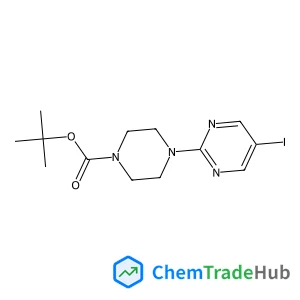
2-Methyl-2-propanyl 4-(5-iodo-2-pyrimidinyl)-1-piperazinecarboxylate
CAS Number:
1027616-32-5
Molecular Formula:
C13H19IN4O2
![2-morpholino-2-[2-(trifluoromethyl)pyrimidin-5-yl]ethanamine structure](https://static.chemtradehub.com/structs/119/1192570-20-9-2810.webp "2-morpholino-2-[2-(trifluoromethyl)pyrimidin-5-yl]ethanamine structure")
2-morpholino-2-[2-(trifluoromethyl)pyrimidin-5-yl]ethanamine
CAS Number:
1192570-20-9
Molecular Formula:
C11H15F3N4O
Recommended Suppliers






Disclaimer
This page provides academic journal information for reference and research purposes only. We are not affiliated with any journal publishers and do not handle publication submissions. For publication-related inquiries, please contact the respective journal publishers directly.
If you notice any inaccuracies in the information displayed, please contact us at support@chemtradehub.com. We will promptly review and address your concerns.