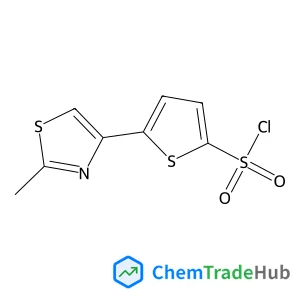
5-(2-Methyl-1,3-thiazol-4-yl)-2-thiophenesulfonyl chloride
CAS Number:
215434-25-6
Molecular Formula:
C8H6ClNO2S3
Jinkang Dou, Ruiqi Yang, Kun Du, Li Jiang, Xiayun Huang, Daoyong Chen
Ultrasound-controlled drug release is a very promising technique for controlled drug delivery due to the unique advantages of ultrasound as the stimulus. For this technique, the polymer assemblies that are sufficiently stable in the suspensions but dissociable under a gentle ultrasound treatment are very desirable. In most cases, such polymer assemblies were constructed by few specific polymers. Few examples of the polymer assemblies that are formed by common linear polymers while able to respond strongly to a gentle ultrasound treatment have been reported, because the chain entanglements within the assemblies resist efficiently the ultrasound-induced shearing force; notably, the ultrasound treatment should be gentle enough and incapable of breaking the polymer chains, otherwise it will damage biological tissues. In this study, we report that through intermediate intrachain-crosslinking of one block of a common diblock copolymer, and then self-assembly of the crosslinked polymer in the selective solvent for the uncrosslinked block, vesicles, worm-like micelles and spherical micelles that are highly regular and stable in the suspensions but dissociable under a gentle ultrasound treatment were prepared. The intermediate crosslinking restricts the chain entanglements within the assemblies remarkably, and thus enhances greatly ultrasound-responsiveness for the polymer assemblies. In addition, during the self-assembly, the as-crosslinked block chains are still flexible and less entangled and thus more dynamic, making the crosslinked polymer much more capable than its precursor in forming regular assemblies with various morphologies. Since most of common polymers either are crosslinkable or can be modified to be crosslinkable, this approach is a general method for preparing the strongly ultrasound-responsive polymer assemblies with different compositions, morphologies and structures.
Daniel M. Gill, Sabrina A. Shamir, Fiona L. Wilkinson, M. Yvonne Alexander, Marinonio L. Cornelio, Alan M. Jones
DOI: 10.1039/D0MD00366B
Nattawadee Panyain, Aurélien Godinat, Aditya Raymond Thawani, Sofía Lachiondo-Ortega, Katie Mason, Sarah Elkhalifa, Lisa M. Smith, Jeanine A. Harrigan
DOI: 10.1039/D1MD00218J
Swagat Sharma, Lauren Lesiak, Christopher D. Aretz, Yu Du, Sushil Kumar, Nagsen Gautam, Yazen Alnouti, Nikilesh V. Dhuria, Yashpal S. Chhonker, C. David Weaver, Corey R. Hopkins
DOI: 10.1039/D1MD00129A
Koushik Roy, Syamal Roy, Siddhartha Roy
DOI: 10.1039/D1MD00099C
William L. Neumann, Karin E. Sandoval, Shirin Mobayen, Mahsa Minaeian, Stephen G. Kukielski, Khush N. Srabony, Rafael Frare, Olivia Slater, Susan A. Farr, Michael L. Niehoff, Audrey Hospital, Maria Kontoyianni, A. Michael Crider, Ken A. Witt
DOI: 10.1039/D1MD00044F
Yiwei Liu, Luyi Zhou, Ying Dong, Rui Wang, Ying Pan, Shuze Zhuang, Dong Liu, Jianqiang Liu
DOI: 10.1039/D0MD00416B
Ankita Punetha, Keith D. Green, Atefeh Garzan, Nishad Thamban Chandrika, Melisa J. Willby, Allan H. Pang, Caixia Hou, Selina Y. L. Holbrook, Kyle Krieger, James E. Posey, Tanya Parish, Oleg V. Tsodikov, Sylvie Garneau-Tsodikova
DOI: 10.1039/D1MD00239B
Lisa Barbaro, Gayathri Nagalingam, James A. Triccas, Jonathan B. Baell, Daniel L. Priebbenow
DOI: 10.1039/D1MD00063B
Waste containing 6-Chloro-5-(2'-hydroxy-3'-methoxy-4-biphenylyl)-3-(3-methoxyphe...
(3alpha,5alpha)-3-Hydroxypregnane-11,20-dione is primarily used in the pharmaceu...
The market for 4-Amino-6-chloro-2-pyridinecarboxylic acid (CAS: 546141-56-4) is ...
Alternatives to (2-Benzoylethyl)trimethylammonium chloride (CAS: 24472-88-6) in ...
N-[4-Nitro-3-(trifluoromethyl)phenyl]acetamide (CAS: 393-12-4) is generally safe...
Alternative reagents such as other phosphates or similar functional groups can b...
There are alternatives to N,N'-Bis(3-aminopropyl)-1,3-propanediamine (CAS: 4605-...
When handling Aluminium trihexadecanoate, it is important to use appropriate per...
(1,1-Dioxido-3-oxo-1,2-benzothiazol-2(3H)-yl)acetic acid is a chemical compound ...
Several alternatives to 5,5-dimethyloxolan-2-one (CAS: 3123-97-5) can be used in...

Polymer Chemistry welcomes submissions in all areas of polymer science that have a strong focus on macromolecular chemistry. Manuscripts may cover a broad range of fields, yet no direct application focus is required.