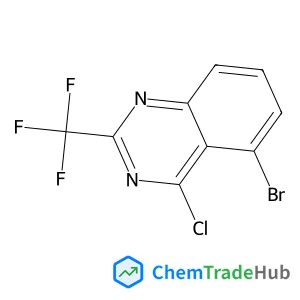
5-Bromo-4-chloro-2-(trifluoromethyl)quinazoline
CAS Number:
2089311-03-3
Molecular Formula:
C9H3BrClF3N2
Ankita Punetha, Keith D. Green, Atefeh Garzan, Nishad Thamban Chandrika, Melisa J. Willby, Allan H. Pang, Caixia Hou, Selina Y. L. Holbrook, Kyle Krieger, James E. Posey, Tanya Parish, Oleg V. Tsodikov, Sylvie Garneau-Tsodikova
Tuberculosis (TB), caused by Mycobacterium tuberculosis (Mtb), is a deadly bacterial disease. Drug-resistant strains of Mtb make eradication of TB a daunting task. Overexpression of the enhanced intracellular survival (Eis) protein by Mtb confers resistance to the second-line antibiotic kanamycin (KAN). Eis is an acetyltransferase that acetylates KAN, inactivating its antimicrobial function. Development of Eis inhibitors as KAN adjuvant therapeutics is an attractive path to forestall and overcome KAN resistance. We discovered that an antipsychotic drug, haloperidol (HPD, 1), was a potent Eis inhibitor with IC50 = 0.39 ± 0.08 μM. We determined the crystal structure of the Eis-haloperidol (1) complex, which guided synthesis of 34 analogues. The structure–activity relationship study showed that in addition to haloperidol (1), eight analogues, some of which were smaller than 1, potently inhibited Eis (IC50 ≤ 1 μM). Crystal structures of Eis in complexes with three potent analogues and droperidol (DPD), an antiemetic and antipsychotic, were determined. Three compounds partially restored KAN sensitivity of a KAN-resistant Mtb strain K204 overexpressing Eis. The Eis inhibitors generally did not exhibit cytotoxicity against mammalian cells. All tested compounds were modestly metabolically stable in human liver microsomes, exhibiting 30–60% metabolism over the course of the assay. While direct repurposing of haloperidol as an anti-TB agent is unlikely due to its neurotoxicity, this study reveals potential approaches to modifying this chemical scaffold to minimize toxicity and improve metabolic stability, while preserving potent Eis inhibition.
Wen Yang, Jianniao Tian, Lijun Wang, Shui Fu, Hongyun Huang, Yanchun Zhao, Shulin Zhao
DOI: 10.1039/C6AN00184J
Dongpo Xu, Mingxia Gao, Chunhui Deng, Xiangmin Zhang
DOI: 10.1039/C6AN00361C
Tyler J. Dill, Matthew J. Rozin, Eric R. Brown, Stephen Palani, Andrea R. Tao
DOI: 10.1039/C6AN00212A
Jennifer Wild, Meera Shanmuganathan, Mika Hayashi, Murray Potter
DOI: 10.1039/C9AN01642B
Ziyi Cheng, Rui Wang, Yanlong Xing, Linlu Zhao, Jaebum Choo, Fabiao Yu
DOI: 10.1039/C9AN01260E
C. Y. Shi, C. H. Deng
DOI: 10.1039/C6AN00220J
Nikola Mielniczek, Magdalena Jarosz, Joanna Denbigh, Renata Budzynska
DOI: 10.1039/C9AN01456J
Wuyang Hua, Xinyi Wang, Sinan Pei
DOI: 10.1039/C9AN01746A
Golbarg Mohammadi Roozbahani, Youwen Zhang, Xiaohan Chen, Mona Hoseini Soflaee, Xiyun Guan
DOI: 10.1039/C9AN01784D
Hui Hun Cho, Si Hyun Kim, Jun Hyuk Heo, Young Eel Moon, Young Hun Choi, Dong Cheol Lim, Kwon-Hoon Han
DOI: 10.1039/C6AN00744A
Waste containing 6-Chloro-5-(2'-hydroxy-3'-methoxy-4-biphenylyl)-3-(3-methoxyphe...
(3alpha,5alpha)-3-Hydroxypregnane-11,20-dione is primarily used in the pharmaceu...
The market for 4-Amino-6-chloro-2-pyridinecarboxylic acid (CAS: 546141-56-4) is ...
Alternatives to (2-Benzoylethyl)trimethylammonium chloride (CAS: 24472-88-6) in ...
N-[4-Nitro-3-(trifluoromethyl)phenyl]acetamide (CAS: 393-12-4) is generally safe...
Alternative reagents such as other phosphates or similar functional groups can b...
There are alternatives to N,N'-Bis(3-aminopropyl)-1,3-propanediamine (CAS: 4605-...
When handling Aluminium trihexadecanoate, it is important to use appropriate per...
(1,1-Dioxido-3-oxo-1,2-benzothiazol-2(3H)-yl)acetic acid is a chemical compound ...
Several alternatives to 5,5-dimethyloxolan-2-one (CAS: 3123-97-5) can be used in...
![(3-{[4-(Aminomethyl)-6-(trifluoromethyl)-2-pyridinyl]oxy}phenyl)[(3R,4R)-3-fluoro-4-hydroxy-1-pyrrolidinyl]methanone structure](https://static.chemtradehub.com/structs/200/2007885-39-2-affc.webp "(3-{[4-(Aminomethyl)-6-(trifluoromethyl)-2-pyridinyl]oxy}phenyl)[(3R,4R)-3-fluoro-4-hydroxy-1-pyrrolidinyl]methanone structure")