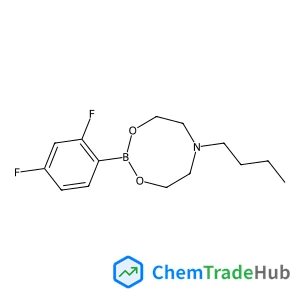
6-Butyl-2-(2,4-difluorophenyl)-1,3,6,2-dioxazaborocane
CAS Number:
1190988-98-7
Molecular Formula:
C14H20BF2NO2
Xiaomin Zhu, Jian Zhang, Cheng Miao, Siyu Li, Youliang Zhao
Despite tremendous progress in self-assembly, it remains a challenge to achieve multi-tunable reversible low-dimensional nano-objects. Given the crucial role of macromolecular architectures in self-assembly, this study aims at design of stimuli-responsive shape-variable toothbrushes to address this challenge. Four examples of miktobrush-coil terpolymers comprising thermoresponsive poly(N-isopropylacrylamide) and thermo/pH/oxidation-responsive poly(2-(dimethylamino)ethyl methacrylate) heterografts and hydrophilic poly(N,N-dimethyl acrylamide) were synthesized. Although compositions and external stimuli only slightly affected the cloud points, the transmittances under different conditions were significantly different due to the formation of distinct nanoparticles. Some factors such as composition, concentration, pH and temperature could induce intriguing hierarchical self-assembly via changing the degree of hydration and protonation and amphipathy. Intrinsic balances between competing interactions and tunable molecular shapes led to stepwise formation of a diversity of nanostructures such as spheres, disks, vesicles, disk-like compound vesicles, nanosheets, cylinders, nanoribbons and polyhedron micelles. Multi-tunable hierarchical self-assembly (MHSA) affords a versatile platform to directly fabricate on-demand low-dimensional nano-objects in aqueous solution. Our study underlies systematic research on shape-dependent properties and applications starting from the same precursor.
Ingrid Allart-Simon, Aurélie Moniot, Nicolo Bisi, Miguel Ponce-Vargas, Sandra Audonnet, Marie Laronze-Cochard, Janos Sapi, Eric Hénon, Frédéric Velard, Stéphane Gérard
DOI: 10.1039/D0MD00423E
Kyeonghwan Kim, Jeong Hwa Lee, Sunmi Kim, Songmin Lee, Donghee Lee, Hye Yun Kim, Ikyon Kim, YoungSoo Kim
DOI: 10.1039/D1MD00030F
Zeyu Wang, Mingju Shui, Ian W. Wyman, Qing-Wen Zhang, Ruibing Wang
DOI: 10.1039/D1MD00019E
Jennifer R. Baker, Cecilia C. Russell, Jayne Gilbert, Adam McCluskey, Jennette A. Sakoff
DOI: 10.1039/D1MD00021G
William L. Neumann, Karin E. Sandoval, Shirin Mobayen, Mahsa Minaeian, Stephen G. Kukielski, Khush N. Srabony, Rafael Frare, Olivia Slater, Susan A. Farr, Michael L. Niehoff, Audrey Hospital, Maria Kontoyianni, A. Michael Crider, Ken A. Witt
DOI: 10.1039/D1MD00044F
Sahil Mishra, Shreya
DOI: 10.1039/D0MD00318B
Swagat Sharma, Lauren Lesiak, Christopher D. Aretz, Yu Du, Sushil Kumar, Nagsen Gautam, Yazen Alnouti, Nikilesh V. Dhuria, Yashpal S. Chhonker, C. David Weaver, Corey R. Hopkins
DOI: 10.1039/D1MD00129A
Matthias R. Bauer, Paolo Di Fruscia, Simon C. C. Lucas, Iacovos N. Michaelides, Jennifer E. Nelson, R. Ian Storer, Benjamin C. Whitehurst
DOI: 10.1039/D0MD00370K
Jolien De Neve, Thomas M. A. Barlow, Dirk Tourwé, Frédéric Bihel, Frédéric Simonin, Steven Ballet
DOI: 10.1039/D1MD00041A
Waste containing 6-Chloro-5-(2'-hydroxy-3'-methoxy-4-biphenylyl)-3-(3-methoxyphe...
(3alpha,5alpha)-3-Hydroxypregnane-11,20-dione is primarily used in the pharmaceu...
The market for 4-Amino-6-chloro-2-pyridinecarboxylic acid (CAS: 546141-56-4) is ...
Alternatives to (2-Benzoylethyl)trimethylammonium chloride (CAS: 24472-88-6) in ...
N-[4-Nitro-3-(trifluoromethyl)phenyl]acetamide (CAS: 393-12-4) is generally safe...
Alternative reagents such as other phosphates or similar functional groups can b...
There are alternatives to N,N'-Bis(3-aminopropyl)-1,3-propanediamine (CAS: 4605-...
When handling Aluminium trihexadecanoate, it is important to use appropriate per...
(1,1-Dioxido-3-oxo-1,2-benzothiazol-2(3H)-yl)acetic acid is a chemical compound ...
Several alternatives to 5,5-dimethyloxolan-2-one (CAS: 3123-97-5) can be used in...

Polymer Chemistry welcomes submissions in all areas of polymer science that have a strong focus on macromolecular chemistry. Manuscripts may cover a broad range of fields, yet no direct application focus is required.