












Amino alcohol acrylonitriles as broad spectrum and tumour selective cytotoxic agents
Literature Information
Publication Date
2021-03-09
DOI
10.1039/D1MD00021G
Impact Factor
0
Authors
Jennifer R. Baker, Cecilia C. Russell, Jayne Gilbert, Adam McCluskey, Jennette A. Sakoff
View Original
Abstract
We have identified specific dichlorophenylacrylonitriles as lead compounds in the development of novel anticancer compounds, notably, (Z)-N-(4-(2-cyano-2-(3,4-dichlorophenyl)vinyl)phenyl)acetamide (1) and ANI-7 (2). Herein we specifically probe the SAR associated with the terminal aromatic ring and associated cytoxicity in a broad range of human cancer cell lines. Synthesis of three focused libraries revealed a poor tolerance for electron withdrawing and donating moieties (Library A). A clear preference for hydrophobic substituents on a terminal piperazine moiety (Library B) with good levels of broad spectrum cytotoxicity, e.g.13a (GI50 2.5–6.0 μM), as did the introduction of a methylene spacer with 13i (4-CH3PhCH2; GI50 1.5–4.5 μM). Removal of the aromatic moiety and installation of simple hydrophobic groups (Library C), in particular an adamantyl moiety, afforded highly active broad spectrum cytotoxic agents with GI50 values ranging from 1.7 μM (14k; 1-adamantyl) to 5.6 μM (14i; pyrrolidine). Within these libraries we note lung cancer selectivity, relative to normal cells, of 13h (fluoro substituted acrylonitrile, GI50 1.6 μM, 9.3-fold selective); the colorectal selectivity of 14h (methylpiperidine analogue, GI50 0.36 μM, 6.9-fold selective) and the breast cancer selectivity of 13f (nitrile substituted acrylonitrile, GI50 2.3–6.0 μM, up to 20-fold selective). The latter was confirmed as a novel AhR ligand and a CYP1A1 activating compound, that likely induces cell death following bioactivation; a phenomenon previously described in breast cancer cell populations.
Recommended Journals
Related Literature
A novel platform self-assembled from squaraine-embedded Zn(ii) complexes for selective monitoring of ATP and its level fluctuation in mitotic cells
Ruizhi Feng, Yongqian Xu, Hongwei Zhao, Xuemei Duan, Shiguo Sun
2016-04-26
Communication
DOI: 10.1039/C6AN00646A
Nano-analytical characterization of endogenous minerals in healthy placental tissue: mineral distribution, composition and ultrastructure
Elena Tsolaki, Louis Didierlaurent, Samuel Staubli, Robert Zboray, Antonia Neels, Dörthe Dietrich, Pius Manser, Lotus May Desbiolles, Sebastian Leschka, Simon Wildermuth, Sandro Lehner, Pascale Chavatte-Palmer, Wolfram Jochum, Peter Wick, Tina Bürki-Turnherr, Tina Fischer, René Hornung, Sergio Bertazzo
2019-10-02
Communication
DOI: 10.1039/C9AN01312A
Correction: Micropatterning neuronal networks
Heike Hardelauf‡, Sarah Waide‡, Julia Sisnaiske, Peter Jacob, Vanessa Hausherr, Nicole Schöbel, Dirk Janasek, Christoph van Thriel
2016-05-04
Correction
DOI: 10.1039/C6AN90037B
A novel logic gate based on liquid-crystals responding to the DNA conformational transition
Fubing Xiao, Hui Tan, Yan Wu, Shuzhen Liao, Zhaoyang Wu, Guoli Shen, Ruqin Yu
2016-04-13
Communication
DOI: 10.1039/C6AN00504G
Effects of surface treatments on trapping with DC insulator-based dielectrophoresis
Claire V. Crowther, Viola Sanderlin, Mark A. Hayes, Gillian H. Gile
2019-11-05
Paper
DOI: 10.1039/C9AN01186B
Orderly nucleic acid aggregates by electrostatic self-assembly in single cells for miRNA detection and visualizing
Yuanyuan Wang, Zhaopeng Yu, Zhen Zhang, Shusheng Zhang
2016-03-29
Communication
DOI: 10.1039/C6AN00160B
Biosensor surface functionalization by a simple photochemical immobilization of antibodies: experimental characterization by mass spectrometry and surface enhanced Raman spectroscopy
Bartolomeo Della Ventura, Martina Banchelli, Riccardo Funari, Anna Illiano, Marella De Angelis, Paola Taroni, Angela Amoresano, Paolo Matteini, Raffaele Velotta
2019-10-10
Paper
DOI: 10.1039/C9AN00443B
An intramolecular charge transfer and excited state intramolecular proton transfer based fluorescent probe for highly selective detection and imaging of formaldehyde in living cells
Wen Chen, Mei Yang, Na Luo, Fenglin Wang, Ru-Qin Yu, Jian-Hui Jiang
2019-10-03
Paper
DOI: 10.1039/C9AN01778J
Highly intense fluorescence of novel carbon nanocrystals combined with a DNAzyme-assisted autocatalytic multiple amplification strategy for sensitive detection of thrombin
Xiaochun Wang, Zhengkun Lu, Lu Tan, Guifen Jie
2016-04-15
Communication
DOI: 10.1039/C6AN00279J
You might also like
Compound Q&A
How should waste containing 6-Chloro-5-(2'-hydroxy-3'-methoxy-4-biphenylyl)-3-(3-methoxyphenyl)-1H-pyrrolo[3,2-d]pyrimidine-2,4(3H,5H)-dione (CAS: 1346607-05-3) be handled?
Waste containing 6-Chloro-5-(2'-hydroxy-3'-methoxy-4-biphenylyl)-3-(3-methoxyphe...
1346607-05-36-Chloro-5-(2'-hydro...
Compound Q&A
What are the main uses of (3alpha,5alpha)-3-Hydroxypregnane-11,20-dione (CAS: 23930-19-0)?
(3alpha,5alpha)-3-Hydroxypregnane-11,20-dione is primarily used in the pharmaceu...
23930-19-0(3alpha,5alpha)-3-Hy...
Compound Q&A
What is the market or research trend for 4-Amino-6-chloro-2-pyridinecarboxylic acid (CAS: 546141-56-4)?
The market for 4-Amino-6-chloro-2-pyridinecarboxylic acid (CAS: 546141-56-4) is ...
546141-56-44-Amino-6-chloro-2-p...
Compound Q&A
Are there alternatives to (2-Benzoylethyl)trimethylammonium chloride (CAS: 24472-88-6) in synthesis?
Alternatives to (2-Benzoylethyl)trimethylammonium chloride (CAS: 24472-88-6) in ...
24472-88-6(2-Benzoylethyl)trim...
Compound Q&A
Is N-[4-Nitro-3-(trifluoromethyl)phenyl]acetamide (CAS: 393-12-4) safe?
N-[4-Nitro-3-(trifluoromethyl)phenyl]acetamide (CAS: 393-12-4) is generally safe...
393-12-4N-[4-Nitro-3-(triflu...
Compound Q&A
Are there alternatives to [(4R,5R,6S)-5-hydroxy-10-imino-3,7-dioxa-1,9-diazatricyclo[6.4.0.02,6]dodeca-8,11-dien-4-yl]methyl dihydrogen phosphate (CAS: 39679-56-6) in synthesis?
Alternative reagents such as other phosphates or similar functional groups can b...
39679-56-6[(4R,5R,6S)-5-hydrox...
Compound Q&A
Are there alternatives to N,N'-Bis(3-aminopropyl)-1,3-propanediamine (CAS: 4605-14-5) in synthesis?
There are alternatives to N,N'-Bis(3-aminopropyl)-1,3-propanediamine (CAS: 4605-...
4605-14-5N,N'-Bis(3-aminoprop...
Compound Q&A
What precautions should be taken when handling Aluminium trihexadecanoate (CAS: 555-35-1)?
When handling Aluminium trihexadecanoate, it is important to use appropriate per...
555-35-1Aluminium trihexadec...
Compound Q&A
What is (1,1-Dioxido-3-oxo-1,2-benzothiazol-2(3H)-yl)acetic acid (CAS: 52188-11-1)?
(1,1-Dioxido-3-oxo-1,2-benzothiazol-2(3H)-yl)acetic acid is a chemical compound ...
52188-11-1(1,1-Dioxido-3-oxo-1...
Compound Q&A
Are there alternatives to 5,5-dimethyloxolan-2-one (CAS: 3123-97-5) in synthesis?
Several alternatives to 5,5-dimethyloxolan-2-one (CAS: 3123-97-5) can be used in...
3123-97-55,5-dimethyloxolan-2...
Source Journal
Recommended Compounds
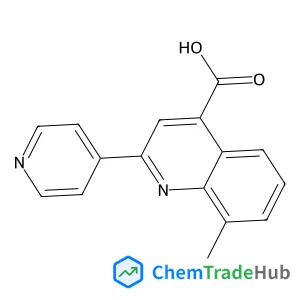
8-Methyl-2-pyridin-4-ylquinoline-4-carboxylic acid
CAS Number:
107027-42-9
Molecular Formula:
C16H12N2O2
Recommended Suppliers





Disclaimer
This page provides academic journal information for reference and research purposes only. We are not affiliated with any journal publishers and do not handle publication submissions. For publication-related inquiries, please contact the respective journal publishers directly.
If you notice any inaccuracies in the information displayed, please contact us at support@chemtradehub.com. We will promptly review and address your concerns.