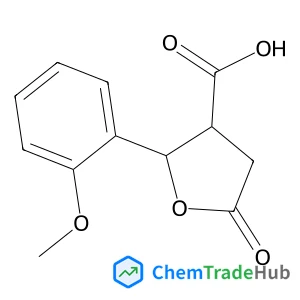
trans-2-(2-Methoxyphenyl)-5-oxotetrahydrofuran-3-carboxylic acid
CAS Number:
99226-02-5
Molecular Formula:
C12H12O5
E. Engelage, H. Hijazi, M. Gartmann, L.-M. Chamoreau, B. Schöllhorn, S. M. Huber, C. Fave
Redox-active bidentate halogen bond donors based on halopyridinium groups as halogen-bond donating units were synthesized and their structures were elucidated by X-ray diffraction analyses and DFT calculations. Via reversible twofold reduction, these dicationic species can be transformed to neutral compounds which should be much weaker Lewis acids. The corresponding electrochemical data were obtained, and CV as well as UV-vis and NMR techniques were also used to determine binding constants of these halogen bond donors to halides. While all titrations agree on the relative order of binding strengths (with chloride being bound strongest), there are marked deviations in the overall affinity constants which are discussed. In contrast to earlier azo-bridge analogues, the ethylene-linked variants presented herein do not oxidize halides, and thus the novel halogen bond donors could also be used as Lewis acidic organocatalysts in a halide abstraction benchmark reaction, yielding a performance similar to bis(haloimidazolium)-derived catalysts.
Maximiliano A. Burgos Paci, Julian Few, Sarah Gowrie, Gus Hancock
DOI: 10.1039/C2CP43878J
Sergei Manzhos, Hiroshi Segawa, Koichi Yamashita
DOI: 10.1039/C2CP43448B
Mohammad Reza Poopari, Zahra Dezhahang, Yunjie Xu
DOI: 10.1039/C2CP42722B
Carmine Coluccini, Arvind K. Sharma, Marco Caricato, Angelo Sironi, Elena Cariati, Stefania Righetto, Elisa Tordin, Chiara Botta, Alessandra Forni
DOI: 10.1039/C2CP43140H
Eliane M. de Oliveira, Romarly F. da Costa, Sergio d'A. Sanchez, Alexandra P. P. Natalense, Márcio H. F. Bettega, Márcio T. do N. Varella
DOI: 10.1039/C2CP43375C
DOI: 10.1039/C2CP42850D
Heng-Rui Liu, Ji-Hui Yang, Yue-Yu Zhang, Shiyou Chen, Aron Walsh, Hongjun Xiang, Xingao Gong, Su-Huai Wei
DOI: 10.1039/C2CP44484D
Yufan He, Maolin Lu, H. Peter Lu
DOI: 10.1039/C2CP42944F
Jun Wang, Zhilin Li, Hongkai Zhao
DOI: 10.1039/C2CP41894K
6-(3-Fluorophenyl)picolinic acid is generally considered safe for laboratory use...
(3R)-3-Pyrrolidinol is used in the pharmaceutical industry as a precursor for dr...
When handling (4R,5R)-4,5-Diethoxycarbonyl-2,2-dimethyldioxolane (CAS: 59779-75-...
1-(6-Chloroimidazo[1,2-b]pyridazin-3-yl)ethanone is often synthesized via a mult...
The market for N-Ethyl-3,4-dimethylbenzylamine (CAS: 39180-83-1) remains steady,...
Tert-butyl 3-(pyrrolidin-1-yl)azetidine-1-carboxylate is a chemical compound wit...
1-Bromo-3-chloro-2,4-dimethoxybenzene (CAS: 1228956-93-1) falls under the classi...
The safety of 8-Bromo-2-methyl-3,4-dihydroisoquinolin-1(2H)-one (CAS: 1368622-07...
Benzyl [(3S)-2,6-dioxo-3-piperidinyl]carbamate is generally safe when handled wi...
1-{[4-(4,4,5,5-Tetramethyl-1,3,2-dioxaborolan-2-yl)phenyl]sulfonyl}pyrrolidine s...

Physical Chemistry Chemical Physics (PCCP) is an international journal co-owned by 19 physical chemistry and physics societies from around the world. This journal publishes original, cutting-edge research in physical chemistry, chemical physics and biophysical chemistry. To be suitable for publication in PCCP, articles must include significant innovation and/or insight into physical chemistry; this is the most important criterion that reviewers and Editors will judge against when evaluating submissions. The journal has a broad scope and welcomes contributions spanning experiment, theory, computation and data science. Topical coverage includes spectroscopy, dynamics, kinetics, statistical mechanics, thermodynamics, electrochemistry, catalysis, surface science, quantum mechanics, quantum computing and machine learning. Interdisciplinary research areas such as polymers and soft matter, materials, nanoscience, energy, surfaces/interfaces, and biophysical chemistry are welcomed if they demonstrate significant innovation and/or insight into physical chemistry. Joined experimental/theoretical studies are particularly appreciated when complementary and based on up-to-date approaches.
![2-[({[(2-Methyl-2-propanyl)oxy]carbonyl}amino)methyl]isonicotinic acid structure](https://static.chemtradehub.com/structs/473/473924-63-9-973b.webp "2-[({[(2-Methyl-2-propanyl)oxy]carbonyl}amino)methyl]isonicotinic acid structure")
![2-Methyl-2-propanyl [(2S)-1-hydroxy-3-(4-hydroxyphenyl)-2-propanyl]carbamate structure](https://static.chemtradehub.com/structs/833/83345-46-4-eec2.webp "2-Methyl-2-propanyl [(2S)-1-hydroxy-3-(4-hydroxyphenyl)-2-propanyl]carbamate structure")