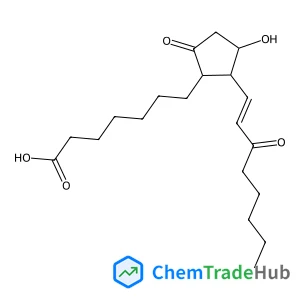
(11alpha,13E)-11-Hydroxy-9,15-dioxoprost-13-en-1-oic acid
CAS Number:
22973-19-9
Molecular Formula:
C20H32O5
Carmine Coluccini, Arvind K. Sharma, Marco Caricato, Angelo Sironi, Elena Cariati, Stefania Righetto, Elisa Tordin, Chiara Botta, Alessandra Forni
We report on a series of novel homologous push–pull compounds, in which identical donor (a dimethylamino) and acceptor (a malonate ester) functionalities endcap crescent PPV fragments, bearing, respectively, 1, 2 and 3 p-phenylenevinylene units in direct linear conjugation (compounds 7–9). The three compounds exhibit striking differences in their linear and nonlinear optical properties. The shorter compound 7 exhibits aggregation-induced emission with a strong luminescence in the solid state (blue emission, photoluminescence quantum yield 38%), and it is nonemissive in solution; the more extended conjugated systems 8 and 9 show classical aggregation-caused quenching in the solid state, while high quantum yield photoluminescence (21 and 93% in toluene) is restored in diluted solutions, through mechanisms involving intramolecular charge transfer in the excited states. EFISH measurements in solutions demonstrate a strong solvent and concentration dependence. As rationalized with the aid of molecular modelling, compounds 8 and, more markedly, 9 aggregate in stable centrosymmetric dimers in solution.
William N. A. Bergius, Lian R. Hutchings, Richard L. Thompson, Michael Jeschke, Rosemary Fisher
DOI: 10.1039/C3PY00041A
Haibo Wang, Fangming Xu, Yin Wang, Xiangsheng Liu, Qiao Jin, Jian Ji
DOI: 10.1039/C3PY00139C
Hyeon Park, Ho-Keun Lee, Tae-Lim Choi
DOI: 10.1039/C3PY00556A
Dong-Gyun Kim, Hyo Kang, Yong-Seok Choi, Sungsoo Han, Jong-Chan Lee
DOI: 10.1039/C3PY00756A
Chun Zhang, Lian-Hui Peng, Buyi Li, Ying Liu, Peng-Cheng Zhu, Zhen Wang, Deng-Huang Zhan, Bien Tan, Xiang-Liang Yang, Hui-Bi Xu
DOI: 10.1039/C3PY00499F
B. Muthuraj, Sameer Hussain, Parameswar Krishnan Iyer
DOI: 10.1039/C3PY00680H
Xue Yong, Wen Wan, Mingjian Su, Wenwei You, Xinwei Lu, Yichen Yan, Jinqing Qu, Ruiyuan Liu, Toshio Masuda
DOI: 10.1039/C3PY00359K
Alexander A. Steinschulte, Bjoern Schulte, Natascha Drude, Michael Erberich, Christian Herbert, Jun Okuda, Martin Möller, Felix A. Plamper
DOI: 10.1039/C3PY00444A
Florian Herbst, Wolfgang H. Binder
DOI: 10.1039/C3PY00362K
6-(3-Fluorophenyl)picolinic acid is generally considered safe for laboratory use...
(3R)-3-Pyrrolidinol is used in the pharmaceutical industry as a precursor for dr...
When handling (4R,5R)-4,5-Diethoxycarbonyl-2,2-dimethyldioxolane (CAS: 59779-75-...
1-(6-Chloroimidazo[1,2-b]pyridazin-3-yl)ethanone is often synthesized via a mult...
The market for N-Ethyl-3,4-dimethylbenzylamine (CAS: 39180-83-1) remains steady,...
Tert-butyl 3-(pyrrolidin-1-yl)azetidine-1-carboxylate is a chemical compound wit...
1-Bromo-3-chloro-2,4-dimethoxybenzene (CAS: 1228956-93-1) falls under the classi...
The safety of 8-Bromo-2-methyl-3,4-dihydroisoquinolin-1(2H)-one (CAS: 1368622-07...
Benzyl [(3S)-2,6-dioxo-3-piperidinyl]carbamate is generally safe when handled wi...
1-{[4-(4,4,5,5-Tetramethyl-1,3,2-dioxaborolan-2-yl)phenyl]sulfonyl}pyrrolidine s...

Physical Chemistry Chemical Physics (PCCP) is an international journal co-owned by 19 physical chemistry and physics societies from around the world. This journal publishes original, cutting-edge research in physical chemistry, chemical physics and biophysical chemistry. To be suitable for publication in PCCP, articles must include significant innovation and/or insight into physical chemistry; this is the most important criterion that reviewers and Editors will judge against when evaluating submissions. The journal has a broad scope and welcomes contributions spanning experiment, theory, computation and data science. Topical coverage includes spectroscopy, dynamics, kinetics, statistical mechanics, thermodynamics, electrochemistry, catalysis, surface science, quantum mechanics, quantum computing and machine learning. Interdisciplinary research areas such as polymers and soft matter, materials, nanoscience, energy, surfaces/interfaces, and biophysical chemistry are welcomed if they demonstrate significant innovation and/or insight into physical chemistry. Joined experimental/theoretical studies are particularly appreciated when complementary and based on up-to-date approaches.