












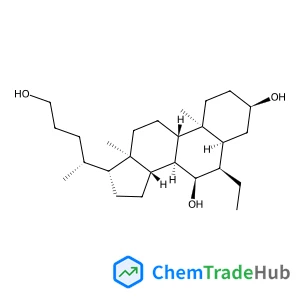
(3alpha,5beta,6alpha,7alpha)-6-Ethylcholane-3,7,24-triol
CAS Number:
1537866-49-1
Molecular Formula:
C26H46O3
Christian Schwieger
How does a small change in the structure of a phospholipid affect its supramolecular assembly? In aqueous suspensions, the substitution of one ester linkage in DPPC (1,2-dipalmitoyl-sn-glycero-3-phosphocholine) by an ether linkage alters its phase behaviour completely. To unravel the effect of replacing a phospholipid's ester linkage by an ether linkage in lipid monolayers, we characterized pure monolayers of the model lipid DPPC and its sn-2 ether analogue PHPC (1-palmitoyl-2-O-hexadecyl-sn-glycero-3-phosphocholine) as well as mixtures of both by measurements of surface pressure–molecular area (π–Amol) isotherms. In addition, we used infrared reflection absorption spectroscopy (IRRAS) to study lipid condensation, lipid chain orientation, headgroup hydration, and lipid miscibility in all samples. Mixed monolayers consisting of DPPC and PHPC were studied further using epifluorescence microscopy. Our results indicate a strong influence of the sn-2 ether linkage on headgroup hydration and ordering effects in the regions of the apolar chains and the headgroups. Both effects could originate from changes in glycerol conformation. Furthermore, we observed a second plateau in the π–Amol isotherms of DPPC/PHPC mixtures and analysis of the mixed π–Amol isotherms reveals a non-ideal mixing behaviour of both lipids which may be caused by conformational differences in their headgroups.
Hanne Jacob, Sandra Ulrich, Ulrich Jung, Sonja Lemke, Talina Rusch, Christian Schütt, Finn Petersen, Thomas Strunskus, Olaf Magnussen, Rainer Herges, Felix Tuczek
DOI: 10.1039/C4CP03438D
Nancy Faßheber, Johannes Dammeier, Gernot Friedrichs
DOI: 10.1039/C4CP01107D
Yu. I. Prylutskyy, I. S. Pashkova, D. Wyrzykowski, A. Woziwodzka, G. Gołuński, J. Piosik, V. V. Cherepanov, U. Ritter
DOI: 10.1039/C4CP03367A
Yuesheng Wang, Pin Liu, Lin Gu, Yong-Sheng Hu, Hong Li, George P. Demopoulos, Liquan Chen
DOI: 10.1039/C4CP02957G
Gulbagh Singh, V. Divakar Botcha, D. S. Sutar, Pavan K. Narayanam, S. S. Talwar, R. S. Srinivasa, S. S. Major
DOI: 10.1039/C4CP00875H
Hyun S. Park, Chong-Yong Lee, Erwin Reisner
DOI: 10.1039/C4CP03883E
Qiang Zhang, Yanghua Deng, Zhonghua Hu, Yafei Liu, Mingming Yao, Peipei Liu
DOI: 10.1039/C4CP02928C
T. Fujii, S. Kuwahara, K. Katayama, T. Ube, T. Ikeda
DOI: 10.1039/C4CP00457D
Kinga Góra-Marek, Adam Stępniewski, Mariusz Radoń, Ewa Broclawik
DOI: 10.1039/C4CP03350G
N-(4-Methoxybenzyl)-2-pyridinamine (CAS: 52818-63-0) is increasingly being used ...
When handling Ethyl 4-(2-chlorophenyl)-1,3-thiazole-2-carboxylate, appropriate p...
Diethyldiselane (CAS: 628-39-7) is classified under the Globally Harmonized Syst...
The market for oxocopper (CAS: 12053-18-8) is primarily driven by its use in cat...
The market for 5-{[(2-Methyl-2-propanyl)oxy]carbonyl}-5-azaspiro[2.4]heptane-7-c...
2-(1-Pyrrolidinyl)-4-pyridinamine is a chemical compound with the CAS number 359...
2-(3-Pyridinyl)-1-azabicyclo[2.2.2]octane (CAS: 91556-75-1) is a crystalline sol...
(S)-Alpha-allyl-proline hydrochloride is usually synthesized via a Wittig reacti...
3-Methyl-1,2-oxazole-5-carboxylic acid (CAS: 4857-42-5) is an organic compound w...
Lys-SMCC-DM1 is synthesized via a multi-step process involving the coupling of S...

Physical Chemistry Chemical Physics (PCCP) is an international journal co-owned by 19 physical chemistry and physics societies from around the world. This journal publishes original, cutting-edge research in physical chemistry, chemical physics and biophysical chemistry. To be suitable for publication in PCCP, articles must include significant innovation and/or insight into physical chemistry; this is the most important criterion that reviewers and Editors will judge against when evaluating submissions. The journal has a broad scope and welcomes contributions spanning experiment, theory, computation and data science. Topical coverage includes spectroscopy, dynamics, kinetics, statistical mechanics, thermodynamics, electrochemistry, catalysis, surface science, quantum mechanics, quantum computing and machine learning. Interdisciplinary research areas such as polymers and soft matter, materials, nanoscience, energy, surfaces/interfaces, and biophysical chemistry are welcomed if they demonstrate significant innovation and/or insight into physical chemistry. Joined experimental/theoretical studies are particularly appreciated when complementary and based on up-to-date approaches.

![1,10-bis(3,5-dimethylphenyl)-12-hydroxy-4,5,6,7-tetrahydroiindeno[7,1-de:1',7'-fg][1,3,2]dioxaphosphocine 12-oxide structure](https://static.chemtradehub.com/structs/141/1412439-82-7-b9a9.webp "1,10-bis(3,5-dimethylphenyl)-12-hydroxy-4,5,6,7-tetrahydroiindeno[7,1-de:1',7'-fg][1,3,2]dioxaphosphocine 12-oxide structure")



