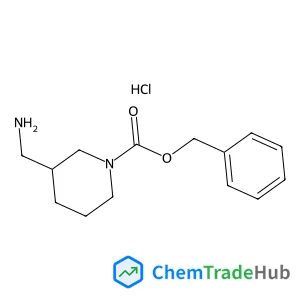
Benzyl 3-(aminomethyl)piperidine-1-carboxylate hydrochloride
CAS Number:
1186663-23-9
Molecular Formula:
C14H21ClN2O2
Andriy Pysanenko, Kateryna Grygoryeva, Jaroslav Kočišek, Ragesh Kumar T. P., Juraj Fedor, Milan Ončák, Michal Fárník
Pyruvic acid represents a key molecule in prebiotic chemistry and it has recently been proposed to be synthesized on interstellar ices. In order to probe the stability of pyruvic acid in the interstellar medium with respect to decomposition by slow electrons, we investigate the electron attachment to its homomolecular and heteromolecular clusters. Using mass spectrometry, we follow the changes in the fragmentation pattern and its dependence on the electron energy for various cluster sizes of pure and microhydrated pyruvic acid. The assignment of fragmentation reaction pathways is supported by ab initio calculations. The fragmentation degree dramatically decreases upon clustering. This decrease is even stronger in the heteromolecular clusters of pyruvic acid with water, where the non-dissociative attachment is by far the strongest channel. In the homomolecular clusters, the dissociative channel leading to dehydrogenation is active over a larger electron energy range than in the isolated molecules. To probe the role of the self-scavenging effects, we explore the excited states of pyruvic acid. This has been done both experimentally, by using electron energy loss spectroscopy, and theoretically, by photochemical calculations. Data on both optically-allowed and forbidden states allow for the explanation of processes emerging upon clustering.
Felix Deschler, Daniel Riedel, Bernhard Ecker
DOI: 10.1039/C2CP43876C
Wuhong Xin, Jiupeng Zhao, Dengteng Ge, Yanbo Ding, Yao Li, Frank Endres
DOI: 10.1039/C2CP43983B
Edroaldo Lummertz da Rocha, Giovanni Finoto Caramori, Carlos Renato Rambo
DOI: 10.1039/C2CP44035K
DOI: 10.1039/C2CP42907A
Mohammed Bahou, Yu-Jong Wu
DOI: 10.1039/C2CP43143B
Yang Yang, Lei Yu
DOI: 10.1039/C2CP42876H
M. Aghsaee, A. Drakon, A. Eremin, S. H. Dürrstein, H. Böhm, H. Somnitz, M. Fikri, C. Schulz
DOI: 10.1039/C2CP42574B
Yee-Fun Lim, Kui Yao, Francis Eng Hock Tay, Kar Heng Seah
DOI: 10.1039/C2CP43873A
Shilin Hou
DOI: 10.1039/C2CP43630B
Tae-Sik Oh, David A. Boyd, David G. Goodwin
DOI: 10.1039/C2CP43036C
6-(3-Fluorophenyl)picolinic acid is generally considered safe for laboratory use...
(3R)-3-Pyrrolidinol is used in the pharmaceutical industry as a precursor for dr...
When handling (4R,5R)-4,5-Diethoxycarbonyl-2,2-dimethyldioxolane (CAS: 59779-75-...
1-(6-Chloroimidazo[1,2-b]pyridazin-3-yl)ethanone is often synthesized via a mult...
The market for N-Ethyl-3,4-dimethylbenzylamine (CAS: 39180-83-1) remains steady,...
Tert-butyl 3-(pyrrolidin-1-yl)azetidine-1-carboxylate is a chemical compound wit...
1-Bromo-3-chloro-2,4-dimethoxybenzene (CAS: 1228956-93-1) falls under the classi...
The safety of 8-Bromo-2-methyl-3,4-dihydroisoquinolin-1(2H)-one (CAS: 1368622-07...
Benzyl [(3S)-2,6-dioxo-3-piperidinyl]carbamate is generally safe when handled wi...
1-{[4-(4,4,5,5-Tetramethyl-1,3,2-dioxaborolan-2-yl)phenyl]sulfonyl}pyrrolidine s...

Physical Chemistry Chemical Physics (PCCP) is an international journal co-owned by 19 physical chemistry and physics societies from around the world. This journal publishes original, cutting-edge research in physical chemistry, chemical physics and biophysical chemistry. To be suitable for publication in PCCP, articles must include significant innovation and/or insight into physical chemistry; this is the most important criterion that reviewers and Editors will judge against when evaluating submissions. The journal has a broad scope and welcomes contributions spanning experiment, theory, computation and data science. Topical coverage includes spectroscopy, dynamics, kinetics, statistical mechanics, thermodynamics, electrochemistry, catalysis, surface science, quantum mechanics, quantum computing and machine learning. Interdisciplinary research areas such as polymers and soft matter, materials, nanoscience, energy, surfaces/interfaces, and biophysical chemistry are welcomed if they demonstrate significant innovation and/or insight into physical chemistry. Joined experimental/theoretical studies are particularly appreciated when complementary and based on up-to-date approaches.
![2-[({[(2-Methyl-2-propanyl)oxy]carbonyl}amino)methyl]isonicotinic acid structure](https://static.chemtradehub.com/structs/473/473924-63-9-973b.webp "2-[({[(2-Methyl-2-propanyl)oxy]carbonyl}amino)methyl]isonicotinic acid structure")