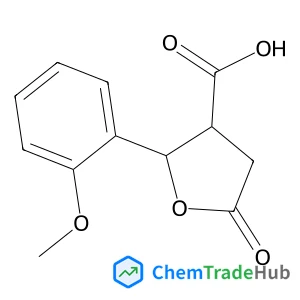
trans-2-(2-Methoxyphenyl)-5-oxotetrahydrofuran-3-carboxylic acid
CAS Number:
99226-02-5
Molecular Formula:
C12H12O5
Yang Yang, Lei Yu
The ferrocene/ferrocenium (Fc/Fc+) redox couple has been deemed one of the best candidates of the standard electrochemical reference for redox reactions in ionic liquids (ILs). To fully reveal the redox reaction mechanism in the IL condensed phase, solvation, as a prerequisite, apparently needs to be understood. As a preliminary attempt to study the solvation of Fc/Fc+ in imidazolium-based ILs, using model complexes, systematic investigations of the intrinsic pair-wise interactions between the solute and solvent ions in the gas phase are performed with B97-D, a dispersion-corrected density functional method. B97-D is carefully benchmarked with available experimental values and high-level ab initio quantum mechanical results for Fc/Fc+ alone and the solvated structures. Present calculations demonstrate dramatically different solvation features for Fc vs. Fc+, e.g., Fc forms direct stable interactions with both solvent cations and anions with binding energies of −11 to −14 kcal mol−1. As an interesting observation, no π-stacking interactions are captured between the imidazolium ring of the solvent cation and the cyclopentadienyl motif of the solute. However, due to the strong electrostatic interactions, Fc+ can only be solvated by solvent anions in the first solvation shell with much stronger binding energies of −72 to −86 kcal mol−1. Binding energies, structures, and electrostatic potentials are all characterized. The electronic structures are further analyzed with the Natural Bond Orbital method. The theoretical calculation results help explain several experimental observations obtained earlier or in the present work, including solubility, diffusion coefficient, and solution conductivity. Due to the involvement of the aromatic structures, the current study also sheds valuable light on π-interactions, in general.
Xiao Jiang, Wei Shao, Kun Jiang, Meijing Zhang, Huanhuan Liu, Chunnuan Ye, Youliang Zhao
DOI: 10.1039/C3PY00217A
Yunxing Li, Yan Wu, Qingjie Xu, Yan Gao, Guangqun Cao, Zhen Meng, Cheng Yang
DOI: 10.1039/C3PY00281K
Shrinivas Venkataraman, Natalia Veronica, Zhi Xiang Voo, James L. Hedrick, Yi Yan Yang
DOI: 10.1039/C3PY00318C
Xiaofu Wu, Hui Tong, Lixiang Wang
DOI: 10.1039/C3PY00806A
Chaoliang He, Chunsheng Xiao, Jianxun Ding, Shuangjiang Yu, Xiuli Zhuang, Xuesi Chen
DOI: 10.1039/C3PY00364G
Venkata S. Pavan K. Neti, Xiaofei Wu, Shuguang Deng, Luis Echegoyen
DOI: 10.1039/C3PY00798G
William N. A. Bergius, Lian R. Hutchings, Richard L. Thompson, Michael Jeschke, Rosemary Fisher
DOI: 10.1039/C3PY00041A
6-(3-Fluorophenyl)picolinic acid is generally considered safe for laboratory use...
(3R)-3-Pyrrolidinol is used in the pharmaceutical industry as a precursor for dr...
When handling (4R,5R)-4,5-Diethoxycarbonyl-2,2-dimethyldioxolane (CAS: 59779-75-...
1-(6-Chloroimidazo[1,2-b]pyridazin-3-yl)ethanone is often synthesized via a mult...
The market for N-Ethyl-3,4-dimethylbenzylamine (CAS: 39180-83-1) remains steady,...
Tert-butyl 3-(pyrrolidin-1-yl)azetidine-1-carboxylate is a chemical compound wit...
1-Bromo-3-chloro-2,4-dimethoxybenzene (CAS: 1228956-93-1) falls under the classi...
The safety of 8-Bromo-2-methyl-3,4-dihydroisoquinolin-1(2H)-one (CAS: 1368622-07...
Benzyl [(3S)-2,6-dioxo-3-piperidinyl]carbamate is generally safe when handled wi...
1-{[4-(4,4,5,5-Tetramethyl-1,3,2-dioxaborolan-2-yl)phenyl]sulfonyl}pyrrolidine s...

Physical Chemistry Chemical Physics (PCCP) is an international journal co-owned by 19 physical chemistry and physics societies from around the world. This journal publishes original, cutting-edge research in physical chemistry, chemical physics and biophysical chemistry. To be suitable for publication in PCCP, articles must include significant innovation and/or insight into physical chemistry; this is the most important criterion that reviewers and Editors will judge against when evaluating submissions. The journal has a broad scope and welcomes contributions spanning experiment, theory, computation and data science. Topical coverage includes spectroscopy, dynamics, kinetics, statistical mechanics, thermodynamics, electrochemistry, catalysis, surface science, quantum mechanics, quantum computing and machine learning. Interdisciplinary research areas such as polymers and soft matter, materials, nanoscience, energy, surfaces/interfaces, and biophysical chemistry are welcomed if they demonstrate significant innovation and/or insight into physical chemistry. Joined experimental/theoretical studies are particularly appreciated when complementary and based on up-to-date approaches.