












Dynamics of a gas-phase SNAr reaction: non-concerted mechanism despite the Meisenheimer complex being a transition state
Literature Information
Publication Date
2020-11-04
DOI
10.1039/D0CP05567K
Impact Factor
3.676
Authors
Nishant Sharma, Rupayan Biswas, Upakarasamy Lourderaj
View Original
Abstract
The commonly accepted mechanism of the nucleophilic aromatic substitution (SNAr) reaction has been found to be governed by the nature of the Meisenheimer structure on the potential energy surface. A stable Meisenheimer intermediate favors a stepwise mechanism, while a Meisenheimer transition state favors a concerted mechanism. Here, we show by using a detailed potential energy map (using the DFT and DLPNO-CCSD(T)/CBS methods) and ab initio classical trajectory simulations that the F− + C6H5NO2 SNAr reaction involves a Meisenheimer transition state and follows a stepwise mechanism in contrast to the expected concerted pathway. The stepwise mechanism observed in the trajectory simulations takes place by the formation of various ion-dipole and σ-complexes. While the majority of the trajectories follow the multi-step mechanism and avoid the minimum energy path, a considerable fraction exhibit a roaming atom mechanism where the F atom hovers around the phenyl ring before the formation of the products.
Recommended Journals
Related Literature
Valence isomer of a β-diketiminate-supported phosphinidene: a case of C–H activation and ring contraction
Zheng Lu, Michael Findlater, Alan H. Cowley
2007-05-08
Communication
DOI: 10.1039/B704266C
Monovalent indium in a sulfur-rich coordination environment: synthesis, structure and reactivity of tris(2-mercapto-1-tert-butylimidazolyl)hydroborato indium, [TmBut]In
Kevin Yurkerwich, Daniela Buccella, Jonathan G. Melnick, Gerard Parkin
2008-06-02
Communication
DOI: 10.1039/B803037E
A chemo- and regio-selective three-component dihydropyrimidinone synthesis
Chris D. Bailey, Chris E. Houlden, Grégory L. J. Bar, Guy C. Lloyd-Jones, Kevin I. Booker-Milburn
2007-06-19
Communication
DOI: 10.1039/B707361E
Cyclic ureas as novel building blocks for bent-core liquid crystals
Benjamin Glettner, Sara Hein, R. Amaranatha Reddy, Ute Baumeister, Carsten Tschierske
2007-04-12
Communication
DOI: 10.1039/B703907G
Stereocontrolled synthesis of carbocyclesvia four successive pericyclic reactions
Roxanne Clément, Christiane M. Grisé, Louis Barriault
2008-06-06
Communication
DOI: 10.1039/B803898H
Substrate mediated reduction of copper-amyloid-β complex in Alzheimer’s disease
Victor A. Streltsov, Joseph N. Varghese
2008-05-14
Communication
DOI: 10.1039/B803911A
1,3-Diindolylureas: high affinity dihydrogen phosphate receptors
Claudia Caltagirone, Philip A. Gale, Jennifer R. Hiscock, Simon J. Brooks, Michael B. Hursthouse, Mark E. Light
2008-05-29
Communication
DOI: 10.1039/B806238B
Polymerization of an optically active phenylacetylene derivative bearing an azide residue by click reaction and reaction with a rhodium catalyst
Shinzo Kobayashi, Ken Itomi, Kazuhide Morino, Hiroki Iida, Eiji Yashima
2008-06-06
Communication
DOI: 10.1039/B806343E
Copper-containing monodisperse mesoporous silica nanospheres by a smart one-step approach
Gaëlle Derrien, Clarence Charnay, Jerzy Zajac, Deborah J. Jones, Jacques Rozière
2008-06-09
Communication
DOI: 10.1039/B804593C
Rescue of the streptomycin antibiotic activity by using streptidine as a “decoy acceptor” for the aminoglycoside-inactivating enzyme adenyl transferase
Montserrat Latorre, Pablo Peñalver, Julia Revuelta, Juan Luis Asensio, Eduardo García-Junceda, Agatha Bastida
2007-06-13
Communication
DOI: 10.1039/B704785A
You might also like
Compound Q&A
Are there alternatives to 1-(4-Chlorophenyl)-N-hydroxymethanimine (CAS: 3848-36-0) in synthesis?
When considering alternatives to 1-(4-Chlorophenyl)-N-hydroxymethanimine (CAS: 3...
3848-36-01-(4-Chlorophenyl)-N...
Compound Q&A
How should (1R,9S,10S,12S,14E,16S,19R,20R,21S,22R)-3,9,21-Trihydroxy-5,10,12,14,16,20,22-heptamethyl-23,24-dioxatetracyclo[17.3.1.1~6,9~.0~2,7~]tetracosa-2,5,7,14-tetraen-4-one (CAS: 183202-73-5) be stored?
This compound should be stored in a cool, dry place away from direct sunlight. I...
183202-73-5(1R,9S,10S,12S,14E,1...
Compound Q&A
How is 3-(4-Bromophenyl)-5-(2-fluorophenyl)-1,2,4-oxadiazole (CAS: 419553-16-5) typically synthesized?
3-(4-Bromophenyl)-5-(2-fluorophenyl)-1,2,4-oxadiazole is synthesized through a m...
419553-16-53-(4-Bromophenyl)-5-...
Compound Q&A
How is 5-Chloro-2-(4-chlorophenyl)-4-methyl-6-[3-(1-piperidinyl)propoxy]pyrimidine (CAS: 1639220-19-1) typically synthesized?
5-Chloro-2-(4-chlorophenyl)-4-methyl-6-[3-(1-piperidinyl)propoxy]pyrimidine (CAS...
1639220-19-15-Chloro-2-(4-chloro...
Compound Q&A
What industries use 2-Chloro-4-(difluoromethoxy)pyridine (CAS: 1206978-15-5)?
2-Chloro-4-(difluoromethoxy)pyridine is used in the pharmaceutical industry for ...
1206978-15-52-Chloro-4-(difluoro...
Compound Q&A
What regulatory guidelines apply to 3-Chloro-6-methylpyridazine (CAS: 1121-79-5)?
3-Chloro-6-methylpyridazine (CAS: 1121-79-5) is classified under the Globally Ha...
1121-79-53-Chloro-6-methylpyr...
Compound Q&A
Are there alternatives to Methyl 4,5-dimethyl-2-nitrobenzoate in synthesis?
Several alternatives can be used in the synthesis of Methyl 4,5-dimethyl-2-nitro...
90922-74-0Methyl 4,5-dimethyl-...
Compound Q&A
Are there alternatives to (2E,2'E)-3,3'-(1,4-Phenylene)bisacrylaldehyde in synthesis?
Alternatives to (2E,2'E)-3,3'-(1,4-Phenylene)bisacrylaldehyde include other acry...
63405-68-5(2E,2'E)-3,3'-(1,4-P...
Compound Q&A
What is 3-Amino-5-chloropyridin-2-ol hydrochloride (CAS: 1261906-29-9)?
3-Amino-5-chloropyridin-2-ol hydrochloride is an organic compound with the CAS n...
1261906-29-93-Amino-5-chloropyri...
Compound Q&A
What precautions should be taken when handling 6,7-Difluoro-2,3-dihydro-4H-chromen-4-one (CAS: 1092349-93-3)?
When handling 6,7-Difluoro-2,3-dihydro-4H-chromen-4-one, it is essential to wear...
1092349-93-36,7-Difluoro-2,3-dih...
Source Journal
Physical Chemistry Chemical Physics

CiteScore:
5.5
Self-citation Rate:
10.3%
Articles per Year:
3036
Physical Chemistry Chemical Physics (PCCP) is an international journal co-owned by 19 physical chemistry and physics societies from around the world. This journal publishes original, cutting-edge research in physical chemistry, chemical physics and biophysical chemistry. To be suitable for publication in PCCP, articles must include significant innovation and/or insight into physical chemistry; this is the most important criterion that reviewers and Editors will judge against when evaluating submissions. The journal has a broad scope and welcomes contributions spanning experiment, theory, computation and data science. Topical coverage includes spectroscopy, dynamics, kinetics, statistical mechanics, thermodynamics, electrochemistry, catalysis, surface science, quantum mechanics, quantum computing and machine learning. Interdisciplinary research areas such as polymers and soft matter, materials, nanoscience, energy, surfaces/interfaces, and biophysical chemistry are welcomed if they demonstrate significant innovation and/or insight into physical chemistry. Joined experimental/theoretical studies are particularly appreciated when complementary and based on up-to-date approaches.
Recommended Compounds
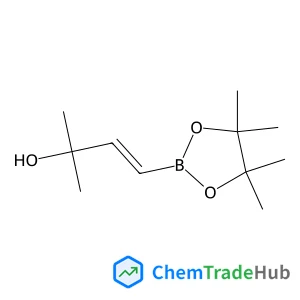
(E)-2-methyl-4-(4,4,5,5-tetramethyl-1,3,2-dioxaborolan-2-yl)but-3-en-2-ol
CAS Number:
581802-26-8
Molecular Formula:
C11H21BO3
Recommended Suppliers






Disclaimer
This page provides academic journal information for reference and research purposes only. We are not affiliated with any journal publishers and do not handle publication submissions. For publication-related inquiries, please contact the respective journal publishers directly.
If you notice any inaccuracies in the information displayed, please contact us at support@chemtradehub.com. We will promptly review and address your concerns.