












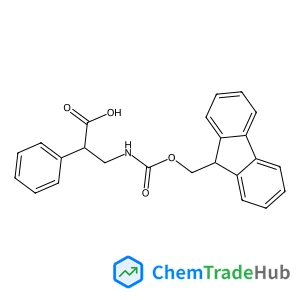
(S)-3-((((9H-Fluoren-9-yl)methoxy)carbonyl)amino)-2-phenylpropanoic acid
CAS Number:
1217663-60-9
Molecular Formula:
C24H21NO4
Zheng Lu, Michael Findlater, Alan H. Cowley
A valence isomer of a β-diketiminate-supported phosphinidene has been prepared by potassium metal reduction of the corresponding chlorophosphenium cation.
Joao Marcelo Ribeiro, Alexander M. Mebel
DOI: 10.1039/C7CP01873H
Alberto Collauto, Royi Kaufmann, William N. Zagotta, Daniella Goldfarb
DOI: 10.1039/C7CP01925D
Anindya Sundar Patra, Gaurangi Gogoi, Ranjan Kumar Sahu, Mohammad Qureshi
DOI: 10.1039/C7CP01444A
Gábor Schuszter, Tünde Gehér-Herczegh, Árpád Szűcs, Ágota Tóth, Dezső Horváth
DOI: 10.1039/C7CP00986K
DOI: 10.1039/C7CP01945A
Sergy Yu. Grebenshchikov, David Picconi
DOI: 10.1039/C7CP01401E
Jógvan Magnus Haugaard Olsen, Erik Donovan Hedegård
DOI: 10.1039/C7CP01194F
Junbo Ren, Weibin Qiu, Houbo Chen, Pingping Qiu, Zhili Lin, Jia-Xian Wang, Qiang Kan, Jiao-Qing Pan
DOI: 10.1039/C7CP01734K
Cang Lang Yao, Jian Chen Li, Wang Gao, Qing Jiang
DOI: 10.1039/C7CP01881A
Parisa Akhshi, Gang Wu
DOI: 10.1039/C7CP01028A
When considering alternatives to 1-(4-Chlorophenyl)-N-hydroxymethanimine (CAS: 3...
This compound should be stored in a cool, dry place away from direct sunlight. I...
3-(4-Bromophenyl)-5-(2-fluorophenyl)-1,2,4-oxadiazole is synthesized through a m...
5-Chloro-2-(4-chlorophenyl)-4-methyl-6-[3-(1-piperidinyl)propoxy]pyrimidine (CAS...
2-Chloro-4-(difluoromethoxy)pyridine is used in the pharmaceutical industry for ...
3-Chloro-6-methylpyridazine (CAS: 1121-79-5) is classified under the Globally Ha...
Several alternatives can be used in the synthesis of Methyl 4,5-dimethyl-2-nitro...
Alternatives to (2E,2'E)-3,3'-(1,4-Phenylene)bisacrylaldehyde include other acry...
3-Amino-5-chloropyridin-2-ol hydrochloride is an organic compound with the CAS n...
When handling 6,7-Difluoro-2,3-dihydro-4H-chromen-4-one, it is essential to wear...

ChemComm publishes urgent research which is of outstanding significance and interest to experts in the field, while also appealing to the journal’s broad chemistry readership. Our communication format is ideally suited to short, urgent studies that are of such importance that they require accelerated publication. Our scope covers all topics in chemistry, and research at the interface of chemistry and other disciplines (such as materials science, nanoscience, physics, engineering and biology) where there is a significant novelty in the chemistry aspects. Major topic areas covered include: Analytical Chemistry Catalysis Chemical Biology and medicinal chemistry Computational Chemistry and Machine Learning Energy and sustainable chemistry Environmental Chemistry Green Chemistry Inorganic Chemistry Materials Chemistry Nanoscience Organic Chemistry Physical Chemistry Polymer Chemistry Supramolecular Chemistry
![4-[(3-Chloro-2-fluorophenyl)amino]-7-methoxy-6-quinazolinyl acetate structure](https://static.chemtradehub.com/structs/740/740081-22-5-f58f.webp "4-[(3-Chloro-2-fluorophenyl)amino]-7-methoxy-6-quinazolinyl acetate structure")




