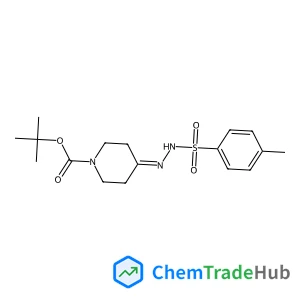
tert-Butyl 4-(2-(p-Tolylsulfonyl)hydrazono)piperidine-1-carboxylate
CAS Number:
1046478-89-0
Molecular Formula:
C17H25N3O4S
Aritri Biswas, Bhabani S. Mallik
We performed first principles molecular dynamics simulations of a relatively dilute aqueous hydrogen peroxide (H2O2) solution to examine its structural alterations and relevant dynamics upon solvation. The internal rotation of the OH groups about the O–O bond facilitates the flexible structure of H2O2. Structural calculations reveal dihedral angle fluctuations in the aqueous solution. Water molecules make stronger hydrogen bonds through the hydrogen atom of the solute than the oxygen atom leading to distinct hydrogen bonding configurations inside the first solvation shell. Time-dependent dihedral angle alterations result in conformational changes and the normalized dihedral angle distribution plot displays characteristic peaks at ∼100–120° and ∼230°, illustrating various conformational states. Within the simulation time, flexibility-induced interconversion of hydrogen peroxide gives rise to several cisoid and transoid conformers. In this study, we examine the relative population of the associated conformational states and the lifetime of the cisoid and transoid conformers from the torsion angle variations. We also determine the free energy landscape of the rotational isomerization process in H2O2 and explore two distinct energy barriers during such interconversion.

Saudi Pharmaceutical Journal

Russian Journal of Organic Chemistry

Chemistry Education Research and Practice

New Journal of Chemistry

Russian Journal of Coordination Chemistry

Russian Journal of Bioorganic Chemistry

Acta Materialia

Journal of Saudi Chemical Society

Russian Chemical Bulletin

Journal of Peptide Science
Ainara Nova, Gregori Ujaque, Pilar González-Duarte, Agustí Lledós
DOI: 10.1039/B801889H
C. V. Ramana, Challa Nageswara Reddy, Rajesh G. Gonnade
DOI: 10.1039/B801755G
Yan Liu, Xiao-Li Yang, Jun Zhang, Yi-Zhi Li, You Song, Hong-Bin Du, Xiao-Zeng You
DOI: 10.1039/B801542B
DOI: 10.1039/B802289E
Ning Du, Hui Zhang, Bingdi Chen, Xiangyang Ma, Deren Yang
DOI: 10.1039/B800401C
Masato Ohashi, Akihiro Yagyu, Tsuneaki Yamagata, Kazushi Mashima
DOI: 10.1039/B703730A
Matthias A. Schade, Albrecht Metzger, Stephan Hug, Paul Knochel
DOI: 10.1039/B803072C
Sungjin Park, Yunha Lee, Bumjung Kim, Jisun Lee, Youngdo Jeong, Jaegeun Noh, Atsushi Takahara, Daewon Sohn
DOI: 10.1039/B706505A
András Stirling, Andrea Hamza, Tibor András Rokob, Imre Pápai
DOI: 10.1039/B804662J
Young Jun Seo, Il Joon Lee, Jeong Wu Yi, Byeang Hyean Kim
DOI: 10.1039/B707278C
When considering alternatives to 1-(4-Chlorophenyl)-N-hydroxymethanimine (CAS: 3...
This compound should be stored in a cool, dry place away from direct sunlight. I...
3-(4-Bromophenyl)-5-(2-fluorophenyl)-1,2,4-oxadiazole is synthesized through a m...
5-Chloro-2-(4-chlorophenyl)-4-methyl-6-[3-(1-piperidinyl)propoxy]pyrimidine (CAS...
2-Chloro-4-(difluoromethoxy)pyridine is used in the pharmaceutical industry for ...
3-Chloro-6-methylpyridazine (CAS: 1121-79-5) is classified under the Globally Ha...
Several alternatives can be used in the synthesis of Methyl 4,5-dimethyl-2-nitro...
Alternatives to (2E,2'E)-3,3'-(1,4-Phenylene)bisacrylaldehyde include other acry...
3-Amino-5-chloropyridin-2-ol hydrochloride is an organic compound with the CAS n...
When handling 6,7-Difluoro-2,3-dihydro-4H-chromen-4-one, it is essential to wear...

Physical Chemistry Chemical Physics (PCCP) is an international journal co-owned by 19 physical chemistry and physics societies from around the world. This journal publishes original, cutting-edge research in physical chemistry, chemical physics and biophysical chemistry. To be suitable for publication in PCCP, articles must include significant innovation and/or insight into physical chemistry; this is the most important criterion that reviewers and Editors will judge against when evaluating submissions. The journal has a broad scope and welcomes contributions spanning experiment, theory, computation and data science. Topical coverage includes spectroscopy, dynamics, kinetics, statistical mechanics, thermodynamics, electrochemistry, catalysis, surface science, quantum mechanics, quantum computing and machine learning. Interdisciplinary research areas such as polymers and soft matter, materials, nanoscience, energy, surfaces/interfaces, and biophysical chemistry are welcomed if they demonstrate significant innovation and/or insight into physical chemistry. Joined experimental/theoretical studies are particularly appreciated when complementary and based on up-to-date approaches.